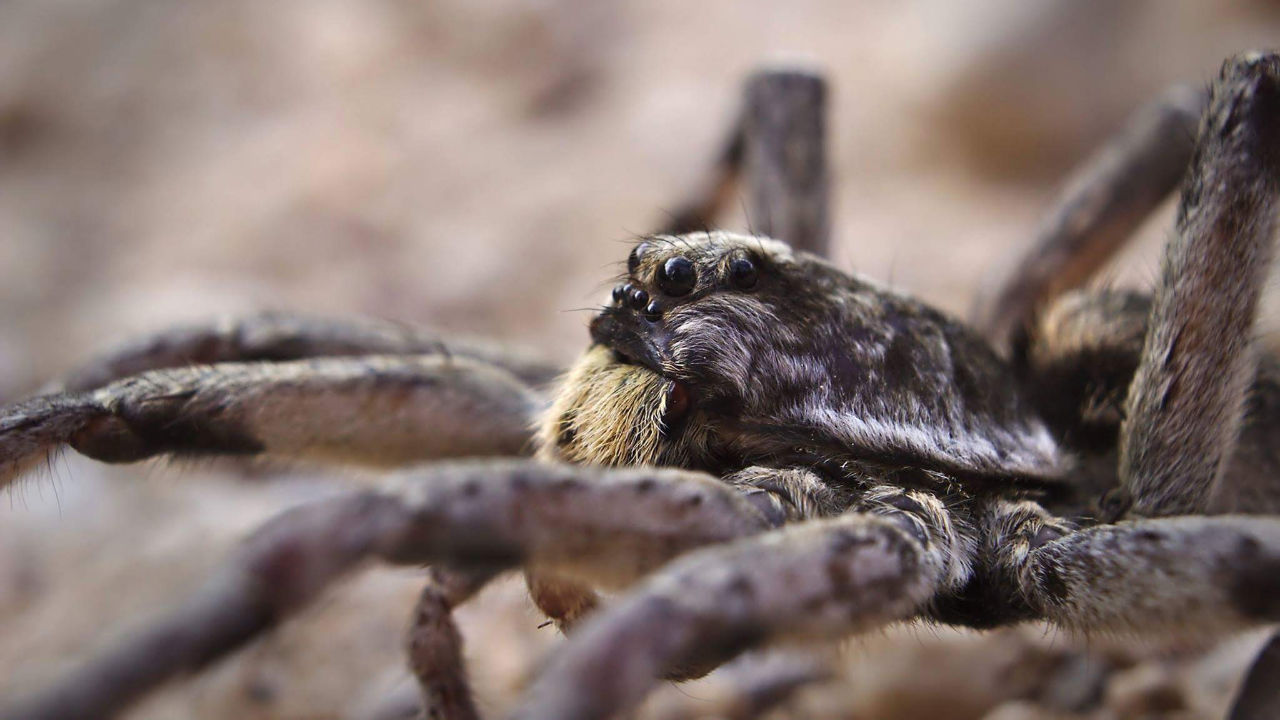
Trabeops aurantiacus is a wolf spider (family Lycosidae) and the sole species in the genus Trabeops. First described by Emerton in 1885 and later placed in its own genus by Roewer in 1959, this spider occurs in the United States and Canada. It represents a monotypic genus within the diverse wolf spider family.
Trachelas is a genus of hunting spiders in the family Trachelidae, established by Ludwig Carl Christian Koch in 1872. The genus contains approximately 99 species with worldwide distribution across tropical, subtropical, and temperate regions. Trachelas sensu stricto is restricted to the Old World, while New World species represent a distinct lineage only distantly related to the core group. The genus has undergone significant taxonomic revision, with species previously assigned to Corinnidae now placed in Trachelidae.
Bull-headed sac spider
Trachelas pacificus is a species of true spider in the family Trachelidae, distributed across the southwestern United States and northwestern Mexico. It is commonly found in houses and adults are present year-round. The species is part of a genus known for sac-like retreats and active hunting behavior rather than web-building.
Broad-faced Sac Spider, Ground Sac Spider
Trachelas tranquillus, commonly known as the broad-faced sac spider, is a hunting spider native to eastern North America. This species is frequently encountered indoors during autumn when males wander in search of mates. It does not construct webs for prey capture but instead hunts actively at night, often around porch lights where insects congregate. Once considered mildly venomous to humans, it is now classified as harmless, though rare bites can cause localized pain and swelling.
Trachelas volutus is a species of true spider in the family Trachelidae. It is found in the United States and Mexico. The genus Trachelas was previously placed in the family Corinnidae but has since been reclassified to Trachelidae based on phylogenetic studies.
Broad-Faced Sac Spiders, Ground Sac Spiders
Trachelidae is a family of araneomorph spiders within the RTA clade, elevated from subfamily status in 2014 based on molecular phylogenetic evidence. The family comprises 29 genera and approximately 307 species distributed across tropical, subtropical, and temperate regions worldwide. Members are commonly known as broad-faced sac spiders or ground sac spiders, though many species are arboreal. The family is characterized by reduced leg spines and other distinctive morphological synapomorphies that distinguish it from related families Corinnidae and Clubionidae.
Trechalea is a genus of semi-aquatic spiders in the family Trechaleidae, distributed from the southern United States through Central and South America to northern Argentina. The genus was established by Thorell in 1869, replacing the preoccupied name Triclaria. At least one species, T. extensa, exhibits specialized diving behavior as an antipredator tactic, using plastron respiration to remain submerged for over 30 minutes.
long-legged water spider
Trechalea gertschi, known as the long-legged water spider, is a species of true spider described by Carico & Minch in 1981. It belongs to the family Trechaleidae, a group of spiders associated with aquatic and semi-aquatic habitats. The species occurs in the United States and Mexico.
Tricholathys monterea is a small spider in the family Dictynidae, first described from specimens collected in California in 1958. The genus Tricholathys comprises North American cribellate spiders that construct irregular, tangled webs. This species is poorly documented in scientific literature, with minimal published information on its biology or ecology.
Trochosa is a large genus of wolf spiders (Lycosidae) with worldwide distribution. These medium-sized, ground-dwelling spiders are cursorial hunters that do not construct webs to capture prey. The genus is particularly well-documented in Europe and North America, though it remains taxonomically unrevised in Africa. As of October 2025, the genus contains 93 species.
Trogloneta paradoxa is a minute spider species in the family Mysmenidae, first described by Gertsch in 1960. Members of this family are among the smallest spiders known, with body lengths typically under 2 mm. The genus Trogloneta is characterized by a distinctive body shape featuring a disproportionately large, spherical posterior abdomen relative to the cephalothorax. The specific epithet "paradoxa" likely refers to this unusual morphology. The species is known from the United States.
Urozelotes rusticus is a cosmopolitan ground-dwelling spider in the family Gnaphosidae and the type species of the genus Urozelotes. Originally described from Europe in 1872, it has been introduced to the Americas, tropical Africa, Australia, and South Africa through human activity. Its synanthropic habits enable it to thrive in buildings and modified environments worldwide.
Usofila pacifica is a small true spider in the family Telemidae, described by Banks in 1894. It is found along the west coast of North America, from the United States into Canada. The species inhabits moist forest floor environments, where it constructs minute, delicate webs.
Varacosa avara is a wolf spider (family Lycosidae) distributed across the United States and Canada. It has been documented as prey for at least two species of spider wasps in the family Pompilidae: Ageniella conflicta and Priocnemis minorata. The species is one of several wolf spiders in the genus Varacosa, which are ground-dwelling hunters. Beyond its recorded role as host for parasitoid wasps, specific details of its biology remain sparse.
Arrowhead Orbweaver, Arrowhead Spider, Triangle Orb Weaver
Verrucosa arenata is a large orb-weaver spider notable for its triangular, arrowhead-shaped abdomen and distinctive upward-facing posture in its web—unusual among orb-weavers. Females display white or yellow triangular markings on the dorsal abdomen, while males are smaller and lack this pattern. The species exhibits color polymorphism with documented trade-offs between camouflage and prey attraction. Its webs feature a unique architecture lacking radial threads, with tougher, stretchier silk enabling specialized "reeling" prey capture behavior.
Wadotes calcaratus is a species of funnel-web spider in the family Agelenidae. It was originally described as Coelotes calcaratus by Keyserling in 1887. The species occurs in eastern North America, where it constructs funnel-shaped webs in forested habitats. It has been documented as prey for the spider wasp Priocnemis minorata.
hacklemesh weaver
Wadotes hybridus is a species of funnel weaver spider in the family Agelenidae, found in the United States and Canada. It is among the larger spiders in its family, reaching up to 14 mm in body length at maturity. The species has been documented as prey for the spider wasp Priocnemis minorata. Taxonomic placement has shifted historically, with the genus Wadotes formerly classified in Amaurobiidae before returning to Agelenidae.
Wagneriana is a genus of orb-weaver spiders in the family Araneidae, first described by F. O. Pickard-Cambridge in 1904. The genus contains at least 29 species distributed across the Neotropical region, from the southern United States through Central America and into South America. Species in this genus construct typical orb webs for prey capture. The genus was revised by Levi in 1991, who described the majority of currently recognized species.
Walckenaeria auranticeps is a species of dwarf spider in the family Linyphiidae. It was described by Emerton in 1882. The species has a transcontinental distribution spanning northern Eurasia and North America, with records from Russia (South Siberia to Far East), Canada, and the United States. As a member of the sheet-web weaving spiders, it belongs to one of the most species-rich families of spiders.
Walckenaeria castanea is a species of dwarf spider (family Linyphiidae) first described by Emerton in 1882. It is known from northern North America, with documented occurrences in the United States, Canada, and Greenland. As a member of the sheet-web weavers, it constructs horizontal webs to capture prey. The species is among the smaller spiders in its family, consistent with the 'dwarf spider' common name applied to linyphiids.
dwarf spider
Walckenaeria columbia is a species of dwarf spider (subfamily Erigoninae) in the sheet-web weaving family Linyphiidae. Described by Millidge in 1983, this small arachnid is distributed across the United States and Canada. As a member of the Erigoninae, it likely constructs simple sheet webs or inhabits vegetation in ground-level habitats, though specific behavioral and ecological details remain poorly documented.
dwarf spider
Walckenaeria cornuella is a species of dwarf spider belonging to the family Linyphiidae. The species was described by Chamberlin and Ivie in 1939. It is distributed across the United States and Canada, with confirmed records from Alberta and British Columbia. Like other members of its genus, it is a small-bodied spider typical of the sheet-web weaving linyphiids.
dwarf spider
Walckenaeria directa is a species of dwarf spider in the family Linyphiidae, first described by O. Pickard-Cambridge in 1874. The species is known to occur in the United States and Canada. As a member of the sheet-web weavers, it belongs to one of the most diverse spider families, though specific ecological details for this species remain limited.
dwarf spider
Walckenaeria exigua is a species of dwarf spider in the family Linyphiidae, first described by Millidge in 1983. It belongs to a genus of small sheet-web weavers characterized by their diminutive size and specialized genital morphology. The species has been documented across much of North America, with confirmed records from both the United States and Canada. Like other members of Linyphiidae, it constructs flat sheet webs with a retreat area, though specific web architecture details for this species remain undocumented.
Walckenaeria occidentalis is a species of sheet-web weaver spider in the family Linyphiidae, described by Millidge in 1983. The specific epithet 'occidentalis' indicates a western distribution pattern. Like other members of this large family of small spiders, it constructs flat sheet webs with a retreat and associated knockdown threads to capture prey. The genus Walckenaeria contains numerous species, many of which are poorly known and require specialist identification.
Walckenaeria palustris is a species of dwarf spider in the family Linyphiidae, described by Millidge in 1983. The specific epithet 'palustris' (Latin for 'of the marsh') suggests association with wetland or marshy habitats. Like other members of the genus Walckenaeria, it is a small-bodied spider with characteristic genitalic structures used for species identification. The species has been recorded in Canada based on available distribution data.
Spiraling Sheet-web Weaver
Walckenaeria spiralis is a dwarf spider species in the family Linyphiidae, first described by Emerton in 1882. It belongs to a large genus of small sheet-web weaving spiders distributed across the Holarctic region. The species is known from scattered records across northern North America and the Russian Far North-East, suggesting a boreal distribution pattern.
dwarf spider
Walckenaeria subdirecta is a species of dwarf spider in the family Linyphiidae, described by Millidge in 1983. This small spider belongs to one of the largest families of spiders, commonly known as sheet-web weavers or money spiders. It has been documented in North America, specifically in the United States and Canada.
Wubana is a genus of sheet-web weaving spiders (family Linyphiidae) endemic to the United States. First described by Ralph Vary Chamberlin in 1919, the genus contains seven recognized species as of 2019. These small spiders construct flat, horizontal sheet webs for prey capture. The genus is exclusively North American with no documented occurrences outside the United States.
Wubana atypica is a species of sheetweb spider in the family Linyphiidae, first described in 1936. It is distributed across the United States and Canada, with confirmed records from Alberta and British Columbia. As a sheetweb spider, it constructs flat, horizontal webs for prey capture. The species remains poorly documented in scientific literature, with limited information available on its biology and ecology.
Wubana pacifica is a species of sheetweb spider in the family Linyphiidae. It was described by Nathan Banks in 1896. The species is known from the United States. As a member of Linyphiidae, it constructs flat, horizontal sheet webs rather than orb webs.
ghost spiders
Wulfila is a genus of ghost spiders (family Anyphaenidae) comprising at least 40 described species. These spiders are active hunters that do not construct webs for prey capture. They are commonly found in urban environments, where research has documented their association with scale-infested trees and shrubs. As members of the hunting spider guild, they contribute to biological control of pest insects in managed landscapes.
ghost spider
Wulfila albens is a species of ghost spider in the family Anyphaenidae, first described by Hentz in 1847. It is found in the United States and Jamaica. As an active hunting spider, it does not construct webs to capture prey. The species has been documented as part of natural enemy communities in urban landscapes, particularly in association with scale-infested trees.
Xeropigo tridentiger is a corinnid spider species first described from Colombia in 1870. It is one of the most widespread species in the genus, with records spanning northern South America including Colombia, Venezuela, and Brazil. The species name refers to the three-toothed (trident) structure of the male pedipalp, a diagnostic feature. Recent taxonomic work has updated its known distribution, confirming its presence across multiple Brazilian states.
Ground Crab Spiders
Xysticus is a large genus of approximately 275–300 species of ground crab spiders in the family Thomisidae. These spiders are ambush predators that do not build webs, instead hunting near the ground by seizing prey with their enlarged anterior legs. The genus exhibits strong sexual dimorphism, with females typically reaching 10 mm in body length while males are roughly half that size. Species identification requires microscopic examination of genitalia due to the morphological similarity among members of the genus.
Xysticus acquiescens is a species of ground crab spider in the family Thomisidae, first described by Emerton in 1919. As a member of the genus Xysticus, it is an ambush predator that relies on camouflage and patience rather than web-building to capture prey. The species is known from the Canadian prairies and adjacent regions of the northern United States. Like other Xysticus species, it exhibits typical crab spider morphology with laterally extended legs and a flattened body adapted for hiding in vegetation or ground cover.
Xysticus apachecus is a species of crab spider in the family Thomisidae, first described by Gertsch in 1933. Like other members of the genus Xysticus, it is a ground-dwelling ambush predator characterized by its crab-like leg posture and sideways movement. The species is known from the United States, though specific details about its ecology and behavior remain limited in the published literature.
Xysticus californicus is a species of crab spider in the family Thomisidae, first described by Keyserling in 1880. The species occurs in the United States and Mexico. As a member of the genus Xysticus, it belongs to a group of spiders commonly known as ground crab spiders, which are characterized by their ambush hunting strategy and crab-like leg posture.
Xysticus discursans is a species of crab spider in the family Thomisidae. It is found in North America, with records from Canadian provinces including Alberta, British Columbia, and Manitoba. As a member of the genus Xysticus, it shares the typical ground crab spider morphology and ambush-hunting behavior characteristic of this group.
elegant crab spider
Xysticus elegans, commonly known as the elegant crab spider, is a medium-sized crab spider in the family Thomisidae. The species exhibits pronounced sexual dimorphism in body size, with females approximately twice as large as males. It is distributed across northern North America including the United States, Canada, and Alaska. The spider is characterized by distinctive coloration including a brown cephalothorax with lighter areas and white-outlined brown spots on the abdomen.
Xysticus gulosus is a species of crab spider in the family Thomisidae, described by Keyserling in 1880. It belongs to the genus Xysticus, a diverse group of ground-dwelling ambush predators commonly known as ground crab spiders. The species is distributed across North America, with confirmed records from the Canadian provinces of Alberta, Manitoba, and Saskatchewan. Like other members of its genus, it likely employs a sit-and-wait hunting strategy, using its enlarged front legs to capture prey.
Xysticus robinsoni is a species of ground crab spider in the family Thomisidae, first described by Willis J. Gertsch in 1953. The species belongs to a genus of ambush predators characterized by their crab-like posture and enlarged front legs used to seize prey. Like other Xysticus species, it is likely a sit-and-wait predator that does not construct webs for prey capture. The species occurs in the United States and Mexico, though specific details about its biology remain poorly documented.
Yabisi is a genus of tree trunk spiders in the family Hersiliidae, described in 2004 by Rheims & Brescovit. The genus contains two species, Y. guaba and Y. habanensis, both found in North America. Members of this genus are associated with tree trunks, consistent with the ecology of Hersiliidae.
Yorima is a genus of araneomorph spiders in the family Cybaeidae, first described by Chamberlin & Ivie in 1942. The genus has undergone several family reassignments, originally placed in Agelenidae (funnel weavers), then Dictynidae in 1967, and finally Cybaeidae in 2017 based on revised phylogenetic understanding. It contains six described species distributed in the United States and Cuba, with most species occurring in the western United States.
Yorima angelica is a species of true spider in the family Cybaeidae, described by Roth in 1956. It is known from the United States. The genus Yorima belongs to a family of small to medium-sized spiders commonly found in leaf litter and other ground-level habitats. Information about this species is limited in the available literature.
Yunohamella is a genus of comb-footed spiders in the family Theridiidae, established by H. Yoshida in 2007. The genus is characterized by distinct male genital morphology: a large tegulum, small median apophysis, thin embolus, and distinct tegular apophysis. Females have an epigyne lacking a pointed scapus or possessing a blunt scapus. As of 2026, the genus comprises thirteen species distributed across Asia, Europe, and North America. Recent taxonomic revisions have clarified species boundaries using morphological and molecular data, including the reestablishment of Y. mneon as a valid species and the synonymy of Y. varietas.
Lyric Cobweaver
Yunohamella lyrica is a cobweb spider in the family Theridiidae, commonly known as the Lyric Cobweaver. The species has a broad geographic distribution spanning North America and East Asia, including Korea and Japan. It belongs to a genus of small spiders that construct irregular, tangled webs.
ground spider
Zelotes duplex is a species of ground spider in the family Gnaphosidae, first described by Chamberlin in 1922. It is found in the United States and Canada. As a member of Zelotes, it belongs to a large genus of active hunting spiders commonly known as ground spiders.
Zelotes funestus is a species of ground spider in the family Gnaphosidae, found in the United States. As a member of the genus Zelotes, it belongs to a diverse group of nocturnal hunting spiders commonly known as ground spiders. The species was first described by Keyserling in 1887.
Zelotes gabriel is a ground spider species in the family Gnaphosidae, described by Platnick and Shadab in 1983. It is native to the United States, specifically recorded from southern California and Baja California. Like other members of the genus Zelotes, it is a nocturnal hunting spider that does not build webs to capture prey. The species name honors Gabriel, the son of entomologist Walter Leal, who attended the ceremony where his father received the National Academy of Inventors Fellowship.