
Trachelas
L. Koch, 1872
Species Guides
3- Trachelas pacificus(Bull-headed sac spider)
- Trachelas tranquillus(Broad-faced Sac Spider)
- Trachelas volutus
Trachelas is a of hunting spiders in the Trachelidae, established by Ludwig Carl Christian Koch in 1872. The genus contains approximately 99 with worldwide distribution across tropical, subtropical, and temperate regions. Trachelas sensu stricto is restricted to the Old World, while New World species represent a distinct lineage only distantly related to the core group. The genus has undergone significant taxonomic revision, with species previously assigned to Corinnidae now placed in Trachelidae.
Pronunciation
How to pronounce Trachelas: /ˈtrækɪləs/
These audio files are automatically generated. While they are not always 100% accurate, they are a good starting point.
Identification
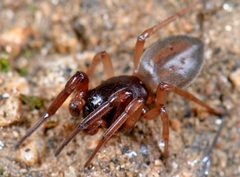
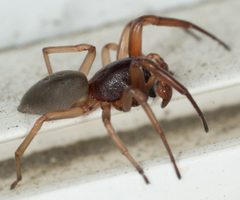
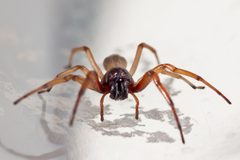
Members of Trachelas can be distinguished from similar hunting spiders by their characteristic arrangement: eight eyes arranged in two rows across the broad, flattened front of the . This contrasts with the six-eyed arrangement of superficially similar spiders like Dysdera. The cephalothorax is typically broad and somewhat flattened. vary in size, with body lengths ranging from approximately 5-15 millimeters depending on the species and sex.
Images
Habitat
in this occupy diverse across their broad geographic range. In North America, Trachelas tranquillus prefers deciduous woodlands and is frequently found in retreats fashioned from curled leaves or under stones. The genus as a whole shows adaptability to both natural and human-modified environments, with some species commonly entering buildings.
Distribution
Worldwide distribution spanning tropical, subtropical, and temperate regions. Old World: Europe, North Africa, Central Asia, Himalayas (China/Yarkand), and throughout the Afrotropical region including Côte d'Ivoire, Nigeria, South Africa, Tanzania, Namibia, Central African Republic, Ethiopia, Ghana, and Kenya. Asia: China, Japan, and extending to Southeast Asia. New World occur in the Americas but represent a distinct phylogenetic lineage.
Behavior
Active hunters that do not construct webs for prey capture. Individuals lay down draglines of silk during climbing to secure themselves. Some , notably Trachelas tranquillus, have been observed scavenging on dead insects in addition to killing live prey, a that may contribute to their success in autumn when other prey becomes scarce. Males wander in search of mates, particularly in autumn.
Ecological Role
that contribute to insect control. In some regions, they serve as prey for spider wasps in the Pompilidae, including the Auplopus. Their scavenging may contribute to nutrient cycling in leaf litter and soil .
Human Relevance
Trachelas tranquillus, known as the Broad-faced Sac Spider, is commonly encountered indoors in eastern North America and southeast Canada during autumn. The was once considered mildly venomous to humans but is now classified as harmless. Verified bites are infrequent and typically result in localized pain and swelling; secondary from bites have been documented but were originally misattributed to venom effects. The spider's regular presence in and around homes increases likelihood of human encounters. Frequently confused with the Woodlouse Hunter (Dysdera crocata), which has similar coloration but six and enlarged jaws.
Similar Taxa
- Dysdera crocataSimilar reddish-brown and gray coloration pattern, but Dysdera has only six arranged in a semicircle and possesses conspicuously enlarged jaws with long fangs. Trachelas has eight eyes in two rows across a broad and lacks enlarged jaws.
- Herpyllus ecclesiasticusBoth are ground-dwelling hunting spiders in similar , but the Eastern Parson Spider has distinctive black and white coloration resembling clerical garb and prominent characteristic of Gnaphosidae.
Misconceptions
Trachelas tranquillus was historically misidentified as mildly venomous to humans, but current classification considers it harmless. Secondary resulting from bites were originally misattributed to spider venom rather than bacterial infection. The is frequently confused with Dysdera due to convergent coloration, leading to misidentification of harmless specimens as potentially dangerous.
More Details
Taxonomic History
The was first used by Koch in an 1866 identification key without formal description. O. Pickard-Cambridge described the type T. minor in 1872. The genus has been variously placed in Trachelidae and Corinnidae, with current placing it in Trachelidae. Molecular based on COI indicates New World species belong to a distinct lineage only distantly related to Trachelas sensu stricto.
Species Diversity
As of October 2025, the includes 99 . Recent taxonomic work has described multiple new species from China and the Afrotropical region, with ongoing revisions clarifying species boundaries and geographic distributions.
Sources and further reading
- BugGuide
- Wikipedia
- GBIF taxonomy match
- iNaturalist taxon
- NCBI Taxonomy
- Catalogue of Life
- Bug Eric: Woodlouse Hunter
- Bug Eric: Spider Sunday: A Common "Indoor" Spider
- Bug Eric: November 2012
- Bug Eric: Spider Season
- Bug Eric: Masters of Mud: Auplopus Spider Wasps
- Bug Eric: 2009
- Redescription of the Himalayan Trachelas costatus (Araneae: Trachelidae)
- A review of the genus Trachelas (Araneae: Corinnidae) from China
- A revision of the genus Trachelas L. Koch, 1872 (Araneae: Trachelidae) in the continental Afrotropical Region
- An update on the distribution of the genus Trachelas L. Koch, 1872 (Araneae, Trachelidae) in China, with description of a new species
- Description of two new species of the genus Trachelas L. Koch, 1872 and the male of T. gaoligongensis Jin, Yin & Zhang, 2017 from China (Araneae, Trachelidae)