
Dysdera crocata
C. L. Koch, 1838
Woodlouse Spider, Woodlouse Hunter, Sowbug Hunter, Sowbug Killer, Pillbug Hunter, Slater Spider
Dysdera crocata is a specialized spider native to the Mediterranean region of Europe that has become established worldwide through human commerce. It is the only representative of the Dysderidae in North America. Despite its formidable appearance—featuring disproportionately large and long fangs—it poses no significant danger to humans. The has been the subject of recurring internet hoaxes falsely claiming it is a new, deadly spider. It is primarily and strongly associated with human-modified environments, particularly where its prey abounds.
Pronunciation
How to pronounce Dysdera crocata: //dɪsˈdɛɹə kroʊˈkɑːtə//
These audio files are automatically generated. While they are not always 100% accurate, they are a good starting point.
Identification
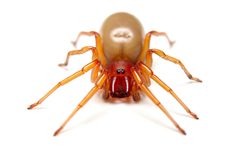
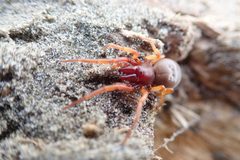
Dysdera crocata is readily identified by its distinctive coloration and : the and legs are bright reddish-brown to orange, contrasting with a beige or grayish . Most notably, it possesses six arranged in a compact semicircle at the front of the cephalothorax—unlike the eight eyes typical of most spiders. The are exceptionally large relative to body size, with elongated fangs adapted for piercing the armored of woodlice. females measure 11–15 mm in body length, males 9–10 mm. The spider may be confused with Trachelas tranquillus (Broad-faced Sac Spider), which shares similar coloration but has eight eyes in two rows, lacks the enlarged jaws, and has a broader cephalothorax.
Images
Habitat
This favors disturbed in both forested and open areas, showing a strong preference for human-modified environments. Outdoors, it occurs under stones, logs, boards, bricks, and other debris, particularly in warm, sheltered locations. It also occupies leaf litter and partially decayed wood. The spider frequently enters buildings, where it is most often encountered. In North America, it is most common in urban areas.
Distribution
Native to the Mediterranean region of western Europe. Introduced and established throughout much of the world including North America, South America, South Africa, Australia, and New Zealand. In North America, it occurs across the United States and southern Canada, with records from Nova Scotia to Florida, west to Minnesota, Kansas, Oklahoma, and Texas, and in the western states including Colorado, Arizona, and California. European specimens have been documented from Germany (Frankfurt, Karlsruhe) and Austria (Vienna).
Diet
Specialized of terrestrial isopods (woodlice, sowbugs, pillbugs, roly-polies), using its enlarged and long fangs to pierce their armored or turn them over to attack the soft surface. In captivity, individuals will accept other small prey, indicating some dietary flexibility, though woodlice remain the primary prey in natural settings.
Life Cycle
Development from to maturity requires approximately eighteen months. Individuals may live an additional two to three years as . Mating occurs in spring. Females produce a egg sac containing up to 70 eggs, consisting of only a few strands of silk. Spiderlings emerge and develop through multiple instars before reaching adulthood.
Behavior
hunter that does not construct webs for prey capture. By day, it hides in silken retreats—oval enclosures spun in crevices of decaying wood or other sheltered locations—used for molting and . At night, it actively prowls for prey. When disturbed, it may display its large menacingly. The is known to enter buildings, where it typically remains near ground level, preferring to hug baseboards rather than climb.
Ecological Role
of woodlice and other small soil-dwelling . May contribute to of isopod in gardens and agricultural settings. Serves as occasional prey for spider wasps and other predators.
Human Relevance
Frequently encountered indoors, causing alarm due to its appearance. Subject of repeated internet hoaxes falsely claiming it is a new, deadly —most notably a 2018 viral Facebook post that was debunked by Snopes and the Entomological Society of America. Documented bites are rare and produce only localized pain lasting approximately one hour, occasionally with minor dermatitis; no medically significant envenomation has been confirmed. Secondary from bites have been reported but attributed to bacterial rather than venom. The species is sometimes kept for educational display to promote spider appreciation and counter arachnophobia.
Similar Taxa
- Trachelas tranquillus (Broad-faced Sac Spider)Nearly identical reddish-brown and gray color pattern, but possesses eight in two rows (vs. six in semicircle), lacks enlarged and long fangs, has broader , and climbs more readily.
Misconceptions
Widely targeted by internet hoaxes falsely claiming it is a newly discovered, lethal responsible for multiple human deaths. These claims are entirely fabricated; the species has been present in North America for decades and its bite is not dangerous to healthy humans. The large fangs are specialized for woodlice prey, not defense against vertebrates.
Sources and further reading
- BugGuide
- GBIF taxonomy match
- iNaturalist taxon
- NCBI Taxonomy
- Catalogue of Life
- Don't Believe Everything You Read About Spiders--Or Anything Else for that Matter! | Bug Squad
- Bug Eric: Woodlouse Hunter
- Bug Eric: August 2018
- Bug Eric: Spider Sunday: A Common "Indoor" Spider
- Bug Eric: November 2012
- Bug Eric: 2018
- A biosemiotic interpretation of certain genital morphological structures in the spiders Dysdera erythrina and Dysdera crocata (Araneae: Dysderidae).