
Trachelidae
Simon, 1897
Broad-Faced Sac Spiders, Ground Sac Spiders
Genus Guides
2Trachelidae is a of araneomorph spiders within the RTA clade, elevated from status in 2014 based on molecular phylogenetic evidence. The family comprises 29 and approximately 307 distributed across tropical, subtropical, and temperate regions worldwide. Members are commonly known as broad-faced sac spiders or ground sac spiders, though many species are arboreal. The family is characterized by reduced leg spines and other distinctive morphological synapomorphies that distinguish it from related families Corinnidae and Clubionidae.
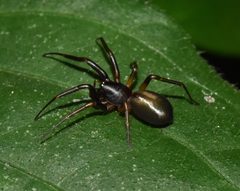
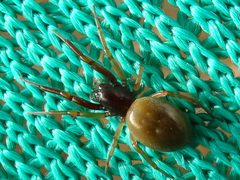
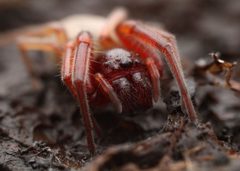
Pronunciation
How to pronounce Trachelidae: /træˈkiːlɪˌdaɪ/
These audio files are automatically generated. While they are not always 100% accurate, they are a good starting point.
Identification
Distinguished from Corinnidae and Clubionidae by molecular phylogenetic data and the combination of reduced leg spines, absence of , and specific genital characteristics. The CTC clade affiliation can be confirmed by the presence of two tarsal claws with hair tufts. Some (Coronarachne, Falcaranea, Trachecymbius) possess strongly protruding setal bases on surfaces of legs, more developed in males. Arboreal may be collected via fogging, distinguishing them from ground-dwelling relatives.
Images
Habitat
Ecologically diverse: includes both ground-dwelling and arboreal . Arboreal members occupy tree in rainforest, jungle rubber agroforest, savanna, and forest ; some species specifically associated with tree bark microhabitats. Ground-dwelling species occur in leaf litter. Some species occur in agricultural (rubber, oil palm). Several species commonly found indoors.
Distribution
Worldwide distribution in tropical, subtropical, and temperate regions. Documented from Africa (including Afrotropical and southern African regions), Asia (China, India, Himalayas, Sumatra, Vietnam), Europe, North Africa, Central Asia, and South America (Argentina, Paraguay). Some previously considered Afrotropical endemics (e.g., Planochelas) have been discovered in Asia (China), indicating broader distributions than previously recognized.
Behavior
Members of the RTA clade are wandering hunters that do not construct webs for prey capture. Arboreal are frequently collected via fogging and beating, indicating active movement in vegetation. Bark-dwelling species exhibit cryptic habits beneath tree bark. Ground-dwelling species (e.g., Orthobula) inhabit leaf litter.
Ecological Role
Predatory component of arboreal and terrestrial . In southern African savanna and forest , arboreal trachelids represent a prominent component of fauna. Some show habitat specificity across land-use gradients, with potential as indicators of forest disturbance.
Human Relevance
Some commonly occur indoors. No documented medical significance or economic impact specified in sources.
Similar Taxa
- CorinnidaeTrachelidae was previously classified within Corinnidae; separated based on 2014 phylogenetic analysis showing distant relationship
- ClubionidaeFormerly placed in Clubionidae; distinguished by reduced leg spines and other synapomorphies
- LiocranidaeSome historically misclassified in Liocranidae (e.g., Argistes africanus transferred to Trachelidae)
More Details
Taxonomic History
First described as 'Tracheleae' (modern Trachelinae) by Eugène Simon in 1897. Transferred to Clubionidae, then Corinnidae following splits. Deeleman-Reinhold (2001) first suggested family status. Ramírez (2014) molecular analysis confirmed separation from Corinnidae, establishing modern family circumscription. Now placed in CTC (Claw Tuft Clasper) clade.
Phylogenetic Affiliation
Member of RTA clade (wandering spiders) and CTC clade (Claw Tuft Clasper clade). Molecular based on COI gene have been used to evaluate relationships among Afrotropical and confirm boundaries.
Sources and further reading
- BugGuide
- Wikipedia
- GBIF taxonomy match
- iNaturalist taxon
- NCBI Taxonomy
- Catalogue of Life
- Redescription of the Himalayan Trachelas costatus (Araneae: Trachelidae)
- Four new species of Utivarachna Kishida, 1940 (Araneae: Trachelidae) from Sumatra
- Three new genera of arboreal dark sac spiders from southern Africa (Araneae: Trachelidae)
- A new species of Orthobula Simon, 1897 (Araneae: Trachelidae) from South America
- A new species of Orthobula Simon, 1897 (Araneae, Trachelidae) from South China
- Transfer of the Namibian Argistes africanus Simon, 1910 (Araneae: Liocranidae) to Afroceto Lyle & Haddad, 2010 (Trachelidae), with a new synonym
- A revision of the genus Trachelas L. Koch, 1872 (Araneae: Trachelidae) in the continental Afrotropical Region
- CHAPTER 20. Ghosts, Goblins, Pirates, and Other Wandering Hunters: Mimetidae, Corrinidae, Trachelidae, Gnaphosidae, Caponiidae, Dysderidae, Oonopidae, Anyphaenidae, Miturgidae, Eutichuridae, and Liocranidae
- Breaking the Afrotropical boundary: Discovery of Planochelas in Asia reveals transcontinental distribution, with a new bark-dwelling species from China (Araneae, Trachelidae)
- A new species of Utivarachna Kishida, 1940 from Fanjing Mountain Nature Reserve, Guizhou, China (Araneae: Trachelidae)
- Four new species of the sac spider genus Planochelas Lyle & Haddad, 2009 (Araneae, Trachelidae) from central and southern Africa
- An update on the distribution of the genus Trachelas L. Koch, 1872 (Araneae, Trachelidae) in China, with description of a new species
- Description of two new species of the genus Trachelas L. Koch, 1872 and the male of T. gaoligongensis Jin, Yin & Zhang, 2017 from China (Araneae, Trachelidae)
- Three new species of the spider genus Utivarachna Kishida, 1940 (Araneae, Trachelidae) from China and Vietnam.