
Liocranidae
Simon, 1897
sac spiders
Genus Guides
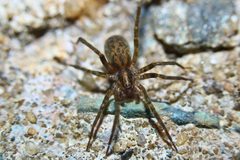
4Liocranidae is a of araneomorph spiders first described by Eugène Simon in 1897. They are commonly referred to as 'sac spiders' due to their habit of constructing silk retreats. The family contains 35 and approximately 357 as of January 2026. The holarctic genus Agroeca is the best-known member, while many other genera remain poorly studied and lack formal . Recent taxonomic work has significantly expanded the family, including the description of numerous new species from China, Vietnam, and other regions.
Pronunciation
How to pronounce Liocranidae: /laɪˌoʊkrəˈnaɪdiː/
These audio files are automatically generated. While they are not always 100% accurate, they are a good starting point.
Identification
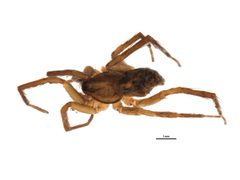
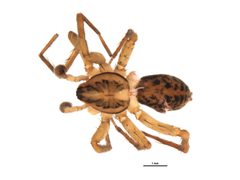
Liocranidae can be distinguished from other sac spider by subtle morphological features, though definitive identification often requires examination of copulatory organs. The family is placed in the superfamily Dictynoidea. Members typically have two tarsal claws and lack the enlarged characteristic of some related families. The Agroeca is recognizable by its holarctic distribution and relatively well-documented , while many other genera require taxonomic knowledge for accurate identification.
Images
Habitat
Liocranidae occupy diverse across their range. The North American Neoanagraphis inhabits extremely dry conditions in the Mojave, Sonoran, and Chihuahuan deserts, where females live in animal burrows. Other members are found in forest litter, under rocks and stones, and in well-vegetated habitats. Several show cave-dwelling (troglobitic) adaptations, including eyelessness and depigmentation. The has been introduced to some oceanic islands, with records from the Ogasawara Islands.
Distribution
The has a wide distribution including the Holarctic region, Oriental region, and parts of the Mediterranean. Specific distribution records include: Denmark, Norway, Sweden, China, Vietnam, southern India, Sri Lanka, Thailand, the Iberian Peninsula, Algeria, Tunisia, Italy, France, Spain, Sardinia, Sicily, Mallorca, and the Ogasawara Islands (Japan). The Agroeca is holarctic. The genus Paratus occurs in the Oriental region at altitudes of 27–2020 metres. The genus Neoanagraphis is restricted to North American deserts.
Host Associations
- termites - commensalismThe Andromma shows apparent commensalism with , though the exact nature of this association requires further study.
Behavior
Females of some desert-dwelling (Neoanagraphis) live in animal burrows while males wander and are frequently captured in pitfall traps. Many species are ground-dwelling and construct silk sac-like retreats. Cave-dwelling species show behavioral adaptations to subterranean life including reduced activity and enhanced sensory reliance due to eyelessness.
Human Relevance
Liocranidae are not considered medically significant spiders. They are primarily of scientific interest for taxonomic and biodiversity research. The has been the subject of extensive recent taxonomic work, particularly by researchers documenting new from Asia.
Similar Taxa
- ClubionidaeAlso called sac spiders and construct similar silk retreats; distinguished by morphological details of arrangement and genitalia.
- CorinnidaeGround-dwelling spiders with similar habits; Liocranidae distinguished by tarsal claw structure and copulatory organ .
More Details
Taxonomic activity
The has seen significant recent taxonomic expansion. Researcher Shuqiang Li alone has published 51 new and 677 new in 100 papers, including substantial contributions to Liocranidae. A 2023 paper described one new genus and four new species of Liocranidae from China and Vietnam.
Conservation concern
Troglobitic in the Cybaeodes from the Iberian Peninsula have highly restricted ranges and are considered candidates for protection due to their cave-dwelling status.
Historical taxonomy
The Paratus remained taxonomically for 103 years (1898–2001) until re-examination of type material allowed proper placement in the Paratinae.
Sources and further reading
- BugGuide
- Wikipedia
- GBIF taxonomy match
- NCBI Taxonomy
- Catalogue of Life
- On the amazing discovery of a new species and how to choose names for spiders | Blog
- Araneae | Blog
- Pensoft Editorial Team | Blog - Part 32
- animals | Blog
- The genus Jacaena Thorell, 1897 from southern China (Araneae: Liocranidae)
- Studies in the Liocranidae (Araneae): revision of Andromma Simon, 1893
- A new species of Paratus Simon, 1898 (Araneae: Liocranidae, Paratinae) from India
- Description of three new troglobiontic species of Cybaeodes (Araneae, Liocranidae) endemic to the Iberian Peninsula
- Discovery of presumably introduced spiders, Oedignathascrobiculata Thorell, 1881 (Araneae, Liocranidae) and Boagriusqiong Lin & Li, 2022 (Araneae, Palpimanidae) on Chichi-jima Island, the Ogasawara Islands, Japan.