
Auplopus
Spinola, 1841
spider wasps
Species Guides
7- Auplopus adjunctus
- Auplopus architectus
- Auplopus caerulescens(Blue Mud-dauber Spider Wasp)
- Auplopus carbonarius(potter spider wasp)
- Auplopus mellipes(Red-legged Spider Wasp)
- Auplopus mollis
- Auplopus nigrellus
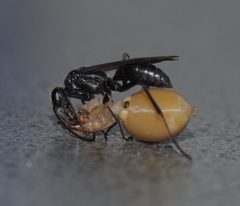
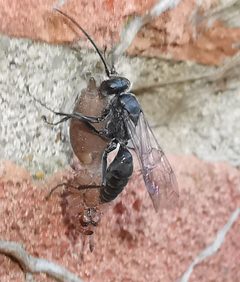
Auplopus is a large of small spider wasps in the Pompilidae, distributed worldwide except Antarctica. Females construct distinctive barrel-shaped mud nests, often inside pre-existing cavities such as abandoned nests of other , hollows in wood, or rock crevices. They hunt spiders, paralyze them with venom, and amputate the legs before transporting the prey to their nests. The wasps provision each mud with one or more paralyzed spiders, lay a single on the final victim, and seal the cell. Auplopus are solitary and non-aggressive, with most activity occurring from May to October.
Pronunciation
How to pronounce Auplopus: //ˈɔːpləpʌs//
These audio files are automatically generated. While they are not always 100% accurate, they are a good starting point.
Identification
Distinguished from other spider wasps by the combination of small size, metallic coloration in many , and the distinctive barrel-shaped mud nests. The pygidial plate in females is diagnostic for the . Nests are typically 15 mm long and 7-10 mm wide, often stacked end-to-end in rows of 2-5 . May be confused with mason bees (Osmia) or mason wasps (Eumeninae) that construct similar mud nests, but these lack the specific barrel shape and stacking pattern of Auplopus. Distinguished from other mud-nesting like Sceliphron and Trypoxylon by the smaller, more delicate barrel-shaped cells rather than large mud clumps or organ-pipe tubes.
Images
Appearance
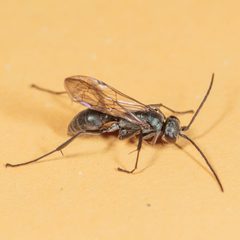
Small averaging approximately 10 mm in length. Several exhibit bright metallic blue-green coloration. Females possess a distinctive oval pygidial plate on the surface of the near the tip, used as a masonry trowel to manipulate mud during nest construction. Males can be distinguished from females by differences in genitalia; females of many species are externally inseparable. The body is relatively compact compared to other pompilid wasps.
Habitat
Occurs in wooded environments, forests, and areas with suitable nesting substrates. Nests are constructed in pre-existing cavities including hollows in wood, under bark on standing trees, rock wall crevices, and frequently inside abandoned nests of other such as Sceliphron caementarium, Trypoxylon politum, and Polistes paper wasps. Also found in Eucalyptus plantations and other silvicultural settings. Requires access to mud for nest construction and proximity to spider .
Distribution
Worldwide distribution except Antarctica. Present across North America with ten recognized ; one species (A. carbonarius) introduced from western Europe and documented in New York and Michigan. Found throughout South America including Brazil. Occurs in Europe, Asia (including Hong Kong, China), and other regions. In North America, active from May to October with peak abundance July through September.
Seasonality
Active primarily from May to October, with peak abundance from July through September in North America. In tropical regions such as Brazil, nesting activity occurs during the hottest months (November to March). Development time varies: some individuals complete development in approximately three months, while others may delay for up to one year.
Diet
feed on honeydew from colonies, particularly on honeyvine milkweed (Ampelamus albidus, Cynanchum leave), sunflower, and other plants. Larvae are provisioned with paralyzed spiders as food.
Host Associations
- Spiders (Araneae) - preyParalyzed and used as larval provisions. Documented prey includes spiders from at least thirteen : Thomisidae (crab spiders), Salticidae (jumping spiders), Clubionidae (sac spiders), Corinnidae (ground sac spiders), Anyphaenidae (ghost spiders), Miturgidae (longlegged sac spiders), Gnaphosidae (ground spiders), and Pisauridae (nursery web spiders). Both and spiders may be taken.
- Ephuta icema - Mutillid that parasitizes Auplopus subaurarius nests
- Ceyxia longispina - Natural enemy of Auplopus subaurarius
- Caenochrysis crotonis - Natural enemy of Auplopus subaurarius
- Photochryptus sp. - Natural enemy of Auplopus subaurarius
- Messatoporus sp. - Natural enemy of Auplopus subaurarius
- Irenangelus eberhardi - of Auplopus semialatus
Life Cycle
Females construct mud nests or use pre-existing cavities, provision them with paralyzed spiders, lay a single on the last spider placed in the , and seal the cell with a mud cap. The larva hatches and feeds on the paralyzed spiders, into a pupa, and develops within a cocoon inside the cell. Development time is variable: some individuals complete development in approximately three months, while others may enter and delay for up to one year. The emerging regurgitates liquid to soften the mud cap, then chews through to exit. Sex ratio tends toward female production.
Behavior
Solitary nesting with females working alone. Females hunt spiders opportunistically, paralyze them with venom, and amputate several or all legs of the prey before transport. This leg amputation facilitates easier ground transport and allows the to feed on spider blood. During nest construction, females curl the beneath the body to contact the mud with the pygidial plate. seldom visit flowers but frequently attend colonies to feed on honeydew. Non-aggressive; females do not defend nests and will flee rather than attack when disturbed.
Ecological Role
of spiders, contributing to regulation of spider and potentially serving as agents. Prey on diverse spider including web-building and non-web-building . Serve as for multiple species including mutillid and cuckoo wasps. Presence indicates healthy woodland with suitable nesting substrates and spider diversity.
Human Relevance
Generally beneficial due to spider and non-aggressive nature. Nests may be found on human structures but cause no damage. Occasionally encountered indoors when nests are built in wall voids or other cavities. Not medically significant; stings are rare and occur only if females are directly handled. Nests are sometimes destroyed due to aesthetic concerns, but conservation is encouraged as these solitary pose no threat and contribute to natural pest control.
Similar Taxa
- Sceliphron caementarium (Black and Yellow Mud Dauber)Also constructs mud nests, but builds larger, clod-like structures with multiple covered in mud layers rather than small discrete barrels. Belongs to Sphecidae rather than Pompilidae.
- Trypoxylon politum (Pipe Organ Mud Dauber)Constructs mud tubes, but these are linear, adjacent, and larger than Auplopus barrels. Males defend nests, unlike Auplopus. Crabronidae.
- Eumenes (Potter Wasps)Create mud nests, but these are urn-shaped with fluted necks and constructed for caterpillar prey rather than spiders. Vespidae, Eumeninae.
- Osmia (Mason Bees)Construct mud nests in cavities that may resemble Auplopus nests, but are bees ( Megachilidae) that provision with pollen and nectar rather than spiders.
More Details
Taxonomic Status
The is in need of revision. Ten are recognized in North America, but females of many species are externally inseparable. Males can be identified by genitalia differences. Auplopus carbonarius is introduced from western Europe and has been documented in New York and Michigan with likely wider distribution.
Nest Architecture
Mud are approximately 15 mm long and 7-10 mm wide, barrel-shaped, and often stacked end-to-end in rows of 2-5. Nests are frequently constructed inside pre-existing cavities including abandoned nests of Sceliphron caementarium, Trypoxylon politum, and Polistes paper wasps, as well as hollows in wood, rock crevices, and even spaces such as bolt holes.
Research Value
Auplopus are relatively well-studied but information is scattered across many journals. Trap-nesting methodologies have been successfully used to study their . Rearing mud nests can yield information on - relationships, which are poorly known and offer opportunities for citizen science contributions.
Sources and further reading
- BugGuide
- Wikipedia
- GBIF taxonomy match
- iNaturalist taxon
- NCBI Taxonomy
- Catalogue of Life
- Bug Eric: Masters of Mud: Auplopus Spider Wasps
- Bug Eric: Mud Masterpieces
- Bug Eric: January 2010
- Ephuta icema Casal, 1969 and its host Auplopus subaurarius Dreisbach, 1963 (Hymenoptera: Mutillidae, Pompilidae) from Brazil
- Comparative aspects of the biology of five Auplopus species (Hymenoptera; Pompilidae; Pepsinae) from Brazil
- Nesting biology and sex ratios ofAuplopus militaris(Lynch-Arribalzaga 1873) (Hymenoptera Pompilidae)*
- Nesting ecology and first description of the male of Auplopus auripilus Cresson (Hymenoptera: Pompilidae)
- Auplopus rectus (Haupt, 1927) (Hymenoptera: Pompilidae) – a new spider wasp species to the fauna of Poland
- Natural history and behavior of a primitively social wasp,Auplopus semialatus, and its parasite,Irenangelus eberhardi (Hymenoptera: Pompilidae)
- Trap-nesting biology of an ectoparasitoid spider wasp, Auplopus subaurarius (Hymenoptera: Pompilidae): the importance of wooded environments for niche generalist species
- Observations on the nesting behavior of two agenielline spider wasps (Hymenoptera, Pompilidae) in Hong Kong, China: Macromerella honesta (Smith) and an Auplopus species
- Observations on the Nesting Behavior of <i>Auplopus Caerulescens Subcorticalis</i> and Other Auplopodini (Hymenoptera: Pompilidae)
- Figure 9 from: Pitts J, Barthelemy C (2012) Observations on the nesting behavior of two agenielline spider wasps (Hymenoptera, Pompilidae) in Hong Kong, China: Macromerella honesta (Smith) and an Auplopus species. Journal of Hymenoptera Research 28: 13-35. https://doi.org/10.3897/jhr.28.3010
- Figure 16 from: Pitts J, Barthelemy C (2012) Observations on the nesting behavior of two agenielline spider wasps (Hymenoptera, Pompilidae) in Hong Kong, China: Macromerella honesta (Smith) and an Auplopus species. Journal of Hymenoptera Research 28: 13-35. https://doi.org/10.3897/jhr.28.3010
- Figure 14 from: Pitts J, Barthelemy C (2012) Observations on the nesting behavior of two agenielline spider wasps (Hymenoptera, Pompilidae) in Hong Kong, China: Macromerella honesta (Smith) and an Auplopus species. Journal of Hymenoptera Research 28: 13-35. https://doi.org/10.3897/jhr.28.3010
- Figure 13 from: Pitts J, Barthelemy C (2012) Observations on the nesting behavior of two agenielline spider wasps (Hymenoptera, Pompilidae) in Hong Kong, China: Macromerella honesta (Smith) and an Auplopus species. Journal of Hymenoptera Research 28: 13-35. https://doi.org/10.3897/jhr.28.3010
- Figure 15 from: Pitts J, Barthelemy C (2012) Observations on the nesting behavior of two agenielline spider wasps (Hymenoptera, Pompilidae) in Hong Kong, China: Macromerella honesta (Smith) and an Auplopus species. Journal of Hymenoptera Research 28: 13-35. https://doi.org/10.3897/jhr.28.3010
- Figure 12 from: Pitts J, Barthelemy C (2012) Observations on the nesting behavior of two agenielline spider wasps (Hymenoptera, Pompilidae) in Hong Kong, China: Macromerella honesta (Smith) and an Auplopus species. Journal of Hymenoptera Research 28: 13-35. https://doi.org/10.3897/jhr.28.3010