
Auplopus architectus
(Say, 1836)
Species Guides
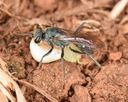
2Auplopus architectus is a small to medium-sized spider wasp in the Pompilidae. Females construct distinctive barrel-shaped mud nests, often inside pre-existing cavities such as rock crevices, wood holes, or abandoned nests of other . The hunts spiders, amputates their legs to facilitate transport, and provisions each mud with multiple paralyzed victims before laying a single . occur in disjunct regions of North America including California, the northeastern United States, and Arkansas.
Pronunciation
How to pronounce Auplopus architectus: /ˈɔː.ploʊ.pəs ɑːrˈkɪ.tɛk.təs/
These audio files are automatically generated. While they are not always 100% accurate, they are a good starting point.
Identification
Distinguished from other spider wasps by its mud-nesting rather than burrowing. The barrel-shaped mud , approximately 15 mm long and 7-10 mm wide, are characteristic. May be confused with mason bees (Osmia) or mason wasps (Eumeninae) that construct similar mud nests; examination of nest contents or is required for definitive identification. Females of several Auplopus are externally similar; male genitalia examination may be necessary for species-level identification.
Images
Appearance
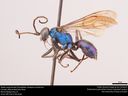
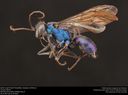
Small to medium-sized . Females reach approximately 1.5 inches in length. is iridescent, particularly pronounced in the A. a. metallicus. is black. Wings are typically amber in color. Females possess an oval pygidial plate on the near the tip, used to manipulate mud during nest construction. Males average about 10 millimeters in length and can be distinguished from females by genitalia differences; females of different are often externally inseparable.
Habitat
Primarily wooded areas. Nests in rock crevices in natural settings. Frequently associated with human structures, nesting in cracks of old buildings, holes in wood, and cavities such as the back of pipes. Often builds inside abandoned nests of Sceliphron caementarium, Trypoxylon politum, or Polistes paper wasps.
Distribution
Disjunct in California, the northeastern United States, and Arkansas.
Seasonality
Active from May to October, with peak abundance from July through September.
Diet
feed on honeydew from colonies, particularly on honeyvine milkweed (Ampelamus albidus, Cynanchum leave), sunflower, and other plants. Larvae are provisioned with paralyzed spiders from at least thirteen including Thomisidae, Salticidae, Clubionidae, Corinnidae, Anyphaenidae, Miturgidae, Gnaphosidae, and Pisauridae.
Life Cycle
Female constructs barrel-shaped mud , provisions it with multiple paralyzed spiders (often amputating legs to facilitate transport), lays a single on the final victim, and seals the cell. Larva hatches, feeds on fresh paralyzed prey, to pupa, and emerges as . In at least some , emerging adults regurgitate liquid to soften the mud cap before chewing an exit hole. Some individuals may overwinter as pupae.
Behavior
Females exhibit nervous, energetic and are constantly active in prey search. When inside buildings, individuals are attracted to sunlit windows. Solitary and non-aggressive; females do not defend nests and will flee rather than attack. Males do not participate in nest construction or provisioning.
Ecological Role
of spiders, potentially influencing local arachnid . Serves as for (specific not well documented). Contributes to nutrient cycling through prey consumption and nest decomposition.
Human Relevance
Generally beneficial due to spider . Occasionally enters buildings where nests may be constructed in structural cavities. Non-aggressive; stings only if handled. Mud nests may be considered unsightly on buildings but cause no structural damage. Nests can be collected for scientific study of - relationships.
Similar Taxa
- Auplopus carbonariusIntroduced Palearctic with overlapping distribution in eastern North America; externally similar females require genitalia examination for separation
- Phanagenia bombycinaLarger in tribe Auplopini with similar mud-nesting ; found east of the Rocky Mountains
- Osmia (mason bees)Construct similar mud nests but are bees ( Megachilidae) rather ; nest contents and differ
- Eumenes (potter wasps)Vespid that construct mud urns but with different shape (fluted neck) and provision with caterpillars rather than spiders
- Trypoxylon politumCrabronid that constructs linear mud tube nests; Auplopus architectus frequently nests inside abandoned Trypoxylon nests
More Details
Nesting substrate flexibility
Demonstrates remarkable opportunism in nest site selection, utilizing pre-existing cavities ranging from natural rock crevices to anthropogenic structures including bolt holes, pipe interiors, and window frames.
Prey handling
Documented to amputate several or all legs of spider prey, which serves dual purposes: accessing for feeding and reducing prey bulk for transport to nest.