
Auplopus carbonarius
(Scopoli, 1763)
potter spider wasp, yellow-faced spider wasp
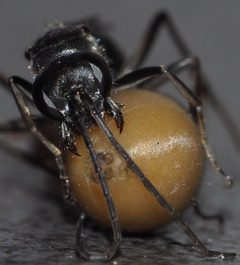
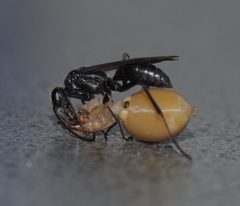
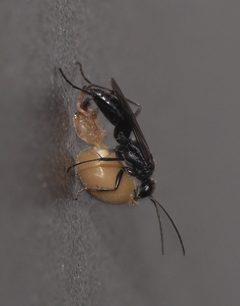
Auplopus carbonarius is a small spider wasp native to Europe that has been introduced to North America. Females construct distinctive barrel-shaped mud inside pre-existing cavities, stocking each with a paralyzed spider as food for their larva. The is notable for its complex nesting among Pompilidae, including leg amputation of prey to facilitate transport. are approximately 10 mm in length, with males distinguished by ivory-colored maculae beside the .
Pronunciation
How to pronounce Auplopus carbonarius: //ˈaʊpləpəs ˌkɑrbəˈnɛəriəs//
These audio files are automatically generated. While they are not always 100% accurate, they are a good starting point.
Identification
Distinguished from other British Pompilidae by construction of barrel-shaped mud . Males identified by ivory maculae beside . Females may be distinguished from other Auplopus by genitalia differences in males; females of several Auplopus species are externally inseparable. Nests of small barrel-shaped mud cells (approximately 15 mm long, 7-10 mm wide) arranged in rows within cavities are diagnostic.
Images
Appearance
Small approximately 10 mm in length (males 8 mm). Body predominantly dark. Males distinguished by ivory-colored maculae (pale markings) alongside the . Females possess an oval pygidial plate on the near the tip, used as a masonry trowel for manipulating mud pellets during nest construction.
Habitat
Woodland, particularly areas with water courses and marshy zones that provide wet mud and clay for nest construction. Nests are built in pre-existing cavities including beneath stones, in masonry, tree stumps (often old burrows), under bark, in tree trunk crevices, in empty cynipid galls, and in abandoned burrows of other including other hymenopteran nests.
Distribution
Native to western Europe; introduced to eastern North America with documented records in New York and Michigan. In Europe: south eastern England, central Europe, Scandinavia, Belgium. Native range includes eastern United States and eastern Canada in introduced .
Seasonality
period June to August in Great Britain. active May to October in North America, most abundant July through September.
Diet
feed on honeydew from colonies, particularly on honeyvine milkweed (Ampelamus albidus), sunflower, and other plants. Larvae feed on paralyzed spiders provisioned by females.
Host Associations
- Clubionidae - preymost frequent prey
- Gnaphosidae - preyrecorded prey
- Salticidae - preyrecorded prey
- Agelenidae - preyrecorded prey
- Thomisidae - preyrecorded prey
- Lycosidae - preyrecorded prey
- Segestriidae - preyrecorded prey
- Anyphaenidae - preyrecorded prey
- Ampelamus albidus - food sourcehoneydew from colonies
- Helianthus - food sourcehoneydew from colonies
Life Cycle
Females construct barrel-shaped mud (approximately 15 mm long, 7-10 mm wide) from small pellets of mud obtained from damp soil, carried to nest site with water collected separately. Cells are laid sideways, often stacked end-to-end in rows of two to five within pre-existing cavities. Each cell is stocked with one paralyzed spider; multiple spiders may be placed in each cell before -laying. Female lays single egg on last victim, then seals cell. Larva hatches, feeds on paralyzed spider(s), pupates within cell. Emerging regurgitates liquid to soften mud cap, then chews exit hole to escape.
Behavior
Females amputate several or all legs of spider prey to facilitate transport over ground and to feed on spider blood. Prey transport occurs more often by crawling than by . Females demonstrate behavioral versatility in nest site selection, using diverse pre-existing cavities. Solitary; not aggressive. occasionally visit flowers such as spurge.
Ecological Role
of spiders, particularly non-web-building . Contributes to spider . Provides potential for (host- relationships poorly documented). Mud nest construction may contribute to soil nutrient redistribution in microhabitats.
Human Relevance
Not medically significant; stings occur only if female is grabbed directly. Nests occasionally found in human structures (masonry, under bridges, in abandoned bolt holes). Considered beneficial due to spider . Introduced to North America, potentially expanding range.
Similar Taxa
- Eumenes spp. (potter wasps)Construct mud urns, but in Vespidae; stock with caterpillars rather than spiders; complete urn before hunting
- Sceliphron caementarium (black and yellow mud dauber)Builds mud nests, but in Sphecidae; constructs larger, clod-like clusters covered in mud layers; often re-used by Auplopus
- Trypoxylon politum (pipe organ mud dauber)Builds adjacent mud tubes in linear series, not barrel ; often re-used by Auplopus for nest sites; male defends nest
- Other Auplopus speciesFemales externally inseparable; males distinguished by genitalia; several North American are bright metallic blue-green
- Osmia mason beesConstruct similar mud nests; distinguished by different nest architecture and Hymenoptera (Megachilidae)
- Eumeninae mason waspsSome construct similar mud ; distinguished by (Vespidae) and prey type (caterpillars)
More Details
Introduction to North America
Introduced from western Europe; first documented in New York and Michigan, likely with wider distribution than currently recorded
Nesting plasticity
Shows exceptional behavioral versatility in nest site selection compared to most other spider wasps, using diverse pre-existing cavities
Prey handling
Leg amputation serves dual purpose: facilitates ground transport of prey and allows female to feed on spider