
Messatoporus
Cushman, 1929
Species Guides
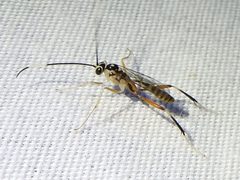
3Messatoporus is a large New World of ichneumonid wasps in the Cryptinae, comprising 89 valid . The genus is monophyletic and distinguished by a unique combination of morphological synapomorphies including specialized structure and propodeal features. Species exhibit a morphological gradient from forms resembling other Osprynchotina to a highly derived with convergent traits similar to Gabuniina, interpreted as adaptations for locating and accessing deeply concealed .


Pronunciation
How to pronounce Messatoporus: //ˌmɛsəˈtɒpɔːrəs//
These audio files are automatically generated. While they are not always 100% accurate, they are a good starting point.
Identification
Distinguished from other Cryptinae by the combination of clypeal projections, long tapered with reduced tooth, and the unique ovipositor structure where the ventral valve completely encloses the valve. The propodeal features (concave margin, transverse wrinkles posteriorly, long shallow basal ) provide additional diagnostic characters. -level identification requires examination of multiple morphological characters and is facilitated by the provided dichotomous keys.
Images
Habitat
Found in secondary Atlantic Forest and presumably other Neotropical forest . Specific microhabitat associations include trap nests colonized by spider wasps.
Distribution
New World distribution, with records from North America (Vermont, USA) and throughout the Neotropics. Documented from Brazil (Rio Grande do Sul, Espírito Santo) with extensive across the region.
Host Associations
- Auplopus subaurarius Dreisbach, 1963 - is a pompilid spider wasp. Multiple Messatoporus (M. bisignatus, M. elektor, M. opacus) reared from trap nests colonized by this host.
Life Cycle
Develops as within nests of spider wasps. Reared from trap nests indicating larval development inside host .
Behavior
Exhibits vibrational sounding for location and substrate perforation to access concealed hosts. The derived shows adaptations interpreted as specializations for locating and exploiting more deeply concealed hosts.
Ecological Role
of spider wasps (Pompilidae), specifically kleptoparasitic or parasitic on nest-provisioning . Acts as a secondary consumer in and may influence of spider-hunting wasps.
Similar Taxa
- Other Osprynchotina generaMessatoporus is distinguished by its unique combination of clypeal, mandibular, propodeal, and ovipositor characters; less derived resemble other Osprynchotina but lack the complete ovipositor structure.
- GabuniinaDerived Messatoporus show convergent morphological similarities to Gabuniina in adaptations for location and substrate perforation, but differ in tribal-level characters and detailed .
More Details
Phylogenetic significance
The demonstrates a distinct morphological transition from plesiomorphic states resembling other Osprynchotina to an apomorphic state with multiple convergences to Gabuniina. This transition is interpreted as an evolutionary response to exploiting more deeply concealed , with associated changes in host location and substrate perforation capabilities.
Taxonomic history
Originally described by Cushman in 1929, the underwent major revision in 2013 recognizing 89 valid (65 new). Two synonymies were proposed: M. jocosus and M. rufiventris under M. discoidalis; M. tricolor under M. variegatus. Messatoporus nigrispina was transferred to Prosthoporus.
Sources and further reading
- BugGuide
- GBIF taxonomy match
- iNaturalist taxon
- NCBI Taxonomy
- Catalogue of Life
- New Species, Host Record, and Male Discovery for Three Messatoporus Cushman (Hymenoptera, Ichneumonidae, Cryptinae) from Brazil
- Phylogeny and revision of Messatoporus Cushman (Hymenoptera, Ichneumonidae, Cryptinae), with descriptions of sixty five new species