
Auplopus mollis
Townes, 1957
Auplopus mollis is a small spider wasp in the Pompilidae, tribe Auplopini. Females construct distinctive free-standing mud , typically barrel-shaped and approximately 15 mm long by 7–10 mm wide, often stacked end-to-end in rows of two to five. The hunts non-web-building spiders, amputates their legs to facilitate transport, and provisions each mud cell with multiple paralyzed spiders before laying a single . feed on honeydew rather than visiting flowers.
Pronunciation
How to pronounce Auplopus mollis: /ˈɔːpləˌpʊs ˈmɒlɪs/
These audio files are automatically generated. While they are not always 100% accurate, they are a good starting point.
Identification
Distinguished from other mud-nesting by the small, barrel-shaped mud constructed in pre-existing cavities rather than as free-standing exposed structures. Cells are smaller and more delicate than those of Sceliphron caementarium (black and yellow mud dauber) and lack the fluted urn shape of Eumenes potter wasps. Differs from Trypoxylon politum (pipe organ mud dauber) in cell arrangement: Auplopus cells are stacked barrels rather than linear partitioned tubes. May be confused with Osmia mason bees or Eumeninae mason wasps that construct similar mud nests; examination of the wasp or nest contents (spider prey versus pollen/nectar provisions) confirms identity.
Images
Appearance
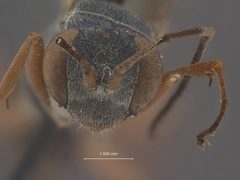
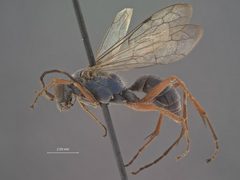
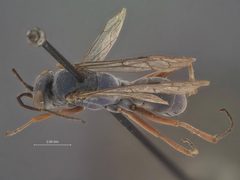
Small averaging approximately 10 mm in length. Females possess a characteristic oval pygidial plate on the surface of the near the tip, used as a masonry trowel to manipulate mud pellets during nest construction. Several Auplopus exhibit bright metallic blue-green coloration; females of these species are externally indistinguishable without examination of male genitalia for definitive identification.
Habitat
Constructs nests in sheltered pre-existing cavities including holes in wood, crevices in rock walls, spaces under bark on standing trees, and abandoned nests of other . Nests are not built in exposed locations but require protection from direct weather. often found in proximity to colonies on honeyvine milkweed, sunflower, and other plants.
Distribution
North America; occurs across the continent with records from Arizona and other western states. The Auplopus is widespread continentally, though -level distributions require further revision.
Seasonality
Active from May through October, with peak abundance from July through September.
Diet
feed on honeydew, the sugary liquid waste secreted by aphids. Larvae are provisioned with paralyzed spiders from including Thomisidae (crab spiders), Salticidae (jumping spiders), Clubionidae (sac spiders), Corinnidae (ground sac spiders), Anyphaenidae (ghost spiders), Miturgidae (longlegged sac spiders), Gnaphosidae (ground spiders), and Pisauridae (nursery web spiders). Both adult and spiders may be taken as prey.
Life Cycle
Female constructs mud , provisions it with multiple paralyzed spiders (often with legs amputated), lays single on final spider victim, and seals cell with mud cap. Larva hatches and consumes fresh paralyzed prey. Upon maturity, larva into pupa within cocoon; in at least some , emerging regurgitates liquid to soften mud cap before chewing exit hole. Development may complete in several weeks or pupa may overwinter for extended period.
Behavior
Solitary nesting ; each female constructs and provisions her own nest without cooperation. Females exhibit specialized mud-manipulation behavior, curling beneath body to apply pygidial plate to mud pellets. Prey transport involves amputating spider legs, which reduces prey size and allows the to feed on spider . demonstrate opportunistic hunting of non-web-building spiders and frequent colonies for honeydew feeding.
Ecological Role
of spiders, potentially influencing local spider . Contributor to nutrient cycling through prey subduing and larval consumption. serve as consumers of honeydew, though ecological significance of this feeding mode is unquantified. Nests in abandoned may contribute to structure of cavity-nesting Hymenoptera.
Human Relevance
Non-aggressive; solitary do not defend nests and stings are rare unless wasp is directly handled. Nests may be encountered in human structures including abandoned bolt holes, rock walls, and eaves. No significant pest status; occasional nuisance if nests discovered in high-visibility locations. Potential educational and scientific value for studying - relationships through nest rearing.
Similar Taxa
- Sceliphron caementariumAlso constructs mud nests, but builds larger, clod-like multi-cellular structures covered in additional mud layers rather than discrete small barrels.
- Trypoxylon politumBuilds linear partitioned mud tubes rather than stacked barrel ; often constructs exposed nests on flat surfaces.
- Eumenes spp.Potter wasps construct exposed urn-shaped mud pots with fluted necks, not barrel in cavities; provision nests with caterpillars rather than spiders.
- Osmia spp.Mason bees construct similar mud but provision with pollen and nectar rather than spiders; are bees not .
More Details
Taxonomic Status
The Auplopus is in need of revision; ten are recognized in North America but species boundaries, particularly among metallic blue-green forms with externally identical females, remain poorly resolved.
Introduced Species
A. carbonarius, introduced from western Europe, has been documented in New York and Michigan and likely has a broader U.S. distribution than currently recorded.
Nest Associates
Auplopus mollis and frequently construct nests inside abandoned nests of Sceliphron caementarium, Trypoxylon politum, and Polistes paper wasps.