
Auplopus mellipes
(Say, 1836)
Red-legged Spider Wasp
Species Guides
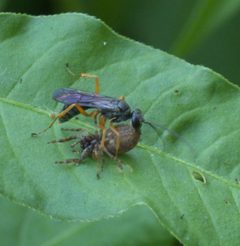
2Auplopus mellipes is a small spider wasp in the Pompilidae, tribe Auplopini. Females construct distinctive barrel-shaped mud to house their paralyzed spider prey and developing larvae. The has a widespread distribution across North America and is most active during summer months. Unlike many spider wasps that dig burrows, Auplopus species are unique among Pompilidae for their free-standing mud nest construction.
Pronunciation
How to pronounce Auplopus mellipes: /ˈɔː.plɒ.pəs ˈmɛl.ɪ.piːz/
These audio files are automatically generated. While they are not always 100% accurate, they are a good starting point.
Identification
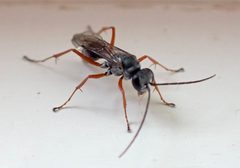
Identified by the combination of small size (~10 mm), metallic blue-green coloration in many individuals, and association with barrel-shaped mud nests. The pygidial plate on the female is diagnostic for the . Separation from other Auplopus requires examination of male genitalia; females of different species are often inseparable externally. Nests are distinguished from similar mud structures by their small barrel shape (approximately 15 mm long, 7-10 mm wide) and placement inside pre-existing cavities or sheltered .
Images
Appearance
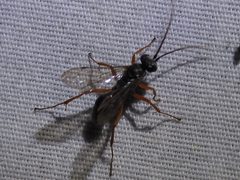
Small averaging approximately 10 millimeters in length. Some exhibit bright metallic blue-green coloration. Females possess a distinctive oval pygidial plate on the surface of the near the tip, used as a masonry trowel for manipulating mud during nest construction. Males can be distinguished from females by differences in genitalia, though external separation of females across similar is difficult.
Habitat
Constructs nests in sheltered locations including pre-existing cavities in wood, under bark on standing trees, crevices in rock walls, and inside abandoned nests of other such as Sceliphron caementarium, Trypoxylon politum, and Polistes paper wasps. found around colonies on honeyvine milkweed, sunflower, and other plants where honeydew is available.
Distribution
Widespread across North America; specifically documented from Vermont and other parts of the United States. The Auplopus occurs across the entire continent.
Seasonality
Active from May to October, with peak abundance from July through September.
Diet
Host Associations
- Aphids - food source feed on honeydew secreted by aphids on plants including honeyvine milkweed (Ampelamus albidus) and sunflower
- Spiders - prey for larvaeDocumented prey includes spiders from at least 13 : Thomisidae (crab spiders), Salticidae (jumping spiders), Clubionidae (sac spiders), Corinnidae (ground sac spiders), Anyphaenidae (ghost spiders), Miturgidae (longlegged sac spiders), Gnaphosidae (ground spiders), and Pisauridae (nursery web spiders). amputate several or all legs of prey to facilitate transport and feed on spider blood.
Life Cycle
Female constructs barrel-shaped mud , provisions it with one or more paralyzed spiders, lays a single on the last victim, and seals the cell. Larva hatches and feeds on the fresh, paralyzed prey. Upon maturation, larva into pupa within a cocoon inside the cell. Emerging regurgitates liquid to soften the mud cap, then chews through to exit. Development may be completed in a few weeks, or the pupa may overwinter for a longer period.
Behavior
Solitary nesting . Female constructs mud using the pygidial plate to manipulate mud pellets, curling her beneath her body during construction. Hunts spiders opportunistically, amputating legs to facilitate transport and to feed on spider blood. visit colonies for honeydew rather than flowers. Not aggressive; females will not sting unless physically restrained.
Ecological Role
of spiders, potentially influencing local spider . Provides prey for nest . Mud nest construction may contribute to nutrient cycling and soil structure in microhabitats.
Human Relevance
Generally beneficial due to spider . Occasionally enters human dwellings, particularly older structures with suitable nesting cavities, but poses minimal risk due to non-aggressive nature. Mud nests may be considered unsightly by some homeowners but are harmless and temporary. Rearing of nests has been suggested as a citizen science opportunity to document - relationships.
Similar Taxa
- Eumenes (potter wasps)Also construct mud nests, but build urn-shaped pots with fluted necks rather than barrel-shaped ; provision nests with caterpillars rather than spiders; Vespidae rather than Pompilidae
- Sceliphron caementarium (Black and Yellow Mud Dauber)Builds mud nests but constructs clod-like multi- structures covered in additional mud layers rather than discrete barrel cells; Sphecidae; larger size
- Trypoxylon politum (Pipe Organ Mud Dauber)Constructs linear mud tubes with internal partitions rather than barrel-shaped ; often nests in exposed locations on flat surfaces; Crabronidae; males defend nests
- Osmia (mason bees)Some construct similar small mud nests; distinguished by being bees ( Megachilidae) with different and larval diet (pollen/nectar rather than spiders)
- Phanagenia bombycinaAlso in tribe Auplopini and constructs similar mud barrel nests; slightly larger; found east of the Rocky Mountains; often builds inside old Trypoxylon nests
More Details
Subspecies
Two recognized: Auplopus mellipes mellipes (Say, 1836) and Auplopus mellipes variitarsatus (Dalla Torre, 1897)
Taxonomic Status
The Auplopus is in need of revision; boundaries and identification criteria remain problematic, particularly for females
Nest Architecture
Nests typically contain 2-5 barrel-shaped stacked end-to-end in linear rows. Cells measure approximately 15 mm in length and 7-10 mm in width. Construction inside pre-existing cavities or other nests provides protection and structural support for the delicate mud cells.