Auplopus adjunctus
(Banks, 1911)
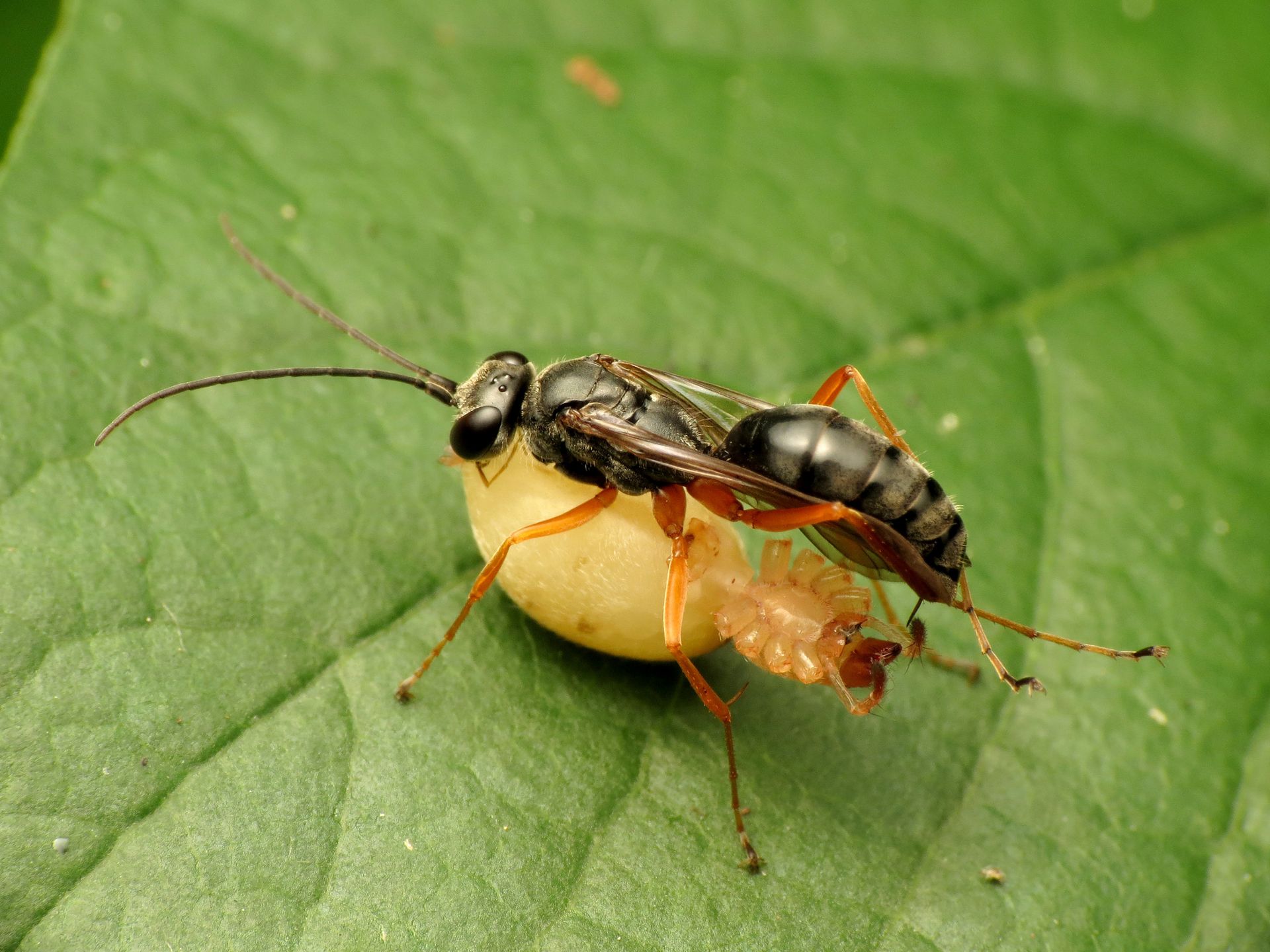
Auplopus adjunctus is a small spider wasp in the Pompilidae, tribe Auplopini. Like other members of its , females construct distinctive barrel-shaped mud to house their offspring, provisioning each cell with paralyzed spiders as food. The is one of approximately ten recognized Auplopus species in North America, though the genus is taxonomically challenging and in need of revision. are most commonly encountered from May through October, with peak abundance in July through September.
Pronunciation
How to pronounce Auplopus adjunctus: /ɔːˈpləʊpəs ædˈʒʌŋktəs/
These audio files are automatically generated. While they are not always 100% accurate, they are a good starting point.
Identification
Small averaging about 10 mm in length. Females possess a distinctive oval pygidial plate on the surface of the near the tip, used as a masonry trowel to manipulate mud during nest construction. Males can be distinguished by genitalia differences. Several Auplopus exhibit bright metallic blue-green coloration; females of these species are externally inseparable, requiring male genitalia examination for definitive identification to species.
Images
Habitat
Nests are constructed in sheltered microhabitats including pre-existing cavities in wood, spaces under bark on standing trees, rock wall crevices, and abandoned nests of other such as Sceliphron caementarium, Trypoxylon politum, and Polistes paper wasps. Barrel-shaped mud are approximately 15 mm long and 7–10 mm wide, often stacked end-to-end in rows of two to five.
Distribution
North America; specific range details for A. adjunctus are not well-documented in available sources, though the Auplopus occurs across the entire continent.
Seasonality
active from May to October, with peak abundance from July through September.
Diet
feed on honeydew from colonies, particularly on honeyvine milkweed (Ampelamus albidus, Cynanchum laeve), sunflower, and other plants. Larvae are provisioned with paralyzed spiders.
Host Associations
- Thomisidae - preycrab spiders
- Salticidae - preyjumping spiders
- Clubionidae - preysac spiders
- Corinnidae - preyground sac spiders (Trachelas sp.)
- Anyphaenidae - preyghost spiders
- Miturgidae - preylonglegged sac spiders (Cheiracanthium sp.)
- Gnaphosidae - preyground spiders
- Pisauridae - preynursery web spiders
- Sceliphron caementarium - nest siteoften builds mud inside abandoned nests
- Trypoxylon politum - nest siteoften builds mud inside abandoned nests
- Polistes - nest siteoften builds mud inside abandoned paper wasp nests
Life Cycle
Female constructs mud , provisions it with one or more paralyzed spiders (often with legs amputated to facilitate transport), lays a single on the final spider victim, and seals the cell. Larva hatches and consumes the paralyzed prey, then pupates within the cell. In at least one congeneric , the emerging regurgitates liquid to soften the mud cap before chewing an exit hole. Some individuals may overwinter as pupae.
Behavior
Females are solitary nest builders. They amputate several or all legs of spider prey, which facilitates ground transport and allows the to feed on spider blood. are not aggressive and rarely sting unless handled. Seldom visit flowers.
Ecological Role
of spiders, contributing to . As a solitary , provides limited pollination services through incidental contact. Serves as for various , though specific relationships remain poorly documented.
Human Relevance
Not medically significant; stings are possible but uncommon and not considered dangerous. Mud nests may be encountered on structures and sometimes mistaken for signs of more aggressive social . Nests can be reared by citizen scientists to document - relationships.
Similar Taxa
- EumenesPotter wasps construct urn-shaped mud nests with fluted necks, provisioned with caterpillars rather than spiders; nests are typically more exposed and vase-like rather than barrel-shaped.
- Trypoxylon politumPipe organ mud dauber constructs linear mud tubes with internal partitions, often with male-female cooperative nest defense; nests are tubular rather than barrel-shaped.
- Sceliphron caementariumBlack and yellow mud dauber builds larger, clod-like multi- nests covered with additional mud layers; much larger with different coloration.
- OsmiaSome mason bees construct similar mud nests; bees are vegetarians provisioning nests with pollen/nectar rather than spiders, and have different .
More Details
Taxonomic Uncertainty
The Auplopus is in need of taxonomic revision. Ten are currently recognized in North America, but identification is challenging, particularly for females of metallic species which are externally inseparable.
Nest Construction Detail
The pygidial plate is used like a masonry trowel, with the female curling her beneath her body so the plate contacts mud pellets during nest construction.