
Verrucosa arenata
(Walckenaer, 1841)
Arrowhead Orbweaver, Arrowhead Spider, Triangle Orb Weaver
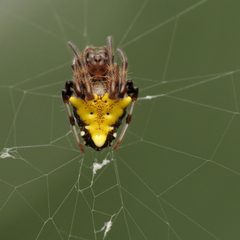
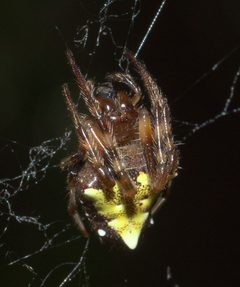
Verrucosa arenata is a large orb-weaver spider notable for its triangular, arrowhead-shaped and distinctive upward-facing posture in its web—unusual among orb-weavers. Females display white or yellow triangular markings on the abdomen, while males are smaller and lack this pattern. The exhibits color with documented trade-offs between camouflage and prey attraction. Its webs feature a unique architecture lacking radial threads, with tougher, stretchier silk enabling specialized "reeling" prey capture .
Pronunciation
How to pronounce Verrucosa arenata: /vɛrˈruːkoʊsə ˌɛəˈneɪtə/
These audio files are automatically generated. While they are not always 100% accurate, they are a good starting point.
Identification
Distinguished from other orb-weavers by triangular (not rounded) shape and upward-facing web posture. Females identified by complete white or yellow triangle on abdomen; males lack this and are rarely seen except during mating. Color morphs (white vs. yellow) occur in both sexes but are most visible in females. Similar in Verrucosa occur in South America but not sympatrically in North America. Web architecture diagnostic: lacks radial threads, has elongated hub, and is down-biased asymmetric with spider at center facing upward.
Images
Habitat
Found in urban and rural environments with trees and bushes for web construction. Occupies plantations, urban parks, gardens, yards, and woodlands. Prefers understory positions in open, humid areas with potential direct sunlight exposure. Web placement in vegetation understory, typically at heights accessible to flying insects.
Distribution
Widespread across North America from USA through Central America to Panama; also recorded in Greater Antilles and parts of South America (Brazil: RN, RS, SP). Present throughout Caribbean, Middle America, and North America.
Seasonality
Active late summer and early fall. Webs typically become non-functional by midday due to insect damage. activity pattern with retreat use at night.
Diet
Specializes in tiny flying insects, particularly Diptera and Hymenoptera. Mosquitoes constitute significant prey due to web architecture with close spiral spacing. Prey subdued with venomous bite, then liquified internally before ingestion.
Life Cycle
with males seeking females in webs for mating. Females larger than males. production details not documented in sources. Juveniles construct webs and exhibit -like foraging .
Behavior
. Constructs orb webs with unique architecture: elliptical shape, elongated hub, no radial threads, down-biased asymmetry. Sits facing upward at web center—one of few large orb-weavers with this posture. Uses "reeling" prey capture: runs toward prey, stops, pulls downward while reeling in radial thread. Plucks web with forelegs to locate prey, then shakes body ('bouncing') before reeling. Approaches heavier prey more slowly. Frequently takes down and remakes webs due to damage from rainfall and reeling stress. Actively thermoregulates to maintain body temperature below ambient levels.
Ecological Role
of small flying insects, potentially contributing to mosquito control. Color creates frequency-dependent selection dynamics: white morphs and better camouflaged, yellow morphs more successful at prey attraction but potentially more vulnerable to predators. Prey capture enhanced by specialized web architecture and reeling .
Human Relevance
Occasionally considered a pest on ornamental ninebark plantings but rarely causes significant defoliation. Valued by naturalists as component of native biodiversity. Subject of behavioral and ecological research due to unusual web posture, color , and prey capture mechanics.
Similar Taxa
- Other Araneidae orb-weaversMost have bulbous and downward in webs; V. arenata has triangular abdomen and upward posture
- Other Verrucosa speciesSouth American not sympatric in North America; identification requires geographic and morphological comparison
More Details
Etymology
name Verrucosa derives from Latin 'verrucosus' meaning 'warty', referring to small wart-like abdominal . Specific epithet arenata from Latin 'arena' meaning 'sand'.
Color polymorphism trade-offs
White morphs more abundant during breeding season with better body condition; yellow morphs attract more prey but may incur higher risk. UV reflectance differs between morphs with potential consequences for and prey visual detection.
Thermal biology
White morphs have higher overall reflectance, providing thermal advantage in exposed by reducing absorption of short-wave and visible radiation. No difference in surface temperature between morphs suggests behavioral or physiological rather than pigmentation-based mechanisms.