
Verrucosa
McCook, 1888
Species Guides
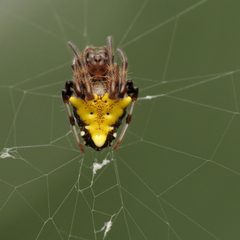
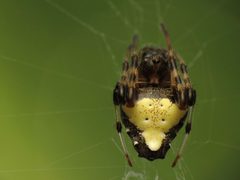
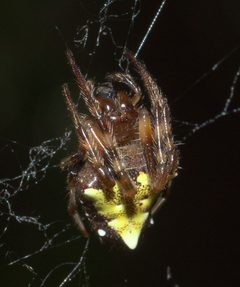
1- Verrucosa arenata(Arrowhead Orbweaver)
Verrucosa is a of New World orb-weaver spiders ( Araneidae) first described by Henry McCook in 1888. The genus contains approximately forty-five described , with the vast majority distributed in South America. A single species, Verrucosa arenata (the arrowhead spider), occurs in the United States, ranging from the eastern USA through Panama and into the Greater Antilles. The genus exhibits a predominantly Neotropical distribution pattern.
Pronunciation
How to pronounce Verrucosa: /vɛˈru.ko.sa/
These audio files are automatically generated. While they are not always 100% accurate, they are a good starting point.
Identification
Members of Verrucosa can be distinguished from other Araneidae by their characteristic abdominal . The type Verrucosa arenata is commonly known as the arrowhead spider due to the distinctive triangular or arrowhead-shaped with variable color patterns. Species-level identification within the genus often requires examination of genitalic structures and consideration of geographic distribution.
Images
Habitat
Most inhabit tropical and subtropical forest environments in South America. The North American representative V. arenata occupies wooded areas, forest edges, and shrublands where it constructs orb webs.
Distribution
Primarily South America, with highest diversity in Brazil, Colombia, Ecuador, and Peru. The extends northward through Central America and the Caribbean, with V. arenata reaching the eastern United States. One formerly placed in Verrucosa from Queensland, Australia (V. furcifera) has been reassigned to Carepalxis.
Behavior
As orb-weaver spiders, members of this construct spiral wheel-shaped webs to capture flying insect prey. V. arenata is known to rest -down in the center of its web, a typical araneid .
Ecological Role
of flying insects; their webs contribute to insect in forest and woodland .
Human Relevance
V. arenata (arrowhead spider) is occasionally encountered by humans in eastern North American woodlands but poses no medical significance. The has no documented economic importance.
Similar Taxa
- AraneusBoth are orb-weaver in Araneidae; Araneus typically have more rounded and different color patterns than the triangular abdomen of V. arenata
- NeosconaAnother common orb-weaver with which V. arenata may be confused; Neoscona lack the distinctive arrowhead-shaped and have different arrangement patterns
Sources and further reading
- BugGuide
- Wikipedia
- iNaturalist taxon
- NCBI Taxonomy
- Catalogue of Life
- From science to literature: New arachnid taxa named after Gabriela Mistral and Pablo Neruda | Blog
- Beetle botanists | Beetles In The Bush
- Uncategorized | Blog - Part 32
- Uncategorized | Blog - Part 51
- LYMPHOSTATIC VERRUCOSA
- Monitoring and conservation of the rare orchid Didimoplexis verrucosa in the face of change
- Evaluation of the Seasonal Movement of the Pistolgrip Mussel (Tritogonia Verrucosa)
- Long-standing, multifocal Tuberculosis verrucosa cutis: Undiagnosed for 40 years.