
Xysticus
C. L. Koch, 1835
Ground Crab Spiders
Species Guides
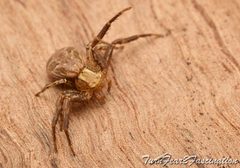
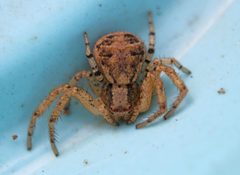
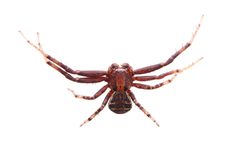
39Xysticus is a large of approximately 275–300 of ground crab spiders in the Thomisidae. These spiders are ambush that do not build webs, instead hunting near the ground by seizing prey with their enlarged legs. The genus exhibits strong , with females typically reaching 10 mm in body length while males are roughly half that size. Species identification requires microscopic examination of genitalia due to the morphological similarity among members of the genus.
Pronunciation
How to pronounce Xysticus: //ˈzɪstɪkəs//
These audio files are automatically generated. While they are not always 100% accurate, they are a good starting point.
Identification
Xysticus are distinguished from other crab spiders by their shorter, sturdier legs compared to flower-dwelling like Misumena. The body is typically brown, beige, or gray with cryptic coloration that blends with soil surfaces. Many species display a broad pale longitudinal band on the prosoma and a flattened opisthosoma with a dark leaf marking. The tibiae and of legs I and II each bear more than three pairs of setae. Species-level identification relies heavily on examination of male and female genital structures.
Images
Habitat
Terrestrial near the ground surface, including soil, leaf litter, and low vegetation. Some occur on weeds or trees. One species, Xysticus ephippiatus, has been documented in tea plantations.
Distribution
distribution with records across North America, Europe, Asia, and Australia. Documented in Denmark, Norway, Sweden, the United States (including Vermont), Italy, Spain, the western Mediterranean region, and Australia.
Seasonality
and immatures overwinter in temperate regions, becoming active in early spring. Ballooning observed in spring and late fall, particularly by spiders. Some show winter activity of adults.
Diet
Active of arthropods. Xysticus ephippiatus preys specifically on Ectropis obliqua (tea caterpillar) larvae. Prey is seized with enlarged legs and killed by venomous bite.
Life Cycle
Females produce sacs guarded in silken retreats. Xysticus bimaculatus exhibits extended maternal care beyond hatching, with mothers providing food to offspring and juveniles showing prey-sharing . Clutch sizes in this are exceptionally small, potentially reflecting limits on maternal care capacity.
Behavior
Ambush hunters that do not build webs. Hunt by stationing in high-traffic areas and grabbing passing arthropods. Move slowly. Use herbivore-induced plant volatiles as indirect foraging cues—Xysticus ephippiatus adjusts patch residence time based on chemical emissions from prey-damaged tea leaves. Ballooning (aerial via silk threads) documented, particularly by immatures in spring and fall. Some show subsocial with extended maternal care.
Ecological Role
that contribute to control. Xysticus ephippiatus functions as a agent of tea pests in agroecosystems. Participates in tritrophic interactions involving plants, herbivores, and natural enemies.
Human Relevance
Some provide of agricultural pests. Xysticus ephippiatus has been studied for its potential in tea plantation pest management. Generally harmless to humans; not medically significant.
Similar Taxa
- CoriarachneBoth are dark brown or reddish-brown crab spiders found on weeds or trees, but Xysticus tends to have shorter, sturdier legs.
- ThomisusFlower crab spiders with longer legs and less patterned in most ; Xysticus species are more terrestrial with shorter legs.
- SynemaSome Xysticus have abdominal patterning resembling Synema, but differ in leg proportions and preference.
Sources and further reading
- BugGuide
- Wikipedia
- GBIF taxonomy match
- iNaturalist taxon
- NCBI Taxonomy
- Catalogue of Life
- Bug Eric: ArachNovember?
- Bug Eric: Spider wasp, Dipogon calipterus
- Bug Eric: Spider Sunday: Spring Spiders
- Bug Eric: One Night, One House, Seventeen Spider Species
- Bug Eric: Ballooning Spiders
- Europe | Blog
- Xysticus grallator Simon, 1932 new to mainland Italy (Araneae, Thomisidae)
- Effects of tea plant volatiles on foraging behavior of <I>Xysticus ephippiatus</I> Simon
- Extended maternal care and offspring interactions in the subsocial Australian crab spider, Xysticus bimaculatus
- Elevation to species level and redescription of Xysticus alpinus Kulczyński, 1887 stat. n. (Araneae, Thomisidae)