
Ectropis
Hübner, [1825]
Engrailed Moths
Species Guides
1- Ectropis crepuscularia(Small Engrailed)
Ectropis is a of geometer moths (Geometridae) comprising approximately 100 distributed primarily across paleotropical regions, Australia, and Asia. The genus includes several economically significant pests, notably E. obliqua and E. grisescens, which are known as tea loopers that damage tea production in China. These two species are morphologically similar but exhibit differences in geographical distribution, composition, and abundance. Only one species or (E. bistortata/E. crepuscularia, the Engrailed/Small Engrailed) occurs in Europe. The genus has a complex taxonomic history with several invalid junior synonyms and homonyms.
Pronunciation
How to pronounce Ectropis: /ˈɛk.trə.pɪs/
These audio files are automatically generated. While they are not always 100% accurate, they are a good starting point.
Identification
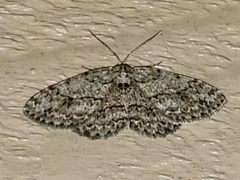
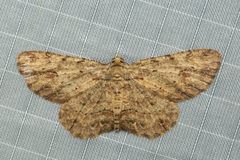
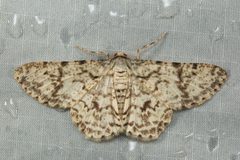
Identification of Ectropis often requires examination of male genitalia or molecular markers, particularly for the E. obliqua and E. grisescens which are morphologically similar. E. crepuscularia (Small Engrailed) is noted for extreme variability in color and pattern, making visual identification challenging. Antennal does not differ significantly between E. obliqua and E. grisescens, but distribution patterns differ. The two sibling species can be distinguished by composition: E. obliqua has (Z,Z)-3,9-cis-6,7-epoxy-nonadecadiene as an additional component not present in E. grisescens.
Images
Habitat
occur in diverse including tropical, subtropical, and temperate regions. E. obliqua and E. grisescens are specifically associated with tea gardens (Camellia sinensis plantations). E. crepuscularia occurs in wooded and open habitats east of the Great Plains in North America, extending to the Pacific Northwest and Alaska panhandle.
Distribution
Primarily paleotropical, extending through Australia and Asia. E. obliqua and E. grisescens occur in China with overlapping but distinct ranges; E. grisescens has a wider distribution across tea-producing areas. E. crepuscularia occurs in eastern North America west to the Great Plains, plus the Pacific Northwest and Alaska. Only E. bistortata/E. crepuscularia complex is present in Europe.
Seasonality
E. crepuscularia has a period generally from March to October, with two per year in most locations. E. obliqua and E. grisescens activity patterns in China correspond to tea growing seasons with multiple generations.
Diet
Larvae feed on deciduous trees and shrubs; E. crepuscularia larvae also feed on some conifers. E. obliqua and E. grisescens are feeders on Camellia sinensis (tea plant).
Host Associations
- Camellia sinensis - larval food planttea plant; primary for E. obliqua and E. grisescens
Life Cycle
Complete with , larva, pupa, and stages. E. crepuscularia has two per year. E. obliqua and E. grisescens have multiple generations annually. Pupae can overwinter; E. crepuscularia pupae may remain for extended periods.
Behavior
are and attracted to light. Mating involves communication; E. obliqua and E. grisescens males interfere with intraspecific mating of the other , causing asymmetric reproductive interference. Hybridization between these produces infertile offspring with desynchronized development due to disruption of and .
Ecological Role
Larvae function as herbivores on woody plants. E. obliqua and E. grisescens are major agricultural pests of tea production. Serve as for fungi (Metarhizium anisopliae) and bacterial biocontrol agents (Bacillus thuringiensis).
Human Relevance
E. obliqua and E. grisescens cause serious damage to tea production in China, requiring chemical control and development of strategies. E. crepuscularia is a common attracted to lights in North America. Research on Ectropis has contributed to understanding of reproductive isolation, olfaction, and detoxification mechanisms.
Similar Taxa
- HypomecisFormerly included now placed in Hypomecis; Boarmia (preoccupied synonym of Ectropis) now type of Boarmiini with Hypomecis
- Calcyopa, Myrioblephara, Parectropis formerly classified in Ectropis now placed in these
- BistonSimilar geometer moths in Boarmiini; may require genitalia examination for distinction
More Details
Taxonomic History
The has complicated nomenclatural history. Gistl's 1848 name Coenobita was preoccupied by hermit crabs (Latreille, 1829). Boarmia Stephens, 1829 was preoccupied and is now the type genus of tribe Boarmiini. All junior synonyms of Ectropis use G. crepuscularia as type , preventing current use of subgeneric names.
Reproductive Isolation Mechanisms
E. obliqua and E. grisescens maintain reproductive isolation through differences in composition and asymmetric reproductive interference, though hybridization can occur producing infertile offspring with developmental .
Research Significance
E. obliqua and E. grisescens serve as model systems for studying divergence, - interactions, carboxylesterase-mediated resistance, and olfaction mechanisms.
Sources and further reading
- BugGuide
- Wikipedia
- GBIF taxonomy match
- iNaturalist taxon
- NCBI Taxonomy
- Catalogue of Life
- Bug Eric: Blacklighting Already?
- Asymmetrical reproductive interference between two sibling species of tea looper: Ectropis grisescens and Ectropis obliqua
- Comparative expression profiles of carboxylesterase orthologous CXE14 in two closely related tea geometrid species, Ectropis obliqua Prout and Ectropis grisescens Warren
- Geographical Distribution ofEctropis grisescens(Lepidoptera: Geometridae) andEctropis obliquain China and Description of an Efficient Identification Method
- Transcriptomic Analysis Reveals Insect Hormone Biosynthesis Pathway Involved in Desynchronized Development Phenomenon in Hybridized Sibling Species of Tea Geometrids (Ectropis grisescens and Ectropis obliqua)
- Comparison of male antennal morphology and sensilla physiology for sex pheromone olfactory sensing between sibling moth species: Ectropis grisescens and Ectropis obliqua (Geometridae)
- Immune and Metabolic Responses in Ectropis grisescens Infected by Metarhizium anisopliae: Insights from Transcriptome and Metabolome Analyses.
- A Biofilm-State Bacillus thuringiensis Formulation Drives Midgut Structural Disruption and Transcriptomic Reprogramming in Ectropis grisescens.