
Coenobita
Latreille, 1829
land hermit crabs, terrestrial hermit crabs
Species Guides
1- Coenobita clypeatus(Caribbean Land Hermit Crab)
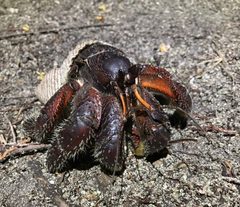
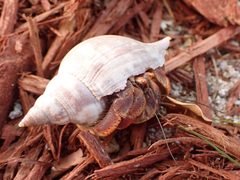
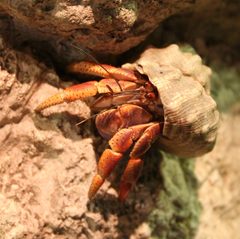
Coenobita is a of terrestrial hermit crabs comprising 21 distributed primarily in tropical and subtropical coastal regions. Unlike marine hermit crabs, these species have adapted to life on land while maintaining a critical dependence on the sea for and shell acquisition. They inhabit empty gastropod shells to protect their soft, asymmetrical and carry water within their shells to prevent desiccation. The genus is closely related to the coconut crab (Birgus latro), with both genera forming the Coenobitidae. Several species are popular in the pet trade.
Pronunciation
How to pronounce Coenobita: /ˌsiːnəˈbaɪtə/
These audio files are automatically generated. While they are not always 100% accurate, they are a good starting point.
Identification
Coenobita can be distinguished from marine hermit crabs by their terrestrial adaptations: a more compact body form, reduced gill structures modified for air breathing, and behavioral dependence on gastropod shells for water retention. Species-level identification requires examination of the shield length, coloration patterns, and major chela ; for example, C. purpureus exhibits distinctive light blue coloration. The is separated from the coconut crab (Birgus latro) by the latter's much larger size, calcified , and abandonment of shell-carrying in adulthood.
Images
Habitat
Coastal and insular environments in tropical and occasionally subtropical zones; specifically the supralittoral zone where access to seawater, gastropod shells, and wrack-fauna is available. In arid regions, coastal areas with elevated relative humidity are preferred. Site fidelity varies with resource availability: crabs remain in areas with abundant wrack-fauna and migrate from areas with scarce resources.
Distribution
Predominantly Indo-Pacific region. Single occur in West Africa (C. scaevola), along the Atlantic coast of the Americas (C. clypeatus), and on the Pacific coast of the Americas (C. compressus). C. purpureus, to Japan, has been recorded as far south as Taiwan.
Diet
Wrack-fauna (strand-cast marine organisms) at the coastline; decomposing plant material including leaves and flowers; animal carcasses. has been observed. Specific dietary composition varies by and .
Life Cycle
Fertilized are carried attached to the female's and must be released into marine environments for larval development; this obligate marine larval stage constrains the terrestrial lifestyle of . occurs year-round in some with seasonal peaks: C. rugosus shows highest ovigerous female percentages in April and September. Juveniles exhibit different activity patterns than adults.
Behavior
activity predominates in , though juveniles may be or nocturnal without clear relation to ecological factors. Shell exchange involves assessment of internal volume and aperture dimensions; crabs demonstrate dissatisfaction with suboptimal shells and preference for shells with favorable volume-to-weight ratios. Social interactions include stereotyped cheliped and leg movements upon approach, shell fighting with rotating movements by attackers, and chirping sounds produced by defenders. Active avoidance of Barber traps has been documented. Regular leg movement sequences and specialized leg facilitate terrestrial locomotion. Site fidelity is strong in favorable .
Ecological Role
Transports marine and terrestrial organisms due to its phylogenetically young terrestrial status and continued use of marine-derived shells. Functions as a scavenger consuming wrack-fauna and decomposing organic matter. Shell utilization patterns influence gastropod shell availability in coastal ; shell selection affects structure and resource partitioning.
Human Relevance
Several are maintained in the pet trade. C. rugosus and C. clypeatus are commonly kept in captivity, requiring artificial that replicate humidity, temperature, and access to appropriate gastropod shells. Research interest focuses on , terrestrial , and shell selection .
Similar Taxa
- Birgus latroThe coconut crab shares the Coenobitidae but is distinguished by abandonment of shell-carrying, calcified , and substantially larger maximum size.
- Marine hermit crabs (Paguridae)Marine hermit crabs occupy different , lack terrestrial adaptations for water retention, and do not exhibit the obligate dependence on coastal marine environments for seen in Coenobita.
Sources and further reading
- BugGuide
- Wikipedia
- iNaturalist taxon
- NCBI Taxonomy
- Catalogue of Life
- Additional Notes on the Ecology of Coenobita
- On the Ecology of Coenobita Clypeatus in Curaçao
- Zur Biologie und �kologie des Landeinsiedlerkrebses Coenobita scaevola Forsk�l am Roten Meer Biology and ecology of the terrestrial hermit crab coenobita scaevola forsk�l of the Red Sea
- SHELL UTILIZATION AND POPULATION ECOLOGY OF LAND HERMIT CRAB Coenobita rugosus AT CAPE PANWA, PHUKET PROVINCE
- Increasing Growth and Survival Rate of Land Hermit Crabs (Coenobita sp.) in Artificial Habitat through Feeding Habit
- Social Facilitation of Foraging Behavior by the Hermit Crab, Coenobita compressus, in Costa Rica
- Has the land hermit crab Coenobita purpureus settled in Taiwan?
- Matthesonema Eremitum N. Sp. (Nematoda, Rhabditida) Associated With Hermit Crabs (Coenobita) From the Philippines and Its Phylogenetic Implications
- Observations on the Social Behavior of the Land Hermit Crab, Coenobita Clypeatus (Herbst)
- Nomenclatural Problems Associated With the Genus Coenobita Latreille, 1829 (Decapoda, Anomura)