
Boarmiini
Boarmiini moths, Cleorini
Genus Guides
34- Aethalura
- Anavitrinella(Common Gray (for A. pampinaria))
- Chesiadodes
- Cleora
- Dasyfidonia
- Ectropis(Engrailed Moths)
- Ematurga
- Epimecis
- Eubarnesia
Boarmiini is a large tribe of geometer moths within the Ennominae , also commonly referred to as Cleorini. The tribe is taxonomically complex, with boundaries that have been variously defined—sometimes narrowly restricted to core , sometimes expanded to include related tribes such as Bistonini, Bupalini, and others based on shared characteristics. Members are typically slender, cryptically colored with distinctive resting postures and complex male genitalia. The tribe has a global distribution with particularly diverse faunas in the Afrotropical, Palearctic, and Oriental regions.
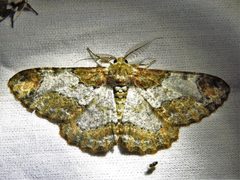
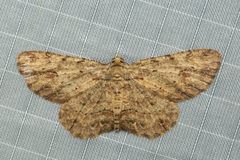
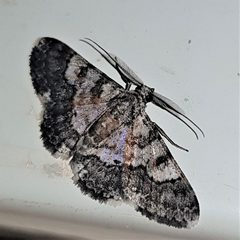
Pronunciation
How to pronounce Boarmiini: //boʊˈɑːr.mi.aɪni//
These audio files are automatically generated. While they are not always 100% accurate, they are a good starting point.
Identification
Boarmiini are difficult to recognize by external alone due to the lack of unequivocal diagnostic characters and their general resemblance to other Ennominae. Identification relies heavily on genitalia examination: males exhibit complex valvae with extended harpe structures and a large, well-developed juxta; females often show a long ovipositor associated with soft-shelled . Egg morphology provides additional diagnostic features: eggs typically have a slender, narrow shape with soft of heavy-walled, unridged polygonal (though this varies, as in Cleora where eggs approach the wide-walled form). is increasingly used for -level identification within the tribe.
Images
Habitat
are diverse and not comprehensively documented for the tribe as a whole. within the tribe occupy mountainous regions from 400–2300 m elevation, forested localities, and various terrestrial environments across tropical, subtropical, and temperate zones. Specific habitat associations are - or species-dependent.
Distribution
Global distribution with representation on all continents except Antarctica. Documented occurrences include: Afrotropical realm (with particular diversity in the Racotis generic complex); Palearctic region (Europe, Middle East, Central Asia); Oriental region (China including Hainan, Taiwan, Vietnam, Thailand, Laos, Myanmar, Peninsular Malaysia, northern India, Nepal, Sumatra); and other regions. The tribe is notably -rich in tropical and subtropical forest .
Life Cycle
are characteristically arranged in longitudinal rows across the tribe. Eggs are typically soft-shelled, slender, and narrow. Larval is poorly documented; some caterpillars mimic twigs or thin leaves. involves a T-shaped .
Behavior
rest with wings spread flat and do not tuck hindwings under forewings. Some caterpillars exhibit twig- or leaf-mimicry as a defensive strategy.
Similar Taxa
- BistoniniHistorically merged into an expanded Boarmiini concept based on shared features; distinguished by egg shape tending toward wide-walled forms and differing .
- BupaliniSometimes included in expanded Boarmiini; separated by distinct morphological and genitalic characteristics in narrow-sense classifications.
- AlsophilinaeOften treated as a separate but may represent a specialized Boarmiini lineage; distinguished by markedly different caterpillar despite shared T-shaped pupal .
- MacariiniRelated Ennominae tribe; some (e.g., Monocerotesa) have been variously assigned to Boarmiini or Macariini, requiring genitalic examination for proper placement.
More Details
Taxonomic instability
The circumscription of Boarmiini has been highly variable. Some treatments massively expand the tribe to include Bistonini, Bupalini, Erannini, Gnophini, Melanolophini, Phaseliini, and Theriini based on characteristics. Other treatments restrict Boarmiini to a narrower core group (sometimes called Cleorini) and maintain these as separate tribes. This instability complicates literature comparisons and requires attention to the specific classification used in any given source.
Fossil record
The earliest known geometrid caterpillar in Baltic amber, Eogeometer vadens (44 million years old, Eocene), has been described as evidence for the Ennominae and particularly the tribe Boarmiini, representing the oldest fossil evidence for this lineage.
Systematic research activity
Recent integrative taxonomic revisions (2019–2024) have substantially revised generic boundaries within Boarmiini, establishing new (Afroracotis, Chorocotis) and transferring numerous between genera based on combined morphological and barcode data. Many ennomine genera remain unassigned to tribe, and the genus list for Boarmiini is considered preliminary.
Sources and further reading
- BugGuide
- Wikipedia
- iNaturalist taxon
- Integrative taxonomic revision of the African taxa of the Racotis Moore, 1887 generic complex (Lepidoptera, Geometridae, Ennominae, Boarmiini)
- Taxonomic revision of the genus Nychiodes Lederer, 1853 (Geometridae: Ennominae: Boarmiini) with description of three new species—an integrative approach
- Contribution to the knowledge of the genus Calcyopa Stüning, 2000 (Lepidoptera, Geometridae, Ennominae, Boarmiini), with description of a new species.
- Review of the genus Prochasma Warren (Geometridae, Ennominae, Boarmiini), with description of a new species from Hainan, South China.
- Two new species of the genus Psilalcis Warren, 1893 (Geometridae, Ennominae, Boarmiini) from Hainan, China.