
Hypomecis
Hübner, 1821
Species Guides
5- Hypomecis buchholzaria(blue spiderwort moth)
- Hypomecis gnopharia
- Hypomecis longipectinaria(hybrid fescue)
- Hypomecis luridula
- Hypomecis umbrosaria(Umber Moth)
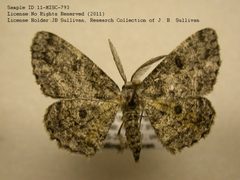
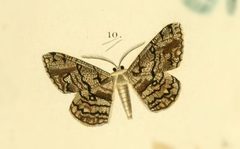
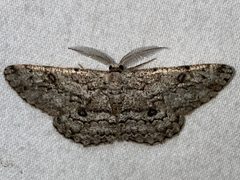
Hypomecis is a of geometrid moths established by Jacob Hübner in 1821. exhibit cryptic bark- or lichen-mimicking coloration and rest on tree trunks during daylight hours. The genus includes the Pale Oak Beauty (H. punctinalis) and Great Oak Beauty (H. roboraria), both widespread in Europe. sequencing has been completed for multiple species, revealing WZ sex determination and -level assemblies.
Pronunciation
How to pronounce Hypomecis: /hɪˈpoʊmɪsɪs/
These audio files are automatically generated. While they are not always 100% accurate, they are a good starting point.
Identification
Distinguished from similar geometrid by the combination of oblique, hair-fringed palpi reaching beyond the , crenulate wing cilia, and characteristic wing venation with 10 and 11 arising from the . Cryptic lichen-mimicking patterns and resting on tree trunks aid field recognition.
Images
Appearance
Palpi oblique, extending beyond the with hair fringing below. Forewings have slightly crenulate (scalloped) cilia. Wing venation: 3 arises near the angle of the , veins 7–9 near the upper angle; veins 10 and 11 typically arise from the cell. Hindwings with vein 3 from near the cell angle and crenulate cilia.
Habitat
varies by : broadleaved woodland (H. punctinalis); heath, moor, and short grassland (H. atomaria). select resting sites on bark to enhance .
Distribution
Widespread across Europe, including UK, Ireland, Scandinavia (Denmark, Norway, Sweden), and eastward through Asia to Japan. Distribution patchy in some regions; H. atomaria collected from Beinn Eighe, Scotland.
Seasonality
active May to June, with partial second in August (H. atomaria) or mid-July (H. punctinalis, southern England).
Diet
Larval feeding: H. atomaria larvae feed on heathers (heath/moor ) and trefoils, clovers, and vetches (grassland habitats). H. punctinalis larvae feed on pedunculate oak, downy birch, silver birch, hawthorn, and sallows.
Host Associations
- pedunculate oak - larval food plantH. punctinalis
- downy birch - larval food plantH. punctinalis
- silver birch - larval food plantH. punctinalis
- hawthorn - larval food plantH. punctinalis
- sallows - larval food plantH. punctinalis
- heathers - larval food plantH. atomaria; heath and moor
- trefoils - larval food plantH. atomaria; grassland
- clovers - larval food plantH. atomaria; grassland
- vetches - larval food plantH. atomaria; grassland
Life Cycle
Pupates close to ground; overwinters as pupa. H. atomaria: -level assembly 690.01 Mb, 32 chromosomes including W/Z , 15.6 kb mitochondrial genome. H. punctinalis: 741.20 Mb genome, 30 chromosomal pseudomolecules (29 + Z), 15.64 kb mitochondrial genome, 13,897 protein-coding genes.
Behavior
resting : rest on tree trunks during daylight, selecting positions that enhance lichen-mimicking . Readily comes to light (H. punctinalis). Often disturbed from heather or short grass (H. atomaria).
Human Relevance
Subject of sequencing through Darwin Tree of Life project. Some (e.g., H. punctinalis, H. roboraria) serve as indicators of woodland quality. No known economic impact.
Similar Taxa
- Other Geometridae genera with bark-resting speciesHypomecis distinguished by specific palpal structure, wing venation, and crenulate cilia; many geometrids share cryptic coloration but lack the complete diagnostic character set.
More Details
Genomic resources
-level assemblies available for H. atomaria and H. punctinalis through Wellcome Open Research. H. atomaria karyotype 2n=62 with WZ/ZZ sex determination; small fully heterochromatic W chromosome frequently enclosed by Z in WZ bivalent. Females show conspicuous sex-chromatin body absent in males.