
Xysticus auctificus
Keyserling, 1880
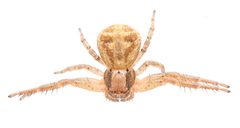
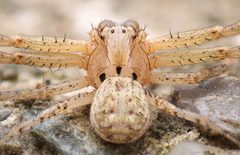
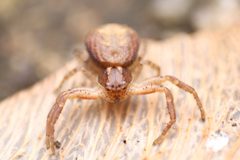
Xysticus auctificus is a of ground crab spider in the Thomisidae, distributed across north-central North America. As a member of the Xysticus, it exhibits the characteristic crab-like leg arrangement and ambush hunting strategy typical of this diverse spider group. The species has been documented in prairie and grassland , where it relies on to capture prey.
Pronunciation
How to pronounce Xysticus auctificus: //zɪsˈtɪ.kʊs ɔːkˈtɪ.fɪ.kʊs//
These audio files are automatically generated. While they are not always 100% accurate, they are a good starting point.
Identification
Xysticus auctificus can be distinguished from other Xysticus through examination of male copulatory organs and detailed morphological features. The Xysticus is characterized by a flattened body, crab-like leg posture with the first two pairs of legs enlarged and held laterally, and a tendency to walk sideways. Species-level identification typically requires microscopic examination of genitalic structures.
Images
Habitat
Prairie and grassland environments in north-central North America. The has been documented in sandy grassland characterized by high ground temperature and temperature fluctuations.
Distribution
North America: Canada (Saskatchewan) and United States (Montana, North Dakota). The distribution appears centered in the northern Great Plains region.
Seasonality
have been observed active during spring months, with some individuals as adults. Activity likely extends through the growing season, though specific data are limited.
Behavior
Ambush that relies on motionless waiting to capture prey. Like other Xysticus , it likely exhibits a sit-and-wait hunting strategy, using its enlarged front legs to seize passing insects. The species has been observed engaging in ballooning for , climbing vertical objects and releasing silk threads to catch wind currents.
Ecological Role
of small arthropods in prairie and grassland . As a crab spider, it likely contributes to regulation of insect , particularly and other small flying or crawling insects.
Similar Taxa
- Xysticus mongolicus (now Spiracme mongolica)Formerly classified in Xysticus, this shares similar preferences for dry sandy environments but has been reclassified to Spiracme based on male copulatory organ characteristics. X. auctificus remains in Xysticus based on distinct genitalic .
- Other Xysticus speciesMany Xysticus are superficially similar in body form and coloration, requiring examination of genitalic structures for definitive identification. X. auctificus is distinguished by specific morphological features of the male and .