
Synema
Simon, 1864
Species Guides
2- Synema parvulum(Black-banded Crab Spider)
- Synema viridans
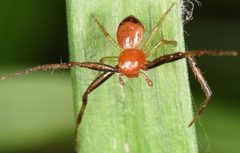
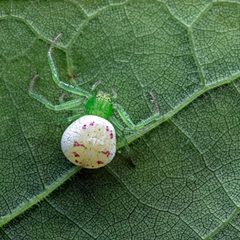
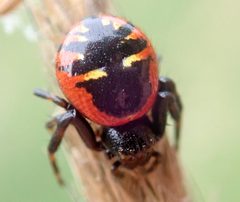
Synema is a of crab spiders (Thomisidae) with a wide distribution across most parts of the world. The genus includes with high morphological variability, as demonstrated by integrative studies combining molecular and morphological data. Some species, such as S. globosum, exhibit deep mitochondrial divergence without corresponding nuclear or morphological differentiation, complicating species delimitation. Members of this genus are typically found in leaf-dwelling and exhibit ballooning as juveniles, which contributes to their broad geographic range.
Pronunciation
How to pronounce Synema: //sɪˈniːmə//
These audio files are automatically generated. While they are not always 100% accurate, they are a good starting point.
Identification
Identification relies on genitalic , particularly male palpal and female epigynal structure. -level identification requires examination of these structures; somatic characters alone are unreliable due to high intraspecific variation. For example, S. guiyang resembles Spilosynema in somatic features but lacks the postero-prolateral cymbial and tutaculum characteristic of that . (COI) can assist in matching sexes but may not resolve species boundaries due to high intraspecific .
Images
Habitat
Leaf-dwelling spiders found in foliage, including forest . S. guiyang specifically documented from woods in Guiyang Forest Park, China.
Distribution
Widespread across most parts of the world. S. globosum has a Palaearctic distribution from Western Europe to Eastern Asia, with spanning from Portugal to Turkey and Greece (distance between most distant sites approximately 3,100 km). S. guiyang known only from Guiyang City, Guizhou Province, China.
Behavior
Juveniles exhibit ballooning , which facilitates wide distribution. S. guiyang observed foraging on foliage.
Similar Taxa
- SpilosynemaSomatically similar with globular and color patterning, but distinguished by presence of postero-prolateral cymbial and tutaculum in male palp, and broad tube-shaped copulatory ducts in female epigyne—features absent in Synema.