
Misumena
Latreille, 1804
Flower Crab Spiders
Species Guides
1- Misumena vatia(goldenrod crab spider)
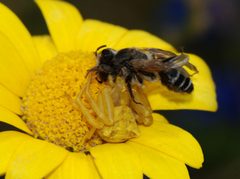
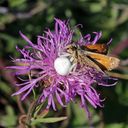
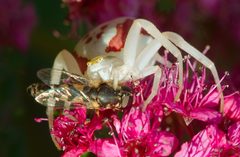
Misumena is a of crab spiders in the Thomisidae, commonly known as flower crab spiders. The genus contains approximately 40 distributed across the Northern Hemisphere, with the most well-known species being Misumena vatia, the goldenrod crab spider. These spiders are ambush that hunt on flowers, where they rely on camouflage to capture pollinating insects. Some species, particularly females of M. vatia, exhibit remarkable color-changing abilities, shifting between white and yellow to match their floral substrate.
Pronunciation
How to pronounce Misumena: /mɪˈsuːmɛnə/
These audio files are automatically generated. While they are not always 100% accurate, they are a good starting point.
Identification
Distinguished from similar Misumenoides and Mecaphesa (also Thomisidae) by subtle morphological differences in arrangement, leg spination, and genitalia structure. Accurate identification to level typically requires examination of reproductive structures. M. vatia is recognizable by its color-changing ability and association with composite flowers such as goldenrod (Solidago).
Images
Habitat
Primarily associated with flowering plants where they serve as ambush . Found in meadows, gardens, agricultural fields, and open woodlands with abundant floral resources. spiderlings show preference for leafy stems over flowering stems, while select high-quality umbels or inflorescences with abundant prey.
Distribution
Widespread across the Northern Hemisphere including North America, Eurasia, and northern Africa. Individual have more restricted ranges; M. vatia occurs across North America and Eurasia, while M. bicolor has been documented from Corsica, Sardinia, Germany, and mainland France.
Seasonality
females are most commonly observed during late spring through autumn when floral resources are abundant. Males mature earlier than females and wander in search of mates. In temperate regions, peak activity coincides with peak flowering of preferred plants such as goldenrod in late summer and early autumn.
Diet
Active of pollinating insects including bees, flies, butterflies, and other flower-visiting arthropods. Documented prey includes honey bees (Apis mellifera), various including Chryxus Arctic (Oeneis sp.), and other hymenopterans. Males of M. vatia have been observed feeding on flower pollen and nectar, though this is supplemental rather than primary nutrition.
Life Cycle
Females produce sacs typically wrapped in folded leaves, which they guard until spiderlings emerge and disperse. Spiderlings are capable of ballooning for , making them more mobile than females. Development includes egg, spiderling, and adult stages with multiple . Females invest heavily in , with eggs accounting for approximately 85% of body weight gain after maturity.
Behavior
Ambush that rely on and patience rather than web-building or active pursuit. Position themselves on flowers and wait for prey to come within striking distance. Use front legs to seize prey and deliver venomous bite. females are relatively sedentary, occupying high-quality floral patches for extended periods. Males are wanderers that search for females. Spiderlings exhibit patch-choice , selecting stems based on leaf availability and shelter.
Ecological Role
Important of in floral . May influence pollinator and plant-pollinator interactions through risk. Serve as prey for birds and other . Their presence on flowers creates a complex ecological interaction involving predator-prey dynamics, plant , and pollinator foraging decisions.
Human Relevance
Generally beneficial in gardens and agricultural settings due to on potential pest insects such as some flies and small bees. Occasionally encountered by gardeners and naturalists on flowers. Subject of extensive scientific research due to their color-changing ability, foraging , and reproductive . Not considered medically significant to humans.
Similar Taxa
- MisumenoidesSimilar body form and flower-associated ; distinguished by subtle differences in arrangement and genital
- MecaphesaOverlapping use and general appearance; requires detailed morphological examination for reliable separation
- ThomisusRelated of crab spiders with similar ambush hunting strategy on flowers; some show convergent color-changing abilities
More Details
Color Change Mechanism
The color change in M. vatia is induced by visual feedback; spiders with painted lose this ability. Yellow pigment is secreted into outer layers and can be transported downward to reveal white guanine-filled inner glands, or excreted to revert to white base coloration.
Scientific Study
Misumena vatia is among the most intensively studied spiders, with research spanning patch-choice , foraging , reproductive , and -prey dynamics. An entire book has been published on its natural history: 'Predator Upon a Flower: and in a Crab Spider' by Douglass Morse (2007).
Sources and further reading
- BugGuide
- Wikipedia
- GBIF taxonomy match
- iNaturalist taxon
- NCBI Taxonomy
- Catalogue of Life
- Bug Squad
- The Crab Spider and the Bee | Bug Squad
- Bug Eric: Dimorphic Jumping Spider, Maevia inclemens
- Bug Eric: Spider Sunday: Goldenrod Crab Spider
- Bug Eric: "Bird Food"
- Lord of the flies! | Beetles In The Bush
- Excretion behavior of adult female crab spiders Misumena vatia (Araneae, Thomisidae)
- Cues Associated With Patch-Choice Decisions By Foraging Crab Spiders Misumena Vatia
- Foraging Behavior of Crab Spiders (Misumena vatia) Hunting on Inflorescences of Different Quality
- A master in disguise? The rediscovery of Misumena bicolor Simon, 1875 (Araneae: Thomisidae)
- Experimental and Observational Studies of Patch Choice at Different Scales by the Crab Spider Misumena Vatia
- Contrasting patch choice behaviour by immature ambush predators, a spider ( Misumena vatia ) and an insect ( Phymata americana )