
Mecaphesa
Simon, 1900
crab spiders
Species Guides
14- Mecaphesa asperata(Northern Crab Spider)
- Mecaphesa californica
- Mecaphesa carletonica(northeastern flower crab spider)
- Mecaphesa celer(swift crab spider)
- Mecaphesa coloradensis(Colorado Mecaphesa)
- Mecaphesa deserti
- Mecaphesa dubia
- Mecaphesa gabrielensis
- Mecaphesa importuna
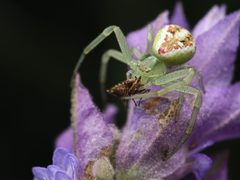
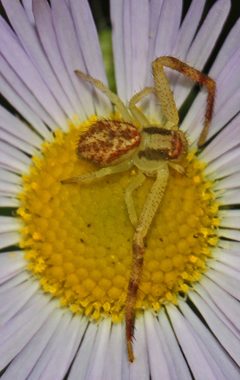
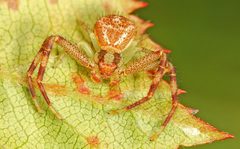
Mecaphesa is a of crab spiders in the Thomisidae, first described by Eugène Simon in 1900. The genus contains approximately 49 distributed across North America, Central America, the Caribbean, South America, and Hawaii. Species exhibit cryptic coloration for ambush on flowers.
Pronunciation
How to pronounce Mecaphesa: //mɛkəˈfiːsə//
These audio files are automatically generated. While they are not always 100% accurate, they are a good starting point.
Images
Habitat
occupy diverse including mesic forests, riparian corridors, dry-mesic upland deciduous forests, dolomite glades, and lava flow matrices. Specific habitat associations vary by species; for example, Mecaphesa celer inhabits isolated vegetated patches within barren lava matrices at Craters of the Moon, Idaho.
Distribution
North America, Central America, the Caribbean, South America, and Hawaii. Individual show restricted ranges: Mecaphesa asperata occurs from North America through the Caribbean; multiple species are to Hawaii including M. anguliventris, M. arida, M. baltea, M. cavata, M. cincta (type species), M. discreta, M. edita, M. facunda, M. hiatus, M. imbricata, M. insulana, M. juncta, M. kanakana, M. naevigera, M. nigrofrenata, M. oreades, M. perkinsi, M. rufithorax, M. semispinosa, and M. velata.
Diet
Ambush that capture and other insects visiting flowers. Mecaphesa asperata has been observed hunting on blossoms of Spiranthes magnicamporum (orchid) and Rhus aromatica (fragrant sumac). Mecaphesa schlingeri preys on herbivores associated with Madia elegans (tarweed).
Behavior
Ambush from flowers using to avoid detection by prey. Mecaphesa schlingeri can navigate sticky plant surfaces of tarweed to access trapped insect carrion and live prey. appears extensive in at least some ; Mecaphesa celer shows genetic panmixia across fragmented lava flow , indicating substantial despite geographic isolation.
Ecological Role
of flower-visiting insects. Contribute to indirect plant defense by reducing herbivore damage; presence on Madia elegans associated with decreased bud damage by Heliothodes diminutiva caterpillars and increased plant .
Sources and further reading
- BugGuide
- Wikipedia
- GBIF taxonomy match
- iNaturalist taxon
- NCBI Taxonomy
- Catalogue of Life
- Bring on the Tourists! | Bug Squad
- Day hike at Little Lost Creek Conservation Area | Beetles In The Bush
- 🌿 Botanizing w/ the WGNSS Botany Group at Victoria Glades Preserve | Beetles In The Bush
- Panmixia in spiders ( Mecaphesa celer , Thomisidae) despite fragmented habitat at Craters of the Moon in Idaho