
Mecaphesa asperata
(Hentz, 1847)
Northern Crab Spider
Mecaphesa asperata is a small crab spider in the Thomisidae, commonly known as the northern crab spider. It is one of the 'flower spiders' that hunts on blossoms, using camouflage to ambush such as bees and flies. The is a Nearctic relative of the better-known goldenrod spider (Misumena vatia) but is considerably smaller. Formerly classified in the Misumenops as M. asperatus, it was transferred to Mecaphesa based on revised .
Pronunciation
How to pronounce Mecaphesa asperata: //mɛkəˈfiːsə æspəˈreɪtə//
These audio files are automatically generated. While they are not always 100% accurate, they are a good starting point.
Identification
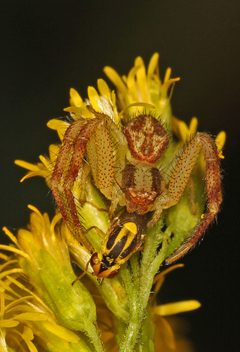
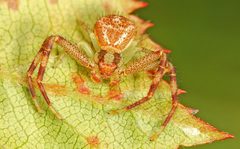
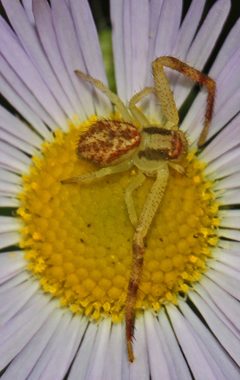
Distinguished from Misumenoides and Misumena by the distinctive covering of numerous short stiff spines on the , , and legs. The white ocular region, red lateral streaks on the abdomen, and the V-shaped abdominal mark are additional identifying characters. Leg I has red annuli on tibia and , contrasting with otherwise yellow legs.
Images
Habitat
Found in open with flowering vegetation, including prairies, glades, forest edges, and riparian corridors. Frequently associated with yellow-flowered plants such as Rhus aromatica (fragrant sumac) and Spiranthes magnicamporum (Great Plains ladies' tresses). Occupies mesic to dry-mesic environments where suitable hunting perches on blossoms are available.
Distribution
North America, Central America, and the Caribbean. Documented from Canada (Alberta, British Columbia, Manitoba) southward through the United States and into Mexico and Central America.
Seasonality
Active during spring through fall, with observations spanning March through October in temperate regions. Peak activity coincides with flowering periods of plants.
Diet
Ambush that captures pollinating insects visiting flowers. Documented prey includes bees and flies. Hunts by remaining motionless on similarly colored flowers and seizing visitors with enlarged legs.
Host Associations
- Rhus aromatica - hunting siteObserved camouflaged on bright yellow flowers, awaiting
- Spiranthes magnicamporum - hunting siteFirst documented observation of this hunting on orchid flowers
Behavior
Typical crab spider ambush hunting : remains motionless on flowers, relying on camouflage to avoid detection by prey. Does not construct webs for prey capture. Capable of moving sideways and backward in crab-like fashion. Has been observed on blossoms of both woody shrubs and herbaceous plants including orchids.
Ecological Role
of pollinating insects; may exert on flower-visiting insect . Serves as prey for larger predators including birds and .
Human Relevance
Non-venomous to humans and not medically significant. May be encountered by field biologists and naturalists during surveys of flowering plants. Of interest to arachnologists studying flower spider and camouflage.
Similar Taxa
- Misumena vatiaLarger Nearctic flower spider lacking the dense covering of stiff spines characteristic of Mecaphesa asperata; goldenrod spider is also generally larger and more robust
- MisumenoidesRelated of flower spiders distinguished by less prominent spination and different abdominal patterning
More Details
Taxonomic history
Formerly placed in Misumenops as Misumenops asperatus; transferred to Mecaphesa based on phylogenetic revisions of Thomisidae
Hunting strategy
Exhibits color matching with flower substrates; individuals on yellow Rhus aromatica flowers were described as 'perfectly camouflaged'
Sources and further reading
- BugGuide
- Wikipedia
- GBIF taxonomy match
- iNaturalist taxon
- NCBI Taxonomy
- Catalogue of Life
- Braconidae | Beetles In The Bush
- 🌿 Botanizing w/ the WGNSS Botany Group at Victoria Glades Preserve | Beetles In The Bush
- October | 2025 | Beetles In The Bush
- April | 2023 | Beetles In The Bush
- Day hike at Little Lost Creek Conservation Area | Beetles In The Bush