
Misumena vatia
(Clerck, 1757)
goldenrod crab spider, flower crab spider, white death spider
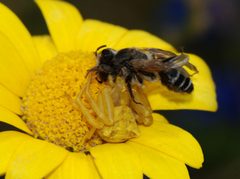
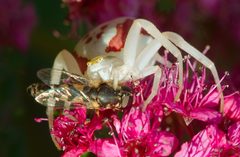
Misumena vatia is a crab spider in the Thomisidae found across the northern hemisphere in North America and Europe. females are ambush that hunt on flowers, where they capture pollinating insects using venom and their enlarged front legs. Females possess a remarkable ability to change color between yellow and white to match their floral substrate, a process taking 6–25 days depending on direction. The exhibits extreme : females reach 6–11 mm while males are only 2.5–5 mm and lack color-changing ability. Females are sedentary, occupying single flowers for extended periods, while males actively search for mates following silk draglines.
Pronunciation
How to pronounce Misumena vatia: //mɪˈsuːmə.nə ˈvætiə//
These audio files are automatically generated. While they are not always 100% accurate, they are a good starting point.
Identification
Distinguished from similar crab spiders by: (1) color-changing capability (females only), unlike Mecaphesa asperata (light-gray to brown with pink stripes, hairy, no color change); (2) geographic range—Misumenoides and Misumenops occur primarily south of M. vatia's range; (3) from Philodromidae (wandering crab spiders) by much longer front legs versus similar-length legs in philodromids; (4) from Xysticus and Coriarchne (brown) and Diaea (lime green) by coloration and floral association. Males identified by small size, dark coloration with white spot through region, and red/white banding pattern.
Images
Habitat
Terrestrial; temperate forest biomes. Found on flowering plants including goldenrod (Solidago), milkweed (Asclepias), daisies, sunflowers, trillium, white fleabane (Erigeron strigosus), ox- daisy (Chrysanthemum leucanthemum), red clover (Trifolium pratense), buttercups (Ranunculus acris), and pasture rose (Rosa carolina). Females occupy single flowers or small patches; males range widely through vegetation.
Distribution
Native to North America and Europe; also recorded in northern Africa, Turkey, Caucasus, Russia (Europe to Far East), Kazakhstan, Iran, Central Asia, China, Korea, and Japan. Introduced to Mexico.
Seasonality
males emerge May–early June, peak June 5–July 15; adult females emerge mid-to-late June, peak around June 25. Active primarily diurnally; occasional hunting in early September when activity increases. Spiderlings overwinter on ground; final to adulthood occurs following May.
Diet
: captures flower-visiting insects including bumblebees (Bombus appositus), honeybees (Apis mellifera), syrphid flies (Toxomerus marginatus), , butterflies (including Chryxus Arctic, Oenis sp.), grasshoppers, , hoverflies. Immatures feed on smaller prey: , aphids (Aphididae), dance flies (Empididae). Males may consume flower pollen and nectar. Uses venom to immobilize prey without wrapping in silk; employs external digestion.
Life Cycle
laid in folded-leaf nests, preferentially on common milkweed (Asclepias syriaca); hatch after 3.5 weeks. Spiderlings undergo one within egg sac, emerge as second instars. Young balloon to disperse. Overwinter on ground as immatures. Final molt to adulthood in May of following year. Females produce single naturally (capable of second if artificially induced). Lifespan: females ~2 years, males ~1 month shorter.
Behavior
Ambush : waits motionless on flowers, camouflaged, seizing prey with enlarged front legs. Females sedentary, occupying hunting sites for extended periods; assess and move between umbels/stems based on prey availability, though 25–35% do not move even from poor sites. Males highly mobile, searching for females by following silk draglines mechanically (not chemically). Males cannot remate within 2 days. Females guard sacs until spiderlings emerge, then die. Retains up to 50 days near hunting sites to avoid predator detection.
Ecological Role
of pollinating insects; may influence and plant-pollinator interactions through risk. Prey for ichneumonid wasps (Trychosis cyperia), ants, other spiders, birds, lizards, shrews. for kleptoparasitic flies (Milichiidae, Chloropidae) attracted to prey capture sites.
Human Relevance
Harmless to humans: fangs cannot penetrate skin, venom weak. Occasionally enters gardens and homes. Subject of extensive behavioral and ecological research; featured in popular natural history accounts. Book-length treatment: Morse (2007) " Upon a Flower."
Similar Taxa
- Mecaphesa asperataSimilar size and shape but light-gray to brown with pink stripes on and ; covered with short stiff hairs; lacks color-changing ability; found in North/Central America and Caribbean
- Misumenoides formosipesFound in North America; similar floral hunting ; belongs to different within Thomisidae; mate-guarding behavior more pronounced than in M. vatia
- Philodromidae (wandering crab spiders)Closely related ; front and back legs similar in length versus greatly elongated front legs in M. vatia; different hunting style (more active pursuit)
- Diaea speciesCrab spiders in same ; lime green coloration; no color-changing ability
- Xysticus and Coriarchne speciesBrown crab spiders; ground-dwelling or bark-dwelling rather than primarily floral; no color change
Misconceptions
'banana spider' refers to yellow coloration, not to be confused with Nephila clavipes (golden silk orb-weaver) or other unrelated 'banana spiders.' Color change is not instantaneous (6–25 days). Despite 'crab spider' name and sideways ability, not closely related to true crabs. Males do not change color—only females possess this ability.
More Details
Color change mechanism
Visual feedback induces color change via secretion of yellow pigments (kynurenine and 3-hydroxykynurenine) into outer layer. White state: pigment sequestered beneath outer layer, white guanine glands visible. Yellow state: pigment in outer layer. White to yellow: 10–25 days (must synthesize pigment). Yellow to white: ~6 days (excrete pigment). Spiders with impaired vision lose ability. Can also show temporary color changes from consuming colored prey (pink, orange, green, brown opisthosoma), reverting in 4–6 days.
Visual system
Eight in two rows; antero- eyes (principal) with tiered and complex rhabdomere organization including 'giant ' for precise point detection. Sensitive to 340–520 nm wavelengths (green and UV photoreceptors confirmed). Visual fields overlap to provide nearly complete upper visual coverage; can see own body coloration to facilitate substrate matching.
Patch choice behavior
Females select hunting sites based on prey availability and nectar production. Approximately 70% choose highest-quality umbels (inflorescences) on a stem; 30% do not select optimally even when high-quality sites are nearby. Movement between stems increases probability of occupying high-quality sites over time. Some individuals consistently select lower-quality sites— dimorphic in patch choice, reason unknown.
Reproductive biology
Primary sex ratio 1.5 females:1 male at hatching, 2.5–5.1:1 at adulthood due to male mortality during mate search. High first-male ; males provide large sperm quantities, preventing rapid remating. ~10% of males guard pre-reproductive females through final ; nearly all such males achieve mating. Sexual moderately common, increasing through season; older males more vulnerable. Female aggression post-mating reduces probability of remating.
Sources and further reading
- BugGuide
- Wikipedia
- GBIF taxonomy match
- NCBI Taxonomy
- Catalogue of Life
- Bug Squad
- The Crab Spider and the Bee | Bug Squad
- Bug Eric: Spider Sunday: Goldenrod Crab Spider
- Bug Eric: "Bird Food"
- Lord of the flies! | Beetles In The Bush
- Bug Eric: Dimorphic Jumping Spider, Maevia inclemens
- Excretion behavior of adult female crab spiders Misumena vatia (Araneae, Thomisidae)
- Cues Associated With Patch-Choice Decisions By Foraging Crab Spiders Misumena Vatia
- Foraging Behavior of Crab Spiders (Misumena vatia) Hunting on Inflorescences of Different Quality
- Experimental and Observational Studies of Patch Choice at Different Scales by the Crab Spider Misumena Vatia
- Contrasting patch choice behaviour by immature ambush predators, a spider ( Misumena vatia ) and an insect ( Phymata americana )