
Trychosis
Förster, 1869
Species Guides
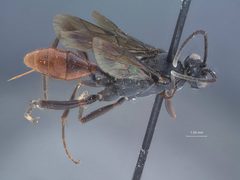
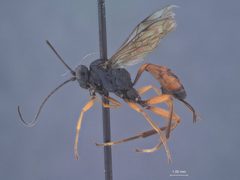
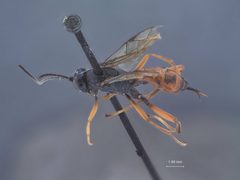
2Trychosis is a of ichneumon wasps in the Ichneumonidae, Cryptinae, tribe Cryptini. The genus contains approximately 44 described distributed across the Holarctic region, with additional records from the Neotropics. Members are small to medium-sized with fore wing lengths ranging from 3.2 to 8.8 mm. At least one species, Trychosis cyperia, has been documented as a parasitoid of spiders.
Pronunciation
How to pronounce Trychosis: //ˈtrɪk.oʊ.sɪs//
These audio files are automatically generated. While they are not always 100% accurate, they are a good starting point.
Identification
Trychosis can be distinguished from related cryptine by the following combination of characters: moderately to strongly convex with margin to convex; mesoscutum very short with dense punctures; epomia usually present and strong; propodeum strongly oblique with anterior and transverse carinae; areolet usually parallel laterally (pentagonal); hind wing with 1-cu as long as or longer than cu-a; tergite 1 long, 0.5–0.6× as long as mesosoma; ovipositor thin, compressed, with nodus.
Images
Habitat
One has been collected from wetland dominated by Cyperaceae and Gramineae, specifically from emerged vegetation at 78.9 m elevation. Broader habitat associations for the remain poorly documented.
Distribution
The has a primarily Holarctic distribution with 44 described globally: 15 Eastern Palaearctic (6 also Western Palaearctic), 14 Western Palaearctic, 20 Nearctic, 2 Neotropical, and 1 Oriental. Distribution records from GBIF include Denmark, Norway, and Sweden. A new species was recently described from Naolihe National Natural Reserve, Heilongjiang Province, China.
Host Associations
- spiders - Documented for Trychosis cyperia; relationships for other unknown
Ecological Role
Members function as , with at least one attacking spiders. The precise ecological role of most species remains undocumented.
Similar Taxa
- Other Cryptini generaShares tribe Cryptini; distinguished by the combination of clypeal structure, short mesoscutum with dense punctures, propodeal carinae, areolet shape, and ovipositor
More Details
Taxonomic history
The was established by Förster in 1869. A recent taxonomic revision described a new from China and provided a key to Chinese species.
Sources and further reading
- BugGuide
- Wikipedia
- GBIF taxonomy match
- iNaturalist taxon
- NCBI Taxonomy
- Catalogue of Life
- The Effect of Host Size on Sex Ratio in the Ichneumonid Wasp, Trychosis cyperia, a Spider Parasitoid
- A new species of Trychosis Förster (Hymenoptera, Ichneumonidae, Cryptinae), with a key to the species known from China.