
Oeneis chryxus
(Doubleday, 1849)
Chryxus Arctic, brown Arctic
Species Guides
2- Oeneis chryxus altacordillera(Chryxus Arctic)
- Oeneis chryxus valerata(Chryxus Arctic)
Oeneis chryxus is a subalpine and alpine distributed across northern and western North America. The species exhibits a distinctive semivoltine , with larvae developing over two years and emerging in patterns. show striking geographic variation in wing coloration, ranging from cream to orange-brown, which functions as camouflage against rocky substrates. The Ivallda Arctic (O. c. ivallda) occupies the highest elevation butterfly in North America at over 4,400 meters on Mount Whitney.
Pronunciation
How to pronounce Oeneis chryxus: //ˈiː.niː.ɪs ˈkrɪk.sus//
These audio files are automatically generated. While they are not always 100% accurate, they are a good starting point.
Identification
Distinguished from by combination of: pattern in most ; highly variable but generally light yellow to orange-brown upperside with reduced eyespot numbers (hindwing often lacking eyespots above); coarse striated underside pattern with broad dark band on hindwing. Male dark forewing discal patch absent in females. Similar include O. nevadensis (Great Arctic), O. macounii (Macoun's Arctic), O. uhleri (Uhler's Arctic), O. alberta (Alberta Arctic), and O. alpina (Sentinel Arctic), which differ in distribution, flight timing, and subtle wing pattern elements. O. chryxus typically shows lighter ground color and more reduced eyespot development than most related species.
Images
Appearance
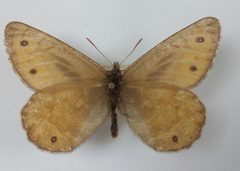
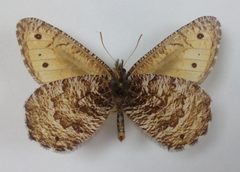
Wingspan 39–54 mm. Upperside variable cream to orange-brown with darker brown edges and wing bases; forewing bears two to four black eyespots near outer margin, hindwing with zero to two. Underside of hindwings shows coarse dark brown and light grey striation with broad dark band and light grey . Males distinguished by dark discal patch on forewing (scent ); females have rounder wings, males more pointed forewings. Coloration varies geographically: darker 'butterscotch' brown in central Sierra Nevada on volcanic/metamorphic substrates, paler cream on granitic rocks in northern and southern Sierra Nevada.
Habitat
Mountainous sparsely vegetated environments with short summers. Occupies subalpine and alpine zones including meadows, steppes, fellfields, rocky outcrops, and mountaintops. Often found near fallen logs or in wind-sheltered gulches providing perching sites. Avoids areas with more than 50–60% plant cover. Males concentrated on elevated ridge tops, females more common in meadows. Extreme (O. c. ivallda) occupy highest alpine environments in Sierra Nevada, including summit of Mount Whitney at 4,421 m elevation.
Distribution
Northern and western North America: West Alberta, British Columbia, Idaho, Montana, Wyoming, Colorado, Utah, Nevada, New Mexico, Alaska, California, and extending to Wisconsin/Quebec in the east. Nine recognized span this range. O. c. ivallda to Sierra Nevada, California, completely isolated from main range (nearest >300 km east, >900 km north).
Seasonality
peak June to July, ranging from late May to late August. (semivoltine) pattern: in most locations adults appear only in even-numbered or odd-numbered years, not both. Where adults observed in consecutive years, these represent temporally isolated with non-overlapping .
Diet
feed on nectar from diverse flowers including pearly everlasting, paintbrush, showy phlox, geranium, and puccoon; also observed feeding on mud. Larval plants documented as grasses and sedges including Festuca idahoensis (Washington), Carex (Colorado), Danthonia spicata, Oryzopsis pungens, and Phalaris arundinacea (eastern Canada).
Host Associations
- Festuca idahoensis - larval Washington
- Carex - larval Colorado
- Danthonia spicata - larval eastern Canada
- Oryzopsis pungens - larval eastern Canada
- Phalaris arundinacea - larval eastern Canada
Life Cycle
Semivoltine (two-year development). : barrel-shaped, white with 19 vertical ribs, laid on dead twigs, leaves, grasses, sedges, or lower branches of Ponderosa Pine; 30–100 eggs per female, hatch in ~15 days. Larva: five instars, pinkish brown first instar with magenta lines, darkens with maturity; final instar pink to light brown with black stripe, bifurcated , short protrusions. Overwinters as first or second instar (first winter), then third, fourth, or fifth instar (second winter). Pupa: formed in duff, soil, or adhered to twigs/bark; dark yellow-brown with heavy black on head and wing cases. : emerges after two-year larval period.
Behavior
Males exhibit territoriality on ridge tops, defending perches against intruders including males, other , and even non-target stimuli (, falling leaves). Territorial defense involves upward spiraling to 30 m, lasting over 45 seconds. Females practice , flying from meadows to elevated ridges where male is 15–30 times higher, reducing search effort and risk. Courtship involves male pursuit and close spiraling; virgin females may perform solicitation flights. Mated females return to meadows for oviposition. Typically rests with wings closed over when threatened. Observed to lean sideways to minimize shadow against lichen-covered rocks.
Ecological Role
function as while nectaring. Larvae are herbivores on grasses and sedges. Serves as prey for including crab spiders (documented by Misumena vatia). creates temporally structured . High-elevation occupy extreme environments with minimal Lepidopteran diversity.
Human Relevance
Subject of conservation concern due to climate change vulnerability; designated Regional Forest Sensitive (Washburn District, Chequamegon-Nicolet National Forest) and State-listed Special Concern species (Wisconsin). degradation from road paving, lodge construction, parking lots, and picnic grounds documented. sequenced as part of California Conservation Project to inform management of isolated Sierra Nevada . Popular among enthusiasts and researchers studying high-elevation , lekking , and temporal population isolation.
Similar Taxa
- Oeneis nevadensisGreat Arctic; larger size, darker coloration, different distribution and period
- Oeneis macouniiMacoun's Arctic; distribution, subtle wing pattern differences
- Oeneis uhleriUhler's Arctic; different geographic range and preferences
- Oeneis albertaAlberta Arctic; more northern distribution, distinct wing markings
- Oeneis alpinaSentinel Arctic; high-arctic distribution, different timing
More Details
Genomic Resources
Highly contiguous assembly available (2024): two haplotypes of ~739 and ~771 Mb, contig N50 ~10 Mb, scaffold N50 ~25.5 Mb, BUSCO completeness 96.5–98.3%. First major genomic resource for Oeneis; mitochondrial genome and endosymbiont genome also sequenced.
Subspecies
Nine historically recognized: O. c. calais, O. c. caryi, O. c. chryxus, O. c. ivallda, O. c. socorro, O. c. stanislaus, O. c. strigulosa, O. c. valerata. O. c. ivallda of particular conservation concern due to extreme isolation and alpine restriction.
Climate Sensitivity
Among the most climate-vulnerable North American butterflies due to obligate association with short-season alpine and subalpine . Warming projected to eliminate many alpine habitats in western United States, threatening long-term persistence.
Sources and further reading
- BugGuide
- Wikipedia
- GBIF taxonomy match
- iNaturalist taxon
- NCBI Taxonomy
- Catalogue of Life
- Rising from the Ashes--Some Day | Bug Squad
- Oh, the Butterflies You'll See at the Bohart During UC Davis Biodiversity Museum Day | Bug Squad
- Bug Eric: Spider Sunday: Goldenrod Crab Spider
- Habitat: Oeneis chryxus stanislaus
- A genome assembly for the Chryxus Arctic (Oeneis chryxus), the highest butterfly in North America
- A NOTE ON THE DISTRIBUTION OF OENEIS CHRYXUS STRIGULOSA (LEPIDOPTERA: SATYRIDAE)
- Determinants of spatial distribution in a population of the subalpine butterfly Oeneis chryxus