
Oeneis nevadensis
Felder, 1867
Great Arctic, Nevada Arctic, great grayling, Felder's Arctic, Pacific Arctic
Oeneis nevadensis, commonly called the great Arctic, is the largest western Arctic with a wingspan of 5.1–6.3 cm. It is distinguished by its , with appearing only in even-numbered years for most . The occurs in high-elevation of the Cascade Mountains from southern British Columbia to northern California, where it represents the southernmost range limit for this Arctic group in western North America.
Pronunciation
How to pronounce Oeneis nevadensis: /ˈiː.nəs nɛ.vəˈdɛn.sɪs/
These audio files are automatically generated. While they are not always 100% accurate, they are a good starting point.
Identification
Distinguished from other Oeneis by larger size and brighter orange-brown upperside coloration. O. n. gigas is slightly larger and darker than nominate form; O. n. iduna is notably paler above. pattern in even-numbered years separates most from O. n. gigas, which flies in odd-numbered years. in eyespot number and distribution of dark scaling on forewing aids identification.
Images
Appearance
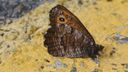
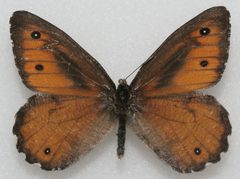
Wingspan 51–63 mm, the largest western Arctic . Upperside bright orange-brown with dark brown scalloped wing margins. Males display one to two black eyespots on forewing and a large dark patch of sex extending from base to near apex. Females bear two to three forewing eyespots with dark scaling restricted to basal area. Both sexes have a small eyespot near hindwing tornus. Underside of forewing matches upperside; hindwing surface uniformly striated dark brown and gray with whitish . Some show irregular dark band on hindwing.
Habitat
Forest clearings, open pinewoods, gravel roads, meadows, slopes, and canyons from sea level to 2,100 m elevation. Along coastal areas, occurs on bare mountain summits. Associated with montane and subalpine zones in the Cascade Mountains.
Distribution
Cascade Mountains from southern British Columbia to northern California. O. n. nevadensis occurs throughout main range; O. n. gigas restricted to southern tip of Vancouver Island; O. n. iduna found in northern coastal California.
Seasonality
fly from early May to late September. exhibit , appearing primarily in even-numbered years. The Vancouver Island O. n. gigas flies in odd-numbered years.
Host Associations
- Poaceae - larval specific plant unknown but believed to be grass
Life Cycle
whitish, oblong, flat-topped. Larva tan with black lateral stripe, sides striped with brown, greenish brown, and white; lacks horns, forked. First-year caterpillar overwinters partially grown; second-year overwinters as fifth instar. Two-year results in .
Behavior
are associated with high mountain hiking trails and open montane . pattern synchronized across , with most appearing in even-numbered years.
Similar Taxa
- Oeneis macouniiSmaller size, duller coloration, different wing pattern elements
- Oeneis polixenesOverlapping range but smaller with different underside pattern
- Oeneis chryxusSmaller western Arctic with more muted coloration
More Details
Fire vulnerability
at southern range limit in California Coast Range, including those on Goat Mountain and Mendocino Pass, were severely impacted by 2020 wildfires. These represented globally significant southernmost occurrences for the .
Taxonomic history
Originally described as Chionobas nevadensis by Felder in 1867. Three currently recognized based on geographic distribution and subtle morphological differences in size and coloration.
Sources and further reading
- BugGuide
- Wikipedia
- GBIF taxonomy match
- iNaturalist taxon
- NCBI Taxonomy
- Catalogue of Life
- Rising from the Ashes--Some Day | Bug Squad
- Oh, the Butterflies You'll See at the Bohart During UC Davis Biodiversity Museum Day | Bug Squad
- Grasshoppers of Colorado
- Grasshoppers of Colorado
- Species Records and Accounts
- Let’s make a deal! | Beetles In The Bush