
Oeneis
Hübner, 1819
Arctics, graylings
Species Guides
11- Oeneis alberta(Alberta Arctic)
- Oeneis alpina(sentinel Arctic)
- Oeneis bore(white-veined Arctic)
- Oeneis chryxus(Chryxus Arctic)
- Oeneis jutta(Jutta Arctic)
- Oeneis macounii(Macoun's Arctic)
- Oeneis melissa(Melissa Arctic)
- Oeneis nevadensis(Great Arctic)
- Oeneis philipi(Philip's Arctic)
Oeneis is a of butterflies in the Satyrinae, commonly known as the Arctics or graylings. Members of this genus are remarkable for their to extreme cold environments, with most restricted to Arctic, sub-Arctic, or high-altitude alpine . The genus exhibits a disjunct distribution across the Northern Hemisphere, with species found in Europe, Arctic Russia, Siberia, Mongolia, Arctic North America, and the Rocky Mountains. Many species have , with development typically spanning two years. The genus comprises approximately 32 recognized species arranged into several species groups based on phylogenetic relationships.
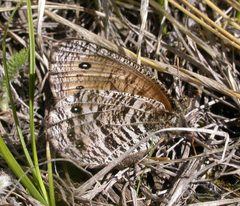
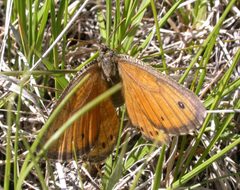
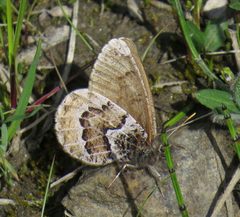
Pronunciation
How to pronounce Oeneis: /ˈoʊ.niː.ɪs/
These audio files are automatically generated. While they are not always 100% accurate, they are a good starting point.
Images
Habitat
Arctic tundra, sub-Arctic regions, and high-altitude alpine environments. Most occupy extreme cold including mountain summits, rocky fell-fields, and northern latitudes. Some species reach the highest elevations of any North American butterflies, such as the Ivallda Arctic (Oeneis chryxus ivallda) on Mt. Whitney, California.
Distribution
Circumpolar distribution with gaps. Present in Europe (four ), Arctic Russia, Siberia, Mongolia, Arctic North America, and the Rocky Mountains. Notably absent from Greenland despite suitable . Eastern Palearctic origin inferred for the tarpeja group; multiple Nearctic origins suggested for other lineages.
Host Associations
- Pinus banksiana - plantMacoun's Arctic (Oeneis macounii) associated with jack pine
- Pinus contorta - plantMacoun's Arctic (Oeneis macounii) associated with lodgepole pine
Life Cycle
Development of most takes two years (). Some exhibit alternate-year , with sympatric cohorts potentially providing opportunity for allochronic isolation.
Human Relevance
Of conservation concern due to vulnerability of alpine to climate change. The Ivallda Arctic (Oeneis chryxus ivallda) is of particular conservation interest as warming conditions lead to loss and fragmentation of high-elevation habitats. Some serve as indicators of habitat health in extreme environments.
Similar Taxa
- DavidinaClosely related forming a major clade with the Oeneis tarpeja group; distinguished by morphological and molecular characters
- NeominosRelated grouped with non-tarpeja Oeneis in phylogenetic analyses; genus-level separation supported by molecular data
Sources and further reading
- BugGuide
- Wikipedia
- GBIF taxonomy match
- iNaturalist taxon
- NCBI Taxonomy
- Catalogue of Life
- Oh, the Butterflies You'll See at the Bohart During UC Davis Biodiversity Museum Day | Bug Squad
- Rising from the Ashes--Some Day | Bug Squad
- Exploring arctic plants and lichens
- Book on plants in the Murmansk region (Russia) scores 4/19 correct insect identifications | Blog
- Habitat: Oeneis macounii Edwards
- Habitat: Oeneis chryxus stanislaus
- Habitat: Oeneis jutta ascerta Masters & Sorensen
- Determinants of spatial distribution in a population of the subalpine butterfly Oeneis chryxus
- A NOTE ON THE DISTRIBUTION OF OENEIS CHRYXUS STRIGULOSA (LEPIDOPTERA: SATYRIDAE)
- Notes on the Demography, Life History, and Behavior of the White Mountain Arctic Butterfly (Oeneis melissa semidea)
- Phylogeny and biogeography of arctic‐alpine butterflies of the genusOeneis(Nymphalidae: Satyrinae)
- Population genetic structure and assessment of allochronic divergence in the Macoun’s Arctic (Oeneis macounii) butterfly
- Vertical and Horizontal Distributions ofOeneis norna asamana(Nymphalidae: Satyrinae) in the Hida Mountain Chain (the Northern Japan Alps) in Japan
- A genome assembly for the Chryxus Arctic (Oeneis chryxus), the highest butterfly in North America