
Toxomerus marginatus
(Say, 1823)
Margined Calligrapher, Margined Calligrapher Fly
Toxomerus marginatus is a common North American hoverfly (Syrphidae) measuring 5–6 mm. are frequent flower visitors, while larvae are predatory on , aphids, and small caterpillars. The has been documented as the most numerous syrphid controlling aphids in California Central Coast lettuce fields. It exhibits strong attraction to methyl salicylate, a floral compound and herbivore-induced plant volatile.
Pronunciation
How to pronounce Toxomerus marginatus: /tɔkˈsɒmərəs mɑːrˈdʒɪneɪtəs/
These audio files are automatically generated. While they are not always 100% accurate, they are a good starting point.
Identification
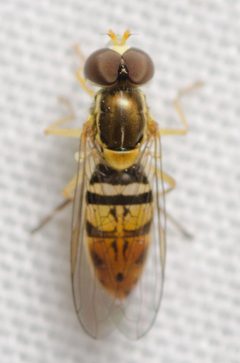
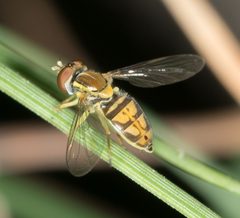
Small hoverfly, 5–6 mm length. whitish yellow, thinly pollinose, expanded forward and downward with yellow facial . reddish yellow, slightly brownish gray above, with black . bare with distinct triangular emargination on margin at or above antenna level. olive black with ashy grey stripe bordered narrowly by brownish coloration; lateral margin with yellow stripe from postpronotum to scutellum. Scutellum yellow with dorsomedial brown spot. black and shining, narrowly margined with yellow: first segment black with yellow base; second segment black with yellow lateral margins and broad yellow medial fascia; third and fourth segments each with median line and large oblique lateral spot; fifth segment with two oblique spots confluent at tip. Legs entirely yellow except black procoxa and brown middle and hind . Wings nearly hyaline; calypter and halter yellow; stigma dark yellow, mostly microtrichose.
Images
Habitat
Found in diverse environments including agricultural fields (lettuce, cranberry), grasslands, and areas with flowering vegetation. Strongly associated with where methyl salicylate is present as a floral or herbivore-induced volatile.
Distribution
Widespread across North America. Documented presence in United States including Vermont, Hawaii, and California Central Coast.
Diet
feed on nectar and pollen from a wide range of flowers. Larvae are of , aphids, and small caterpillars.
Life Cycle
Complete with , larval, pupal, and stages. Larval stage predatory; specific developmental timing not documented in available sources.
Behavior
exhibit strong attraction to methyl salicylate, responding to this compound both as a floral cue and as an herbivore-induced plant volatile. This -mediated facilitates location of prey-infested plants for oviposition.
Ecological Role
Significant agent in agricultural systems. Documented as the most abundant syrphid controlling in California lettuce fields. Larval on , aphids, and caterpillars contributes to pest suppression in both crop and natural . pollination services through flower visitation.
Human Relevance
Valued natural enemy in , particularly in lettuce production. Attraction to methyl salicylate offers potential for monitoring and conservation biocontrol strategies. No documented negative impacts.
Similar Taxa
- Toxomerus geminatusCongeneric syrphid with similar size and general appearance; distinguished by abdominal pattern details and distribution
- Other Toxomerus species members share small size, yellow and black coloration, and predatory larvae; require examination of abdominal pattern, facial structure, and genitalia for definitive identification
- Syrphid flies in genus AllograptaSimilar small size and yellow-black patterning; distinguished by wing venation details and abdominal spot configuration
Sources and further reading
- BugGuide
- Wikipedia
- GBIF taxonomy match
- iNaturalist taxon
- NCBI Taxonomy
- Catalogue of Life
- Field Guide Selected References
- Field Guide
- Pixelated Entomology: Analyzing Beetles' Flower Use Through Digital Samples
- Bug Eric: Don't Sweat 'em
- Green Light: New ID Test Ready for Invasive Mealybug Pest
- Hover Flies Identified: Researchers Tackle 20,000 Syrphid Specimens in Illinois Collection