
Toxomerus geminatus
Say, 1823
Eastern Calligrapher
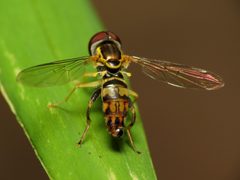
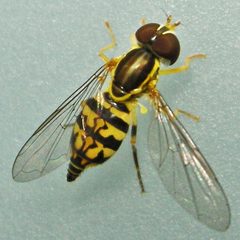
Toxomerus geminatus, commonly known as the Eastern Calligrapher, is a small hover fly (Syrphidae) native to eastern North America. measure 6.1–7.6 mm and are frequently found hovering around flowers where they feed on nectar and pollen. The is very similar in appearance to the Western Calligrapher (Toxomerus occidentalis). Larvae are of aphids and mites, contributing to in agricultural and natural settings.
Pronunciation
How to pronounce Toxomerus geminatus: //tɒkˈsɒmɛrəs dʒɛmɪˈneɪtəs//
These audio files are automatically generated. While they are not always 100% accurate, they are a good starting point.
Identification
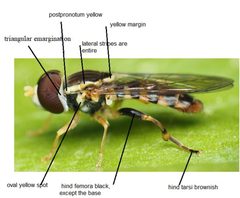
Distinguished from the Western Calligrapher (Toxomerus occidentalis) by geographic range and subtle morphological differences. The yellow lateral thoracic stripes and broadly yellow scutellum margin are key features. Females have a characteristically flattened, oval with complex yellow markings that are highly variable between individuals. The combination of light yellow and with black and yellow thoracic pattern separates it from most other small syrphid flies. Specimens with reduced markings may require careful examination of multiple characters.
Images
Habitat
Found in association with flowering plants where feed. Larval includes areas with and mite on vegetation.
Distribution
Eastern and central United States and Canada. Range extends from eastern Canada south to Texas.
Diet
Life Cycle
Behavior
frequently hover around flowers. Has been observed landing on humans to lap sweat, presumably obtaining salts and minerals.
Ecological Role
Human Relevance
Beneficial insect for pollination and biological pest control. Sometimes mistaken for sweat bees due to its small size and yellow-and-black coloration. occasionally land on humans to obtain moisture and salts from sweat.
Similar Taxa
- Toxomerus occidentalisVery similar in appearance; distinguished by geographic range (western North America) and subtle morphological differences
- Lasioglossum spp.Often mistaken for sweat bees due to small size and yellow-and-black coloration; Toxomerus geminatus is a fly (one pair of wings, short ) rather than a (two pairs of wings, longer antennae)
Misconceptions
Frequently mistaken for sweat bees (Halictidae) in casual observation due to similar size and coloration. Unlike sweat bees, this cannot sting and is harmless to humans.
More Details
Taxonomic note
Originally described by Thomas Say in 1823. The Toxomerus was long assumed to have exclusively predatory larvae until some were discovered feeding on pollen, highlighting ongoing discoveries in syrphid .