
Toxomerus
Macquart, 1855
Calligrapher Flies
Species Guides
13- Toxomerus arcifer(Bow-shaped Calligrapher)
- Toxomerus boscii(Thin-lined Calligrapher)
- Toxomerus corbis(Black-sided Calligrapher)
- Toxomerus dispar(Dark-sided Calligrapher)
- Toxomerus floralis(Florida Calligrapher)
- Toxomerus geminatus(Eastern Calligrapher)
- Toxomerus jussiaeae(Orange-backed Calligrapher)
- Toxomerus marginatus(Margined Calligrapher)
- Toxomerus mutuus
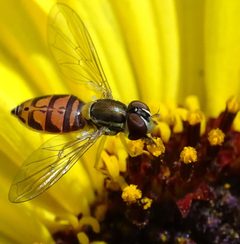
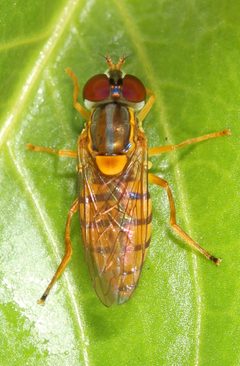
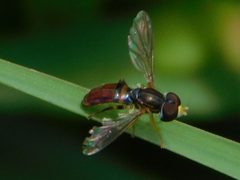
Toxomerus is a large of hoverflies ( Syrphidae) distributed across the Americas, with over 130 described Neotropical and additional Nearctic endemics. Species are small (typically 6–9 mm), characterized by large with indentation and diagnostic abdominal patterns. Most larvae are predatory on soft-bodied insects, particularly aphids, though at least three species are known pollen-feeders. are pollinivorous, feeding on nectar and pollen from diverse flowering plants. The genus includes notable ecological such as Toxomerus basalis, a kleptoparasite of sundews (Drosera), and several species introduced to the Afrotropics.
Pronunciation
How to pronounce Toxomerus: //tɒkˈsɒmərəs//
These audio files are automatically generated. While they are not always 100% accurate, they are a good starting point.
Identification
Distinguished from other hoverfly by the indentation of the and unique abdominal patterning; the latter is diagnostic at the level within the genus. Eyes are large, occupying approximately two-thirds of the , and range from red to black. in eye spacing: males have narrowly separated eyes, while females show wider spacing with visible ocelli. Body length 6–9 mm. Mimics stinging Hymenoptera but has significantly less hair than bees and lacks the two pairs of wings characteristic of that order.
Images
Habitat
Found in diverse environments including dense ground cover, grasses, leaves, agricultural settings (e.g., sugarcane fields), secondary forests, and urban gardens. Some associate with specific plants: Toxomerus basalis occurs with Drosera (sundews), while introduced in Africa inhabit tropical regions in West and Central Africa.
Distribution
Native to the Americas, with highest diversity in the Neotropics. Widespread in North and South America; Toxomerus marginatus is ubiquitous in northern regions, while T. dispar and T. pulchellus dominate tropical areas. Introduced established in the Afrotropics (Togo, Benin, Nigeria, Cameroon) and potentially other Old World regions; T. floralis and T. basalis confirmed as introductions to Africa.
Seasonality
activity peaks during early daylight hours, declining by late afternoon. Polyvoltine such as Toxomerus marginatus breed multiple times per year. Activity patterns correlate with cycles, with adults especially conspicuous in spring and fall.
Diet
Larvae: predominantly predatory on soft-bodied insects including aphids (Aphididae), other Hemiptera, Acari, Thysanoptera, and Lepidoptera larvae. Three known exceptions are pollenivorous: Toxomerus apegiensis (pollen of Olyra obliquifolia, bamboo), T. politus (pollen of Zea mays, corn), and T. floralis (pollen of Cyperus rotundus and Mitracarpus hirtus from two different plant ). : pollinivorous, feeding on nectar and pollen from numerous plant families including Poaceae, Scrophulariaceae, Ericaceae, Cyperaceae, and Orobanchaceae.
Life Cycle
Complete with four stages: , larva (three instars), pupa, and . Females lay eggs in or near colonies or appropriate pollen sources; clutch size can reach hundreds. Larval development includes three instars before . Pupa is convex and pear-shaped, attached to leaves or stems. Adult lifespan approximately one month, varying seasonally (shorter in summer, longer in winter).
Behavior
exhibit hovering and visit flowers for feeding. Territorial observed in Toxomerus basalis around Drosera plants, with adults avoiding sticky traps and demonstrating host recognition. Does not engage in behavioral mimicry of Hymenoptera (no leg waving, wing wagging, or mock-stinging) despite morphological resemblance. Mating occurs midair or on the ground depending on . Foraging activity concentrated in early daylight.
Ecological Role
Larvae function as agents, suppressing and other pest in agricultural and natural systems. serve as for diverse flowering plants. Toxomerus basalis exhibits a unique kleptoparasitic mutualism with Drosera plants. Some introduced populations may compete with native syrphid .
Human Relevance
Beneficial in gardens and agriculture due to larval on aphids and other pests; reduces need for chemical control. contribute to pollination of crops and ornamental plants. Frequently mistaken for sweat bees or stinging Hymenoptera, leading to unnecessary concern. Tiny such as Toxomerus marginatus commonly encountered in North American urban environments.
Similar Taxa
- AllograptaBoth are diverse, relatively understudied Syrphini with similar body plans and Neotropical distributions; distinguished by structure and abdominal patterning in Toxomerus.
- EpisyrphusOld World with convergent mimicry of Hymenoptera; Toxomerus is restricted to the Americas (except introduced ) and distinguished by indentation.
- SyrphusShares aphidophagous larvae and pollinivorous ; Toxomerus are generally smaller (6–9 mm versus larger Syrphus) with distinct .
Sources and further reading
- BugGuide
- Wikipedia
- GBIF taxonomy match
- iNaturalist taxon
- NCBI Taxonomy
- Catalogue of Life
- Syrphids Back Again | Bug Squad
- Bug Eric: Don't Sweat 'em
- Hover Flies Identified: Researchers Tackle 20,000 Syrphid Specimens in Illinois Collection
- The "Accidental Entomologist" Who Studies Insect Community Ecology
- Bug Eric: The Maggot on the Rosebush: Aphid-eating Flower Fly Larvae
- Hover fly on mallow flower | Beetles In The Bush
- Intraspecific variability of the flower fly Toxomerus flaviplurus (Hall, 1927) (Diptera: Syrphidae), with new distribution records in Colombia and Bolivia.
- A second New World hoverfly, Toxomerus floralis (Fabricius) (Diptera: Syrphidae), recorded from the Old World, with description of larval pollen-feeding ecology
- Attracted to feed, not to be fed upon – on the biology of Toxomerus basalis (Walker, 1836), the kleptoparasitic ‘sundew flower fly’ (Diptera: Syrphidae)
- New records of Pseudoscaeva meridionalis (Fluke, 1951), Eristalinus (Eristalodes) taeniops (Wiedemann 1818), and Toxomerus politus (Say, 1823) (Diptera, Syrphidae) to Chile, with updated distributions for the New World according to citizen science