
Toxomerus politus
(Say, 1823)
maize calligrapher
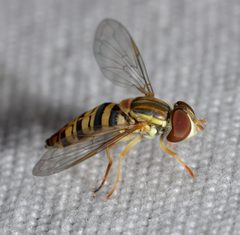
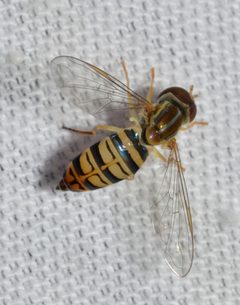
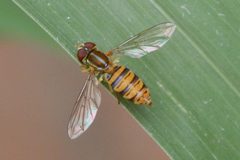
Toxomerus politus, commonly known as the maize calligrapher, is a small hoverfly (Diptera: Syrphidae) measuring 8–9 mm. The is native to North America but has been introduced and is expanding its distribution across Central and South America, with recent records from Chile. and larvae are associated with corn (Zea mays), feeding on pollen. The species has been studied for its male genitalia and sperm ultrastructure using advanced microscopy techniques.
Pronunciation
How to pronounce Toxomerus politus: /tɔkˈsɒmərəs pəˈlaɪtəs/
These audio files are automatically generated. While they are not always 100% accurate, they are a good starting point.
Identification
Distinguished from similar Toxomerus by the combination of: triangular emargination at or above antennal level; greenish-bronze scutal pollinosity with distinct ashy grey stripe bordered by colored stripes; three yellow spots; and specific abdominal pattern with broad yellow cross-band on second segment. Male with narrowly eyes and orange ; female with dichoptic eyes, brown flagellum, and characteristic black spots on fifth abdominal segment. Microscopic examination of male genitalia (, surstylus, , postgonite) may be required for definitive identification from closely related species.
Images
Habitat
Associated with agricultural and natural where corn (Zea mays) occurs. Specimens collected from protected areas of Cerrado vegetation in Brazil, including Emas National Park, Silvânia National Forest, and Fazenda Água Limpa. Likely occupies open habitats, fields, and areas with flowering vegetation.
Distribution
Native to North America (United States, including Vermont); introduced and established in Central and South America. Documented from Brazil (Goiás, Distrito Federal, and multiple states including Acre, Alagoas, Amazonas, Amapá, Bahia, Ceará, Espírito Santo, Maranhão, Minas Gerais, Mato Grosso do Sul, Mato Grosso, Pará, Paraíba, Pernambuco, Piauí, Paraná, Rio de Janeiro, Rio Grande do Norte, Rondônia, Roraima, Rio Grande do Sul, Santa Catarina, Sergipe, São Paulo, Tocantins), Chile (new record), Colombia (Armenia, Villavicencio), and Norway (introduced). Expanding distribution in the New World as an .
Diet
feed on pollen of corn plants (Zea mays). Larvae likely feed on corn pollen based on adult association, though early stages are poorly known.
Host Associations
- Zea mays - pollen source and likely larvae feed on corn pollen; commonly known as 'maize calligrapher' due to this association
Behavior
visit flowers for pollen, particularly corn. Males exhibit typical syrphid of perching and defending territories. Attracted to human sweat for moisture and salts, like many syrphid flies.
Ecological Role
provide pollination services to corn and likely other plants. stages may contribute to decomposition of plant matter. Used as bioindicators in some contexts. As an introduced in South America, may have potential negative impacts on native syrphid species through competition for resources.
Human Relevance
Important of corn crops. Sometimes mistaken for sweat bees due to attraction to human perspiration. Subject of scientific study for male genitalia and sperm ultrastructure. Expanding geographic range makes it a of interest for monitoring potential in the New World.
Similar Taxa
- Toxomerus geminatusSimilar small size and yellow-black coloration; distinguished by abdominal pattern and male genitalia structure
- Toxomerus marginatusOverlapping distribution and ; requires examination of thoracic vittae and abdominal markings for separation
- Lasioglossum sweat bees (Halictidae)Commonly mistaken due to similar size, coloration, and attraction to human sweat; distinguished by single pair of wings, short , and emargination in Toxomerus
Misconceptions
Frequently misidentified as 'sweat bees' in casual observation due to attraction to human perspiration and similar size/coloration to small bees. This reflects a broader pattern of syrphid flies being mistaken for bees or due to mimicry and behavioral convergence.
More Details
Preservation notes
Specimens preserved in 70% ethanol for approximately 5 years retained sufficient morphological integrity for detailed microscopic study of male genitalia and sperm ultrastructure, though some tissue degradation occurred. Critical point drying preserved original coloration better than room-temperature drying.
Research significance
Subject of detailed morphological study using scanning electron microscopy (SEM), transmission electron microscopy (TEM), and confocal laser scanning microscopy (CLSM) to characterize male genitalia structures and sperm ultrastructure, contributing to understanding of syrphid reproductive .
Citizen science contributions
Distribution records significantly enhanced by citizen science data from iNaturalist and similar platforms, enabling detection of range expansion and new country records including Chile.
Sources and further reading
- BugGuide
- Wikipedia
- GBIF taxonomy match
- iNaturalist taxon
- NCBI Taxonomy
- Catalogue of Life
- Meloidae Holdings | Entomology Research Museum
- Bug Eric: Don't Sweat 'em
- Hover Flies Identified: Researchers Tackle 20,000 Syrphid Specimens in Illinois Collection
- Bug Eric: More Beetles from Bones
- ID Challenge #19 | Beetles In The Bush
- The "Accidental Entomologist" Who Studies Insect Community Ecology
- New records of Pseudoscaeva meridionalis (Fluke, 1951), Eristalinus (Eristalodes) taeniops (Wiedemann 1818), and Toxomerus politus (Say, 1823) (Diptera, Syrphidae) to Chile, with updated distributions for the New World according to citizen science
- Contributions of Microscopy to the Morphological Characterization of the Male Genitalia of Toxomerus politus (Diptera, Syrphidae).