
Eupeodes americanus
(Wiedemann, 1830)
American hoverfly, Long-tailed Aphideater
Eupeodes americanus, the American hoverfly, is a Nearctic aphidophagous hoverfly commercialized in Canada as a agent for management. feed on nectar and pollen, while larvae are voracious of aphids, with one larva consuming approximately 2,000 aphids during development. The is notable for its ability to remain active at low temperatures (12–18°C) where other biocontrol agents become inactive. It has been evaluated as a biocontrol agent for greenhouse and field crops including sweet pepper, cucumber, cotton, soybeans, melons, and potatoes.
Pronunciation
How to pronounce Eupeodes americanus: /juːˈpiːoʊdiːz əˌmɛrɪˈkeɪnəs/
These audio files are automatically generated. While they are not always 100% accurate, they are a good starting point.
Identification
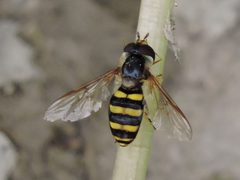
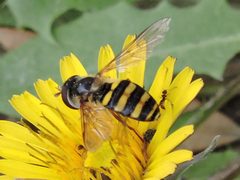
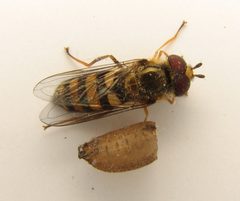
distinguished from similar hoverflies by combination of black to metallic green coloration with three yellow abdominal bands, light yellow , and large black . Larvae identified by yellow-white to salmon brown coloration with distinctive transverse rectangular bars on abdominal segments 6–11 and lateral lines. Distinguished from Aphidoletes aphidimyza by morphological features of Syrphidae versus Cecidomyiidae larvae.
Images
Habitat
Meadows, fields with flowers and foliage. In agricultural settings, found in greenhouses and field crops. Laboratory rearing conducted at 22°C day/19°C night, 60% RH, 16:8 L:D for ; 24°C, 70% RH, 16:8 L:D for larvae. Field specimens collected from Phlox sp. flowers.
Distribution
Nearctic region; native to North America. Found throughout North America from Canada to the southeastern United States. Wild specimens collected in Sainte-Agathe-de-Lotbinière, Québec, Canada. Highly migratory, moving from Canada to southeastern United States during autumn.
Diet
: nectar, sugar:water mixture (1:10 v/v), honey:water mixture (1:3 v/v), wildflower pollen. Larvae: aphids ( feeding on 40+ including Acyrthosiphon pisum, Aulacorthum solani, Aphis gossypii, Aphis glycines, Myzus persicae, Rhopalosiphum padi). One larva consumes approximately 2,000 aphids during development.
Host Associations
- Acyrthosiphon pisum - preylarval food source
- Aulacorthum solani - preylarval food source
- Aphis gossypii - preylarval food source
- Aphis glycines - preylarval food source
- Myzus persicae - preylarval food source
- Rhopalosiphum padi - preylarval food source
Life Cycle
Complete with , larval, pupal, and stages. Preoviposition period: 3–6 days (mean 4.1±0.2 days). Oviposition period: 5–31 days (mean 15.9±1.6 days). Adult female longevity: 20.6±1.6 days. Larval developmental time longer than Aphidoletes aphidimyza. Lifetime : 295.7±40.4 eggs per female (range up to 693 eggs). Egg hatching rate similar to Aphidoletes aphidimyza; (viability) considerably higher.
Behavior
Furtive —larvae feed on aphids without triggering defensive responses. Can fly, lay , and feed at low temperatures (12–18°C) where other biocontrol agents are inactive. Uses banker plant systems to feed and reproduce; from banker systems can locate and oviposit on infested crop plants. Oviposition modulated by : minimum density of 5 aphids required on cucumber, but only 2 on pepper. Lays more than twice as many eggs as Aphidoletes aphidimyza on pepper.
Ecological Role
of pests in natural and agricultural . Member of aphidophagous guild of natural enemies supporting sustainable agriculture. Evaluated and commercialized as a agent for aphid management in greenhouses and field crops including sweet pepper, cucumber, cotton, soybeans, melons, and potatoes.
Human Relevance
Commercialized in Canada as a biocontrol agent for pest management. First hoverfly commercialized in Canada. Being considered as suitable agent for aphids and scale insects in programs.
Similar Taxa
- Aphidoletes aphidimyzaBoth are aphidophagous Diptera used as biocontrol agents; distinguished by -level differences (Syrphidae vs. Cecidomyiidae), with E. americanus having longer larval development, higher , greater activity at low temperatures, and different oviposition thresholds
- Eupeodes volucrisSimilar hoverfly in same with overlapping distribution; E. americanus distinguished by three yellow abdominal bands versus different banding patterns
More Details
Biocontrol agent status
First hoverfly commercialized in Canada for biocontrol. Colony maintained since 2014 with refreshment from wild individuals from Sainte-Agathe-de-Lotbinière, Québec.
Low-temperature activity
Unique among commercial in maintaining , oviposition, and feeding activity at 12–18°C, enabling earlier season aphid control when other agents are inactive.
Sources and further reading
- BugGuide
- Wikipedia
- GBIF taxonomy match
- iNaturalist taxon
- NCBI Taxonomy
- Congratulations, UC Davis Linnaean Games Team: National Champs! | Bug Squad
- Oklahoma is More than OK for Burying Beetles
- Bug Eric: A Couple of Weirdos
- Emerald Ash Borer Infestation of White Fringetree Found to be Widespread
- North America’s itsiest bitsiest longhorned beetle | Beetles In The Bush
- Silphidae | Beetles In The Bush
- Evaluating a new aphid biocontrol agent: The role of aphid density in modulating oviposition behaviour in the American hoverfly, Eupeodes americanus, and the aphid midge, Aphidoletes aphidimyza
- Reproductive parameters of a new biocontrol agent, Eupeodes americanus (Diptera: Syrphidae) and comparison with the commercialized Aphidoletes aphidimyza (Diptera: Cecidomyiidae).