
Aphidoletes aphidimyza
(Rondani, 1848)
aphid midge
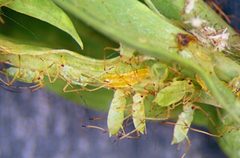
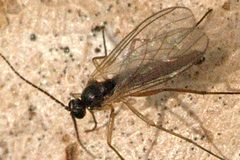
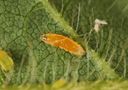
Aphidoletes aphidimyza is a predatory gall midge used worldwide in programs against aphids. are small, delicate, flies that feed on honeydew and hide beneath leaves during daylight. The bright orange, slug-like larvae are specialized aphid that paralyze prey by injecting venom into leg joints before consuming body contents. The is commercially mass-produced and distributed as pupae in moist substrate for greenhouse applications.
Pronunciation
How to pronounce Aphidoletes aphidimyza: //ˌæfɪdoʊˈliːtiːz æˌfɪdɪˈmaɪzə//
These audio files are automatically generated. While they are not always 100% accurate, they are a good starting point.
Identification
distinguished from other small black flies by and association with colonies; larvae recognized by bright orange color, slug-like form, and presence within aphid colonies; differs from hover fly larvae (Syrphidae) by smaller size and distinct leg-attack behavior rather than direct consumption
Images
Habitat
Greenhouses, field crops (alfalfa, hops), orchards (apples), and nursery operations; requires high relative humidity and temperatures of 20–27°C for optimal activity; larvae pupate in soil 1.9–3.8 cm deep
Distribution
Native to and established in North America, Europe, and Japan; mass-produced commercially in Canada, Netherlands, England, Germany, Finland; present in Belgium, Denmark, Norway
Seasonality
Activity peaks at 20–27°C; emerge from pupae in 3–7 days depending on temperature; time approximately 20.6 days at 20°C
Diet
Aphids (Hemiptera: Aphididae); larvae feed on over 70–80 including Myzus persicae (green peach aphid), Aulacorthum solani (foxglove aphid), and Aphis gossypii (melon aphid); feed on aphid honeydew
Host Associations
- Myzus persicae - preygreen peach aphid; preferred for oviposition due to meristem-feeding habit
- Aulacorthum solani - preyfoxglove aphid; less preferred, receives inconsistent control in multi-prey systems
- Aphis gossypii - preymelon aphid; larva kills average of 23.8 individuals during development
- Brassica oleracea var. gemmifera - plant of preybrussels sprouts; aphids reared on this plant provide higher nutritional value to
- Vicia faba - plant of preybroad bean; aphids reared on this plant reduce
- Aphanogmus fulmeki - hymenopteran of pupae, observed in commercial insectaries
Life Cycle
hatch in 2–3 days; larval development 3–7 days; larvae drop to soil and burrow 1.9–3.8 cm to pupate; pupal stage 11.9 days at 20°C; total development from egg to approximately 20.6 days at 20°C; adults live average 10 days; females deposit 100–250 eggs singly or in small groups
Behavior
activity in ; hiding beneath leaves; larvae attack aphids by attaching to leg joints, injecting paralytic venom, then moving to for feeding; larvae may kill more aphids than consumed when prey is high; oviposition preferentially on aphids colonizing new growth and meristematic tissue; attracted to from conspecifics and from spider Linyphia triangularis
Ecological Role
Specialized of aphids; agent in natural and managed ; can achieve 78–95% control of preferred ; efficacy reduced in multi-prey systems when aphid species differ in within-plant distribution
Human Relevance
Commercially mass-produced agent for greenhouse crops, field crops, orchards, and nurseries; sold as pupae in trays or bottles with moist substrate (vermiculite or peat moss); used alone or in combination with other natural enemies such as Aphidius colemani; -based attractants under development to enhance field efficacy
Similar Taxa
- Syrphidae (hover flies)larvae also but larger, lack paralytic venom attack , and have distinct maggot-like form with respiratory siphon
- Aphidius colemani used in same programs; Aphidoletes is with visible larvae while Aphidius produces mummies; direct on parasitized aphids by Aphidoletes reduces parasitoid production
- Fungus gnats (Sciaridae) similar in appearance but larvae feed on fungi, not aphids, and lack bright orange coloration
Sources and further reading
- BugGuide
- Wikipedia
- GBIF taxonomy match
- iNaturalist taxon
- NCBI Taxonomy
- Catalogue of Life
- Fly with a fondness for legs - aphid midges, Aphidoletes aphidomyza — Bug of the Week
- Sexual dimorphism and sex pheromone detection in Aphidoletes aphidimyza
- Sex Pheromones From Linyphia triangularis (Araneae: Linyphiidae) and Aphidoletes aphidimyza (Diptera: Cecidomyiidae) Are Promising Attractants for Aphidoletes aphidimyza (Diptera: Cecidomyiidae)
- Biological Control Outcomes Using the Generalist Aphid Predator Aphidoletes aphidimyza under Multi-Prey Conditions
- An Evaluation of the Parasitoid, Aphidius colemani Viereck (Hymenoptera: Braconidae) and the Predator Aphidoletes aphidimyza Rondani (Diptera: Cecidomyiidae) for Biological Control of Aphis gossypii Glover (Homoptera: Aphididae) on Cucumber
- APHANOGMUS FULMEKI ASHMEAD (HYMENOPTERA: CERAPHRONIDAE), A PARASITOID OF APHIDOLETES APHIDIMYZA RONDANI (DIPTERA: CECIDOMYIIDAE)
- Auswirkungen zweier Wirtspflanzen von Myzus persicae (Sulz.) auf den räuberischen Blattlausfeind Aphidoletes aphidimyza (Rond.) (Diptera: Cecidomyiidae)1
- Distribution and host range of an aphidophagous species of Cecidomyiidae, Aphidoletes aphidimyza (Diptera), in Japan
- Genome-wide identification and multi-level analysis of the HSP gene superfamily in Aphidoletes aphidimyza: sHSP gene family expansion and its role in diapause regulation.