
Misumenoides formosipes
(Walckenaer, 1837)
White-banded Crab Spider
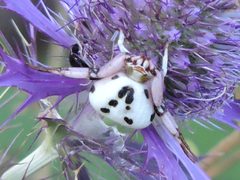
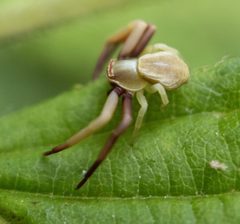
Misumenoides formosipes is a crab spider ( Thomisidae) commonly known as the white-banded crab spider, named for the distinctive white ridge running through the plane of its . The exhibits pronounced , with females significantly larger than males and capable of changing color between white and yellow to match their surroundings, while males maintain a fixed gold coloration with darker front legs. This sit-and-wait hunts on flowers without building webs.
Pronunciation
How to pronounce Misumenoides formosipes: //ˌmɪsʊmɛˈnɔɪdiːz fɔːrˈmoʊsɪˌpiːz//
These audio files are automatically generated. While they are not always 100% accurate, they are a good starting point.
Identification
The white band below the distinguishes Misumenoides formosipes from similar crab spiders. Females can be separated from Misumena vatia (goldenrod crab spider) by the presence of this white ridge and their more variable coloration. Males are distinguished by their fixed gold coloration and darker front legs, unlike the changeable females. The ' crab-like posture—legs extended laterally and enlarged front legs held forward—separates it from non-thomisid spiders.
Images
Appearance
Females measure 5.0–11.3 mm in body length, with a rounded triangular . They can change color between white, yellow, or light brown, with variable markings in red, black, or brown. The defining feature is a white ridge below the bottom row of . Males are much smaller at 2.5–3.2 mm, with an unchangeable gold abdomen and four darker front legs that are disproportionately long. Both sexes have enlarged, strong front legs adapted for seizing prey.
Habitat
Found in heterogeneous including prairies, meadows, and open woodlands. Occupies inflorescences of flowering plants, particularly those attractive to . Has been observed on Rudbeckia hirta and other composite flowers. Tolerates a wide temperature range, with activity recorded from 2.2°C to 48.2°C, though prefers temperatures around 18.4°C.
Distribution
Occurs throughout the United States and in Colombia (specifically recorded from Copacabana, Antioquia). Distribution records from GBIF confirm presence in Canada and the USA, including Vermont.
Seasonality
, active during daylight hours. present during spring and summer months when flowering plants are available. Reproductive activity occurs when females approach maturity; males search for females throughout the active season.
Diet
Females are ambush that capture visiting inflorescences, including honey bees (Apis mellifera). Males are nectarivores, obtaining the majority of their nutrients from nectar, specifically documented feeding on Daucus carota ( Anne's Lace). The small size of males allows them to utilize nectar with low sucrose concentrations.
Host Associations
- Rudbeckia hirta - floral Common flower occupied by this
- Daucus carota - nectar source for malesPrimary nectar source for male spiders
- Apis mellifera - preyDocumented prey item for females
Life Cycle
Females deposit 80–180 tan-colored into a silk sack approximately 10–14 mm wide on nearby foliage. The female guards the egg sac until her death. Males locate (subadult) females and guard them until they to maturity, ensuring mating access. Spiderlings emerge from the egg sac and disperse; specific details of development are not documented.
Behavior
Non-web building sit-and-wait . Females remain stationary on flowers, using enlarged front legs to seize prey. Males actively search for mates by detecting floral scents, traversing vegetation by jumping between plant parts and using silk threads to bridge gaps. Males engage in pre-copulatory mate guarding, fighting off rival males on the female's inflorescence; resident males and those with prior fighting experience have advantages in contests. When threatened, individuals may flee or hide.
Ecological Role
Acts as a of , potentially influencing pollination dynamics through pollinator removal. Males function as nectar consumers, participating in plant-pollinator . The occupies a mid-trophic position as both predator and prey within .
Human Relevance
Photographed frequently by macrophotographers due to its accessibility on flowers and striking appearance. Not considered medically significant or economically important. Serves as a subject for behavioral studies on , color change, and mating systems.
Similar Taxa
- Misumena vatiaSimilar crab spider and flower-dwelling habit, but lacks the white ridge below the and has different color change dynamics
- Other Thomisidae generaShare the crab-like leg posture and front legs, but differ in arrangement and coloration patterns
More Details
Color change physiology
Female color change from white to yellow occurs over 3+ days via production of ommochrome pigments. Change from yellow to white takes longer and involves guanine and deposition in the .
Thermal tolerance
Documented temperature ranges from 2.2°C to 48.2°C, among the widest recorded for spiders, facilitating occupation of exposed floral .
Male dispersal behavior
Males use two distinct locomotion methods: jumping between plant parts and releasing silk threads into the wind to bridge gaps between plants.