
Misumenoides
F. O. Pickard-Cambridge, 1900
whitebanded crab spider
Species Guides
2- Misumenoides formosipes(White-banded Crab Spider)
- Misumenoides quetzaltocatl
Misumenoides is a of crab spiders in the Thomisidae, established by F. O. Pickard-Cambridge in 1900. The genus contains approximately 35 distributed primarily in the Americas, with M. formosipes (whitebanded crab spider) being the most thoroughly documented species in North America. These spiders are ambush that typically hunt on flowers, using their crab-like front legs to grasp prey. The genus has been recently recorded from Bangladesh, extending its known distribution to South Asia.
Pronunciation
How to pronounce Misumenoides: /mɪˌsʊmɛˈnoʊɪdiːz/
These audio files are automatically generated. While they are not always 100% accurate, they are a good starting point.
Identification
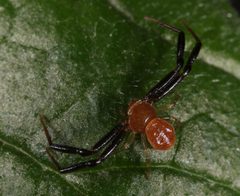
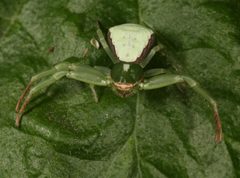
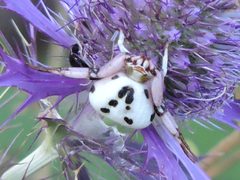
Females of M. formosipes can be distinguished from the similar Misumena vatia by an inverted 'V' marking on the dorsum with the point closer to the , and a 'mask' over the . Males of M. formosipes are markedly smaller than females with a greenish cephalothorax, yellow-orange , and long red to reddish-black front legs. The is characterized by the typical crab spider body plan: flattened body with two pairs of enlarged, front legs held laterally in a crab-like posture.
Images
Habitat
Members of this are found in diverse including prairies, meadows, and forest edges. M. formosipes has been observed hunting in goldenrod sprays and on a wide variety of flowering plants. The Bangladesh record suggests occurrence in tropical or subtropical regions as well.
Distribution
The is distributed across the Americas from Canada and the United States through Mexico, Central America, and South America (Argentina, Brazil, Chile, Colombia, Guyana, Venezuela). A single , M. deccanes, has been recorded from Khulna, Bangladesh, representing the first Asian record of the genus.
Seasonality
M. formosipes are active in late summer and early fall in temperate North America. Males wander in search of females during this period. Specific seasonal data for other is not documented in available sources.
Diet
M. formosipes preys on honeybees, large flies, and small butterflies such as skippers. The tends to take smaller prey than the similar Misumena vatia, avoiding bumblebees and large butterflies. Diet of other species in the is not documented.
Behavior
M. formosipes females are ambush that wait on flowers for . Males wander across diverse vegetation in search of females. The is capable of capturing honeybees as documented prey. No behavioral data is available for other species in the .
Ecological Role
Human Relevance
M. formosipes is a subject of interest for macrophotographers and naturalists. The has been used to demonstrate advanced lighting techniques in insect photography workshops. No economic or medical significance is documented.
Similar Taxa
- Misumena vatiaSimilar crab spider and flower-dwelling habit; distinguished by larger size, different markings (inverted V point position differs), and preference for larger prey including bumblebees
Sources and further reading
- BugGuide
- Wikipedia
- GBIF taxonomy match
- NCBI Taxonomy
- Catalogue of Life
- Araneae | Beetles In The Bush | Page 6
- photography | Beetles In The Bush | Page 9
- Bug Eric: Dimorphic Jumping Spider, Maevia inclemens
- techniques | Beetles In The Bush | Page 10
- Hymenoptera | Beetles In The Bush | Page 7
- A newly recorded crab-spider genus Misumenoides F.O. Pickard-Cambridge, 1900 (Araneae: Thomisidae) from Khulna, Bangladesh