
Diaea
Thorell, 1869
Flower Spiders
Species Guides
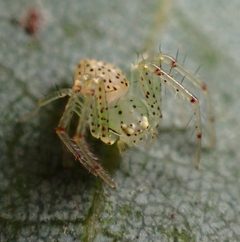
1Diaea is a of crab spiders ( Thomisidae) first described by Thorell in 1869. The genus contains 46 as of September 2025, most with restricted distributions except for D. livens (United States) and D. dorsata (Palearctic). range 4–7 mm in body length and are strongly associated with vegetation, particularly flowers, where their green, yellow, or white coloration provides camouflage.
Pronunciation
How to pronounce Diaea: /ˈdaɪ.iə/
These audio files are automatically generated. While they are not always 100% accurate, they are a good starting point.
Identification
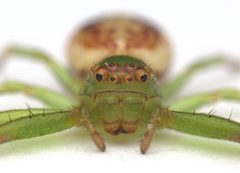
Distinguished from other crab spider by the combination of: recurved rows of nearly equal length; eyes closer to each other than to lateral posterior eyes; lateral eyes on ; and small size (4–7 mm) with green, yellow, or white coloration. The rounded female and oval male abdomen provide useful for identification. Beating and sweeping vegetation is the standard sampling method for detection.
Images
Appearance
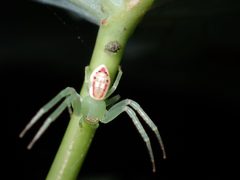
Small crab spiders with body lengths of 4–7 mm. is white, yellow, or green, sometimes darker around the , with smooth bearing simple isolated setae and long prominent setae; moderately convex above. Lateral eyes positioned on . Both eye rows recurved and nearly equal in length; eyes closer to each other than to posterior lateral eyes. round in females, oval in males, matching carapace coloration with darker spots or markings. Legs thin, slender, same color as carapace, sometimes banded. Males more slender than females with proportionally longer legs.
Habitat
Vegetation-dwelling spiders found on trees, shrubs, and grasses. Strongly associated with flowers where color-matching camouflage is employed. Most commonly detected through beating and sweeping of vegetation.
Distribution
Most have restricted geographic ranges. D. livens occurs in the United States; D. dorsata has a Palearctic distribution. GBIF records indicate presence in Denmark, Norway, and Sweden.
Behavior
Hides in and around vegetation, especially flowers, using coloration to blend with surroundings. Detected primarily through beating and sweeping vegetation rather than visual encounter surveys.
Ecological Role
Ambush in vegetation , likely contributing to flower-visiting insect through .
Similar Taxa
- MisumenaBoth are flower-dwelling crab spiders with color-changing abilities; Misumena are generally larger and have different arrangement proportions.
- ThomisusShares flower-dwelling habit and cryptic coloration; Thomisus typically have more flattened body profiles and different abdominal shapes.
More Details
Sampling methodology
This is very commonly sampled through beating and sweeping vegetation, indicating it is not readily observed through passive searching.
Species diversity
As of September 2025, the includes 46 , indicating substantial diversity despite the small number of widespread species.