
Milichiidae
freeloader flies, jackal flies, filth flies
Subfamily Guides
3- Madizinae(freeloader flies)
- Milichiinae
- Phyllomyzinae
Milichiidae is a of minute acalyptrate flies comprising approximately 250 in 19 across three (Madizinae, Milichiinae, Phyllomyzinae). are best known for kleptoparasitic , feeding on bodily fluids of prey captured by predatory such as spiders, assassin bugs, and mantids. They are attracted to olfactory cues released by killed prey, particularly Heteroptera and Hymenoptera. Larvae develop in decaying organic matter including rotting vegetation, wood, bark, manure, and carrion. Some species have forensic importance due to association with corpses, while others exhibit myrmecophilous associations or phoretic behaviors.
Pronunciation
How to pronounce Milichiidae: //mɪˌlɪkiˈaɪdiˌiː//
These audio files are automatically generated. While they are not always 100% accurate, they are a good starting point.
Identification
Distinguished from similar minute flies by the combination of large relative to body size, geniculate folded beneath the head, and short broad . Dark coloration with frequently red provides additional cues. Separation from the closely related Carnidae requires careful examination of morphological characters; historically these families were not distinguished. Presence at events or in association with decaying matter can provide contextual identification clues.
Images
Appearance
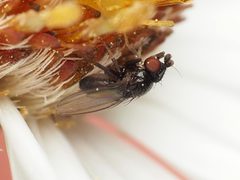
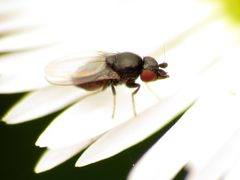
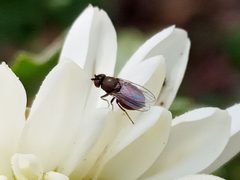
Minute to small flies, typically 1–3 mm in length. Body usually black or dark in coloration. disproportionately large relative to body size compared to similarly sized flies such as Phoridae. often red, though frequently inconspicuous due to small size and dusky coloration. long and geniculate, folded beneath the head when not in use and extended during feeding. short and broad, capable of impressive distension after feeding. In some , such as Milichiella argyrogaster, males possess silvery abdominal hairs.
Habitat
Larval includes decaying plant matter, rotting wood and bark, manure, and decaying animal materials including carrion. habitat spans diverse environments where predatory hunt or where decaying organic matter accumulates. Some associate with colonies, bird nests, or bat roosts.
Distribution
Distributed across all biogeographic regions except Antarctica. Human commerce has inadvertently spread some globally; Desmometopa and Milichiella are recorded on multiple continents. Specific distribution records include North America, South America (Argentina, Chile), Europe (Czech Republic, Slovakia, Greece), and Asia.
Seasonality
Activity patterns vary by and latitude. In temperate regions, peaks in late June for some species, with activity extending from late May through September. Other species show more restricted seasonal activity, such as mid-July to mid-August. Year-round activity likely occurs in tropical regions.
Diet
Larvae feed on rotting vegetable matter, decaying wood or bark, manure, and carrion; at least some are . engage in kleptoparasitism, feeding on bodily fluids of prey captured by other . They penetrate thin of prey items and extract tissues that have been enzymatically liquefied by predator venom.
Host Associations
- spiders (Araneae) - kleptoparasiteParticularly attracted to Nephilinae, Oxyopidae, and Thomisidae prey captures
- assassin bugs (Reduviidae) - kleptoparasiteDocumented feeding on prey of Apiomerus and other reduviids
- mantids (Mantodea) - kleptoparasiteObserved at events
- ants (Formicidae) - myrmecophileSome exhibit food-sharing with ants
- birds (Aves) - Some reported as of nestlings; reports require careful interpretation due to historical confusion with Carnidae
Life Cycle
Larval development lasts approximately 2–3 weeks in temperate climates. Larvae develop in decaying substrates. emerge and engage in kleptoparasitic feeding . Some employ phoretic strategies for , capturing other fly species in and depositing eggs in the captured fly's .
Behavior
exhibit highly specialized kleptoparasitic , locating kills through olfactory cues—specifically low-molecular-weight carbonyl compounds such as trans-2-hexenal and hexanal released by killed Heteroptera. Flies approach kills flying upwind, suggesting scent-following behavior. Some operate in darkness. Females predominate at kleptoparasitic feeding sites; males may assemble to intercept food droplets from gorged females. Some species exhibit cleaning behavior around spider and anal openings, with spiders cooperatively spreading mouthparts to allow feeding.
Ecological Role
Nutrient cycling through larval saprophagy and . Facilitation of decomposition via association with carrion, contributing to applications. Potential pollination services by some . Complex commensal and kleptoparasitic relationships with predatory , potentially influencing -prey dynamics. Association with colonies may provide additional functions.
Human Relevance
Forensic importance due to association with human and animal corpses; larval presence may provide postmortem interval estimates. Some breed in filth and human waste, earning the 'filth flies' and potential sanitary significance. Human commerce has facilitated global spread of some species.
Similar Taxa
- CarnidaeHistorically included within or confused with Milichiidae; separation requires careful morphological examination. Both contain minute dark flies with poorly studied .
- PhoridaeSimilar minute size and dark coloration; distinguished by Milichiidae's disproportionately large and geniculate . Both may occur at events.
- ChloropidaeSimilarly attracted to kills as kleptoparasites; often found co-occurring with Milichiidae at events of spiders and assassin bugs.
Misconceptions
Reports of on bird nestlings require careful interpretation; historical confusion with Carnidae means many early reports may not pertain to Milichiidae. Not all in the engage in kleptoparasitism, and not all events attract Milichiidae—attraction is specific to prey types releasing characteristic olfactory signals.
More Details
Taxonomic history
Milichiidae have been assigned to various superfamilies including Carnoidea, Chloropoidea, and Agromyzoidea. They were formerly included in Carnidae. Current classification recognizes three : Madizinae, Milichiinae, and Phyllomyzinae.
Chemical ecology
Eisner et al. (1991) experimentally demonstrated that milichiid attraction to kills is tied to specific components of defensive sprays in pentatomid and coreid prey . This chemical communication system represents a sophisticated tritrophic interaction.
Sources and further reading
- BugGuide
- Wikipedia
- GBIF taxonomy match
- iNaturalist taxon
- NCBI Taxonomy
- Catalogue of Life
- Milichiideae | Beetles In The Bush
- Diptera | Beetles In The Bush | Page 5
- Pholeomyia texensis Sabrosky (Diptera: Milichiidae): Laboratory Notes on Larval Biology
- Investigation of the Characteristics of the Milichiidae Family (Arthropoda: Insecta: Diptera)
- Additions to the Diptera Acalyptrata fauna (Anthomyzidae, Stenomicridae, Carnidae, Milichiidae, Heleomyzidae) of the Czech Republic and Slovakia
- Systematics and ecology of the Nearctic species ofNeophyllomyza(Diptera: Milichiidae)
- A catalog of the Milichiidae of Chile (Diptera: Carnoidea)
- The Distribution and Avian Hosts of Carnus Hemapterus (Diptera: Milichiidae) in North America