
Phoridae
Curtis, 1833
scuttle flies, humpbacked flies, coffin flies
Genus Guides
5- Aenigmatias
- Chonocephalinae
- Metopininae
- Myriophora(Millipede Killer)
- Phorinae
is a of small, hump-backed flies commonly known as scuttle flies, humpbacked flies, or coffin flies. The family contains approximately 4,000 described in 230 , making it one of the most diverse families of Diptera. Members are characterized by their distinctive escape of running rapidly across surfaces rather than flying, and by a pronounced thoracic hump visible in lateral view. The family exhibits extraordinary biological diversity, with lifestyles ranging from scavenging and to of social insects, including highly specialized in the genus Pseudacteon that are used for of fire ants.
Pronunciation
How to pronounce Phoridae: //ˈfɔrɪdiː//
These audio files are automatically generated. While they are not always 100% accurate, they are a good starting point.
Identification
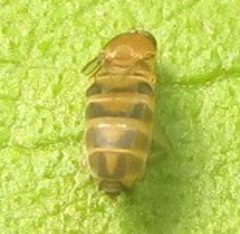
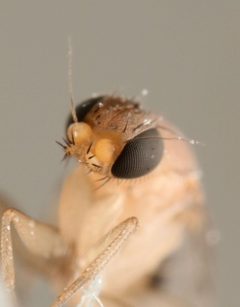
Most reliably distinguished from similar small flies by : running rapidly in darting, erratic patterns across surfaces rather than flying when disturbed. Distinguished from Drosophilidae (vinegar flies) by smaller with dark (not large red eyes), heavier hind , and the characteristic scuttling locomotion. The pronounced thoracic hump visible in lateral view is diagnostic. Wing venation is highly reduced compared to most Diptera, with only R1 and R4+5 developed among radial , and M1, M2, M4 as medial veins. The subcosta is reduced and crossveins are absent.
Images
Habitat
Extremely diverse; occupy ranging from tropical rainforests to urban environments. Larvae develop in organic detritus including , carrion, insect , dead snails, decaying fungi, and plant material. Many species are and occur in human dwellings. are associated with nests of social insects including ants, bees, and . Some species occur in aquatic or semi-aquatic habitats.
Distribution
Worldwide distribution with greatest in the tropics. The is represented on all continents except Antarctica, with extensive radiations in the Neotropical, Afrotropical, and Oriental regions. The Megaselia contains including M. scalaris, one of the most widespread and commonly encountered species in human-modified environments.
Seasonality
Activity patterns vary by and ; species active year-round in suitable indoor environments. Species associated with decomposing organic matter show peak activity corresponding to resource availability. Seasonal distribution of species often tracks activity, with multiple peaks in spring, summer, and early fall documented for some .
Diet
feed on nectar, honeydew, and exudates from fresh carrion and ; some feed on body fluids of living larvae and pupae or prey on small insects. Larvae exhibit diverse feeding habits: scavenging on decaying organic matter, , herbivory including leaf mining, or of earthworms, snails, spiders, , millipedes, and insect , larvae, and pupae.
Life Cycle
Females lay 1–100 tiny at a time in or on larval food, with lifetime up to 750 eggs. Egg-to- development averages approximately 25 days but ranges from 14 to 37 days depending on and conditions. Larvae emerge within 24 hours and feed for 8–16 days before crawling to drier locations to pupate. occurs within the hardened, reddish last larval skin (), which is oval with pointed ends. First instar larvae are metapneustic; later instars are amphipneustic. Abdominal segment 2 of the puparium bears respiratory horns.
Behavior
Characterized by rapid, darting running when escaping threats, only taking when running evasion fails. This "scuttling" locomotion is the source of the "scuttle flies." Some exhibit specialized behaviors: Pseudacteon species attack foraging ants by injecting within seconds using a sharp ovipositor; Megaselia steptoeae is attracted specifically to crushed snails for feeding and oviposition. Some myrmecophilous species are kleptoparasites, riding on and stimulating regurgitation of food. Males of some species fly in swarms.
Ecological Role
Important decomposers and nutrient cyclers through scavenging activities. Significant of social insects, contributing to of ants, bees, and . Some are . The Pseudacteon is used as agents against fire ants (Solenopsis invicta) in the United States, where their presence disrupts foraging and reduces competitive ability of invasive ants. Several species are important in for estimating postmortem intervals.
Human Relevance
Some are nuisance pests in homes, particularly around garbage disposals and drains. Several species, especially Conicera tibialis, are significant in due to their ability to colonize buried human remains, earning the vernacular name "coffin flies." The has been recorded in rare cases of opportunistic myiasis in hospital patients. Because they frequent unsanitary locations, they may mechanically transport -causing organisms to food. The mushroom phorid Megaselia halterata is a pest of cultivated mushrooms, vectoring dry mould ( fungicola). Conversely, Pseudacteon species provide valuable of fire ants.
Similar Taxa
- DrosophilidaeVinegar flies share small size and occurrence in human dwellings, but have proportionally larger with bright red , lighter hind , and characteristic perching with slow rather than rapid scuttling; they readily fly when disturbed
- SciaridaeDark-winged fungus gnats are similar in size and dark coloration but have longer, more slender bodies, longer relative to body size, and different wing venation; they are primarily associated with fungi and moist organic matter rather than showing the broad range of phorids
- MycetophilidaeFungus gnats share association with decaying organic matter and fungi but typically have longer legs, more slender bodies, and different wing venation with distinct patterns; they lack the characteristic hump-backed and scuttling
More Details
Taxonomic Complexity
The exhibits extraordinary morphological and biological diversity that has complicated classification. Current classification recognizes five : Hypocerinae (sister to all other extant ), Phorinae (sister to Aenigmatiinae + Conicerinae + Metopininae), Aenigmatiinae, Conicerinae, and Metopininae. The Metopininae contains two major groups: the mostly tropical Metopina group and the Megaselia group. Generic revisions are critically needed for major including Megaselia (approximately half the in the family), Apocephalus, Peromitra, and Chaetopleurophora.
Extreme Miniaturization
The contains the world's smallest known fly, Euryplatea nanaknihali from Thailand, at 0.4 mm body length. A second contender, Megapropodiphora arnoldi from Brazil at 0.395 mm, has an unusual limuloid body form with relatively enormous , and scutellum, and highly modified legs with enlarged forelegs and reduced mid- and hind legs.
Myrmecophily and Host Specificity
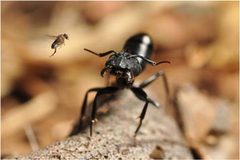
Many phorid exhibit commensal or parasitic relationships with ants. Commensal species inhabit waste piles, while attack foraging or stages. The Pseudacteon contains approximately 110 species of ant-decapitating flies that are exclusively parasitoids of ants. These flies oviposit in the ant ; larvae migrate to the , consume brain tissue, and eventually cause decapitation by enzymatic dissolution of cervical , with occurring in the detached head capsule. This extreme specialization represents one of the most remarkable parasitoid known.
Sources and further reading
- BugGuide
- Wikipedia
- iNaturalist taxon
- NCBI Taxonomy
- Catalogue of Life
- Bug Eric: Scuttle Flies
- scuttle flies | Blog
- Diptera | Blog - Part 2
- Formicidae | Blog
- parasitism | Blog
- parasitoids | Blog - Part 2
- FAMILY PHORIDAE
- GENERIC REVISION OF PHORIDAE OF THE NEARCTIC REGION AND PHYLOGENETIC CLASSIFICATION OF PHORIDAE, SCIADOCERIDAE, AND IRONOMYIIDAE (DIPTERA: PHORIDEA)
- Two new bee-killing flies from Brazil (Insecta: Diptera: Phoridae: Melaloncha)
- A second contender for “world’s smallest fly” (Diptera: Phoridae)
- Megaselia steptoeae (Diptera: Phoridae): specialists on smashed snails
- Taxonomy and the unusual morphological similarity among Hypocerides Schmitz species (Diptera: Phoridae)
- Diptera in the Forensic Investigation of Human Deaths in Great Britain and the Dominant Role of Calliphora vicina (Calliphoridae) in Estimating a Minimum Post-Mortem Interval.
- Postmortem Interval Estimation Based on the Developmental Patterns of Hemilucilia segmentaria (Fabricius) (Diptera, Calliphoridae) and Peckia (Euboettcheria) anguilla (Curran & Walley) (Diptera, Sarcophagidae): a Case in Southeastern Brazil.
- DNA Recovery from Forensically Relevant Blow Fly Larvae (Insecta, Diptera, Calliphoridae) Kept in Different Preservative Solutions.