
Madizinae
freeloader flies
Genus Guides
2- Desmometopa(freeloader flies)
- Leptometopa(freeloader flies)
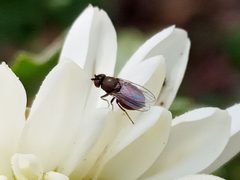
Madizinae is a of freeloader flies within the Milichiidae, comprising approximately 8 and over 160 described . Members of this subfamily are small to minute Diptera known for their kleptoparasitic , frequently associating with predatory arthropods to feed on their prey remains. The subfamily includes the genera *Madiza*, *Phyllomyza*, *Desmometopa*, *Leptometopa*, *Neophyllomyza*, *Paramyia*, *Aldrichiomyza*, and *Stomosis*.
Pronunciation
How to pronounce Madizinae: //ˌmædɪˈzaɪniː//
These audio files are automatically generated. While they are not always 100% accurate, they are a good starting point.
Identification
Madizinae can be distinguished from other Milichiidae (Milichiinae and Phyllomyzinae) by a combination of wing venation and genitalic characters; specific diagnostic features vary by . Members are generally small-bodied with reduced chaetotaxy and characteristic wing venation including a reduced anal lobe. Identification to genus level requires examination of male terminalia and antennal structure.
Images
Distribution
distribution with recorded across multiple continents; specific range varies by .
Diet
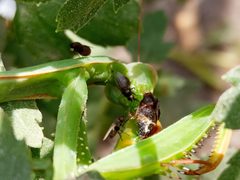
Kleptoparasitic; have been observed feeding on prey remains and regurgitated fluids associated with predatory arthropods, particularly spiders and predatory Heteroptera.
Host Associations
- Salticidae - kleptoparasiteassociates with jumping spiders to feed on captured prey
- Thomisidae - kleptoparasiteassociates with crab spiders
- Reduviidae - kleptoparasiteassociates with assassin bugs
Behavior
exhibit kleptoparasitic , closely following predatory arthropods and positioning themselves near captured prey to access fluids. This behavior has been documented in multiple including *Desmometopa* and *Milichia* (note: *Milichia* belongs to Milichiinae, not Madizinae—correction: documented in *Desmometopa* and related Madizinae genera). Flies remain near the , often hovering or perching nearby until feeding opportunities arise.
Ecological Role
Acts as a kleptoparasite in -prey systems, potentially influencing predator foraging and nutrient cycling at small .
Similar Taxa
- MilichiinaeOther of Milichiidae; distinguished by wing venation patterns and genitalic , though both subfamilies contain kleptoparasitic
- PhyllomyzinaeThird of Milichiidae; generally associated with different and exhibiting distinct morphological features in and male terminalia
More Details
Taxonomic composition
The contains eight : *Aldrichiomyza* (Hendel, 1914), *Desmometopa* (Loew, 1866), *Leptometopa* (Becker, 1903), *Madiza* (Fallén, 1810), *Neophyllomyza* (Melander, 1913), *Paramyia* (Williston, 1897), *Phyllomyza* (Fallén, 1810), and *Stomosis* (Melander, 1913). The genus *Madiza* gives the subfamily its name.