
Trichonephila clavipes
(Linnaeus, 1767)
Golden Silk Orb-weaver, Golden Silk Spider, Golden Orb Weaver Spider, Banana Spider
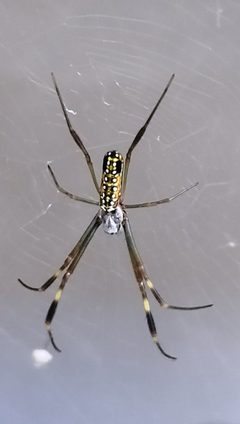
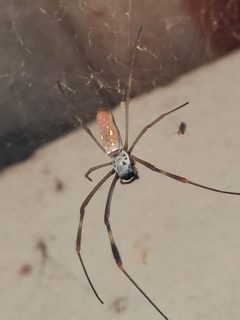
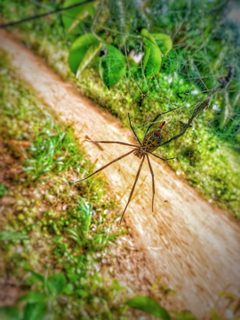
Trichonephila clavipes, commonly known as the golden silk orb-weaver, is a large orb-weaving spider native to continental North and South America. Females are among the largest non-tarantula spiders in North America, measuring 24–40 mm in length, with distinctive yellow-brown coloration and long legs bearing black brush-like tufts of hair. The is renowned for producing golden-colored silk—one of the strongest known biological materials—and constructing large asymmetrical orb webs up to 1–2 meters in diameter. Unlike its Trichonephila clavata (Jorō spider), T. clavipes has limited cold and remains largely confined to warmer southern regions of the United States despite being established there for over 160 years.
Pronunciation
How to pronounce Trichonephila clavipes: /ˌtrɪkoʊˈnɛfɪlə ˈklævɪˌpɛs/
These audio files are automatically generated. While they are not always 100% accurate, they are a good starting point.
Identification
Distinguished from similar large orb-weavers by the combination of: golden-colored silk (visible in webs); black brush-like tufts of hair on legs of females (particularly first, second, and fourth pairs); silvery-white contrasting with orange-brown ; and large web size with asymmetrical structure. Differs from Trichonephila clavata (Jorō spider) by having more widely spaced leg hair tufts and less cold . Separated from Argiope by web asymmetry and leg tuft presence. Distinguished from Trichonephila plumipes by more widely spaced leg hairs.
Images
Habitat
Forests and wooded areas, including forest edges and clearings. Constructs webs attached to trees and low shrubs. In urban environments, may occur in developed areas where individuals have been observed to grow larger than rural counterparts. Webs typically positioned in open flyways between vegetation to intercept flying prey.
Distribution
to continental North and South America. In the United States, occurs in southeastern states from Texas to North Carolina, with rare appearances as far north as Pennsylvania and seasonally in lower Eastern Canada during summer. Most abundant in Florida and Gulf Coast states. Range extends south through Central America to Argentina. Introduced to São Tomé and Príncipe. Distribution is uneven with patches of high local , often resulting from accidental human transport in cargo containers and plant nursery stock.
Seasonality
Peak activity occurs in late summer and fall. Spiderlings emerge in spring and mature through summer. Seasonal northward expansion possible in summer months, with individuals occasionally found beyond 40° N latitude, though survival through winter is rare at these latitudes. Accidental human transport increases markedly in late August to early September during peak .
Diet
Small to medium-sized flying insects captured in orb webs, including grasshoppers, flies, butterflies, , and . Prey is subdued by venom injection rather than silk wrapping. Documented rare on amphibians (Anura).
Life Cycle
with . Females produce egg sacs containing hundreds of eggs, wrapped in golden silk and attached to vegetation near the web. Spiderlings emerge in spring, disperse by ballooning on silk strands, and mature through summer. Males seek out female webs for mating. Females may live longer than males, with males experiencing high mortality risk when moving between webs.
Behavior
Constructs large vertical asymmetrical circular orb webs, 1–2 meters in diameter, with anchor filaments 2–3 meters long. Web contains yellow pigment producing golden coloration. Builds characteristic zigzag silk patterns () in webs. Exhibits thermoregulatory postures including leg extension and body orientation to minimize sun exposure. Produces seven distinct types of silk from specialized glands for different functions. Prey capture involves direct venom injection rather than preliminary silk wrapping. Males move between female webs seeking mates, with movement risk increasing as breeding season progresses.
Ecological Role
of flying insects, potentially contributing to of pest . Webs provide for kleptoparasitic spiders (Argyrodes spp.) and other that steal prey or utilize web structure. Serves as prey for birds and other predators. Clustering pattern of webs creates conducive environment for inquiline species. Potential competition with native orb-weaver species where ranges overlap.
Human Relevance
Poses minimal direct threat to humans; bites occur only in self-defense if handled, causing slight redness and temporary localized pain with low venom. Frequently encountered by hikers in forested areas. Subject of extensive scientific research due to remarkable silk properties—first orb-weaving spider to be completely annotated, revealing 28 unique spidroin genes. Silk investigated for medical applications including neuronal surgery, with demonstrated ability to guide severed without immune rejection. Silk studied for bioremediation applications, showing 91.82% iron removal from contaminated water. Selected for International Space Station experiments testing zero gravity effects on web-building .
Similar Taxa
- Trichonephila clavata (Jorō spider)Also large orb-weaver with golden silk, but native to East Asia and recently in southeastern US; has higher cold , faster metabolism, and more closely spaced leg hair tufts; T. clavipes has wider leg hair spacing and remains confined to warmer regions
- Argiope aurantia (Black and Yellow Garden Spider)Large orb-weaver with bold coloration, but builds symmetrical webs with distinct zigzag , lacks leg hair tufts, and has different abdominal pattern (black and yellow rather than orange-brown with white spots)
- Trichonephila plumipesSimilar large orb-weaver with leg hair tufts, but hairs more closely spaced than in T. clavipes; not native to Americas
More Details
Silk Properties
Major ampullate silk has tensile strength of 4×10⁹ N/m², exceeding steel by factor of eight. Dragline silk exhibits exceptionally high thermal conductivity, exceeding most metals. Seven distinct silk types produced: major ampullate (structural), minor ampullate (scaffolding), piriform (cement), aciniform (prey wrapping), tubuliform (), flagelliform and aggregate (prey capture). Contains 28 unique spidroin genes.
Mating System
Shows both monogynous and polygynous mating with preference for . Unlike related Nephila , males rarely sexual or genital mutilation, enabling multiple matings. Male mating success equivalent across sizes due to ability to mate multiply. Sperm limitation occurs—males produce limited sperm over lifetime, with complete depletion when mating with virgin females.
Physiological Constraints
Lower metabolism and rate compared to T. clavata; 50% survival rate in brief freezing versus 74% in T. clavata. These thermal limitations restrict northward expansion despite long establishment in US. Higher metabolism and freeze in T. clavata explain its greater potential in temperate regions.
Sources and further reading
- BugGuide
- Wikipedia
- GBIF taxonomy match
- iNaturalist taxon
- NCBI Taxonomy
- Catalogue of Life
- Golden Orbweavers Ignore Biological Rules | Bug Squad
- Terrifying big spiders soon in the DMV? Meet the Jorō Spider, Trichonephila clavata, and its cousin the Golden Silk Spider, Trichonephila clavipes — Bug of the Week
- Is the Jorō spider coming to your neighborhood? Trichonephila clavata — Bug of the Week
- Destination: Eastern North America to revisit Jorō spiders, Trichonephila clavata, spreading in their new home in the United States — Bug of the Week
- Jorō spiders enjoy their new home in the DMV: Jorō spider, Trichonephila clavata — Bug of the Week
- Archive — Bug of the Week
- Golden Silk Spider, Trichonephila clavipes (Linnaeus) (Arachnida: Araneae: Tetragnathidae)
- Distribution of Trichonephila clavipes (Linnaeus, 1767) (Araneae: Araneidae) in Honduras
- Feasibility of Bioremediation of Iron-Contaminated Water Using Trichonephila Clavipes Spider Webs
- Feasibility of bioremediation of iron-contaminated water using Trichonephila clavipes spider webs
- FIRST REPORT OF TRICHONEPHILA CLAVIPES (LINNAEUS, 1767) (ARANEAE: ARANEIDAE) PREDATION ON AN AMPHIBIAN (ANURA) IN SOUTHERN BRAZIL
- Physiological evaluation of newly invasive jorō spiders ( Trichonephila clavata ) in the southeastern USA compared to their naturalized cousin, Trichonephila clavipes
- Ecological dynamics of Trichonephila clavipes and its inquilines in an urban green area from submontane Neotropical rainforest
- Small details in a large spider: cheliceral and spinneret behavior when Trichonephila clavipes (Araneae: Araneidae) cuts lines and wraps prey
- Sperm storage organs change with female age and mating history in the Golden Silk spider Trichonephila clavipes (Araneae: Araneidae)
- In search of the perfect web? Males of the golden silk orb‐web spider trichonephila clavipes do not aggregate in webs of high‐quality females
- Trichonephila sexpunctata (Araneae: Nephilidae): New Record from Rio Grande do Sul State, Southern Brazil