
Trichonephila
Dahl, 1911
Banded Orbweavers, Golden Orb-weavers
Species Guides
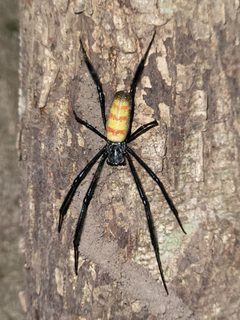
2- Trichonephila clavata(Jorō spider)
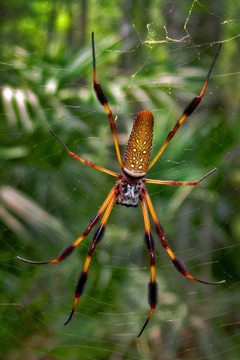
- Trichonephila clavipes(Golden Silk Orb-weaver)
Trichonephila is a of large orb-weaver spiders renowned for constructing massive, golden-hued webs. Females exhibit pronounced sexual size dimorphism, reaching 12–40 mm in body length while males remain much smaller. The genus was elevated from subgenus status in 2019 and now encompasses 13 distributed across tropical and subtropical regions worldwide. Several species, including the Jorō spider (T. clavata) and golden silk spider (T. clavipes), have become notable invaders in North America, with T. clavata demonstrating remarkable cold and rapid range expansion along the eastern United States.
Pronunciation
How to pronounce Trichonephila: /ˌtrɪk.oʊ.nəˈfaɪlə/
These audio files are automatically generated. While they are not always 100% accurate, they are a good starting point.
Identification
Distinguished from other orb-weaver by extremely large body size in females, golden-yellow silk coloration produced by xanthurenic acid, and massive orb webs exceeding one meter in diameter. Females display elongate cylindrical with bold color patterns incorporating black, blue, red, yellow, silvery, and/or white markings; legs are long, slender, and sometimes banded or reddish. The is longer than wide and features short hornlike in larger . Males are diminutive by comparison. The eight are arranged in two evenly spaced rows. Species-level identification relies on distinctive abdominal color patterns, though intraspecific variation can be considerable.
Images
Habitat
Constructs large orb webs in open wooded areas, between tree branches, shrubs, and tall grasses; frequently found around artificial light fixtures where prey occur. Webs are typically positioned where flying insect prey is abundant. Some demonstrate for urban and suburban environments, including roadside and areas near human structures.
Distribution
Native to tropical and subtropical regions of Africa, Oceania, Asia, Central America, South America, and the West Indies. In North America, T. clavipes is established in the southeastern United States from Texas to North Carolina, with rare occurrences as far north as Pennsylvania; T. clavata (Jorō spider), native to East Asia (Japan, China, Korea, Taiwan), was introduced to Georgia around 2010 and has since spread to Florida, Alabama, Mississippi, the Carolinas, Tennessee, Kentucky, Virginia, West Virginia, Maryland, Ohio, and continues expanding northward.
Seasonality
Activity patterns vary by sex and . Males of some species are most active July through September, while females remain active later into fall. The Jorō spider (T. clavata) completes its rapidly within a narrower seasonal window than its T. clavipes, enabling it to exploit cooler climates.
Diet
Captures flying insects in orb webs; has been observed preying on brown marmorated stink bugs and spotted lanternflies in its introduced North American range. One documented observation records on an anuran amphibian in southern Brazil.
Life Cycle
are laid in clutches surrounded by fine puffy silk, typically positioned near the web on surrounding vegetation. The egg surface is coated with chorionic microspheres—milky, water-insoluble spherical structures approximately 2.3 µm in diameter that provide protective functions equivalent to cocoon silk in silken eggcases. Spiderlings disperse by ballooning on silk strands.
Behavior
Builds large orb webs (1–1.5 m diameter) with yellowish viscid spirals and pulled out of direct course to create a notched appearance; supporting lines are exceptionally strong. Spiders reuse webs over extended periods, replacing only the viscid capture lines. Older individuals may construct partial webs while younger spiders build more complete orbs. When disturbed, exhibits prolonged immobility (freeze response) lasting over an hour—unprecedented duration among documented spiders—potentially facilitating urban . During heavy rainfall, hangs from only the fourth pair of legs to reduce impact damage and promote water drainage. Males abandon their webs to seek females, performing vibratory to signal non-prey status; females sometimes cannibalize males post-mating. Females occasionally engage in nonsexual intraspecific , particularly when provoked or stressed.
Ecological Role
Acts as a of flying insects; in its native Asian range, maintains ancient associations with agricultural pests including brown marmorated stink bugs and spotted lanternflies, suggesting potential for in invaded areas. Large individuals may serve as prey for birds and reptiles. Webs have been documented supporting kleptoparasitic birds, with a northern cardinal observed perching on and stealing prey from a Jorō spider web—apparently the first recorded instance of a spider web supporting a perching bird.
Human Relevance
Poses minimal direct threat to humans; bites are rare and cause only minor localized pain comparable to a mosquito bite, with fangs too small to reliably pierce human skin. The Jorō spider has generated substantial public concern due to its large size and rapid range expansion in North America. Spider silk has been investigated for bioremediation applications, with T. clavipes webs demonstrating 91.82% iron removal from contaminated water. Management typically requires only physical removal with a broom or stick; chemical are generally unnecessary.
Similar Taxa
- NephilaFormerly included Trichonephila as a subgenus; distinguished by phylogenetic and morphological criteria supporting generic separation in 2019
- ArgiopeLarge orb-weavers with bold coloration, but lack golden silk and extreme female gigantism; construct patterns in webs unlike Trichonephila
- AraneusCommon orb-weavers that are substantially smaller, lack golden silk, and do not exhibit the extreme sexual size dimorphism characteristic of Trichonephila
Sources and further reading
- BugGuide
- Wikipedia
- GBIF taxonomy match
- iNaturalist taxon
- NCBI Taxonomy
- Catalogue of Life
- Golden Orbweavers Ignore Biological Rules | Bug Squad
- Terrifying big spiders soon in the DMV? Meet the Jorō Spider, Trichonephila clavata, and its cousin the Golden Silk Spider, Trichonephila clavipes — Bug of the Week
- Destination: Eastern North America to revisit Jorō spiders, Trichonephila clavata, spreading in their new home in the United States — Bug of the Week
- Jorō spiders enjoy their new home in the DMV: Jorō spider, Trichonephila clavata — Bug of the Week
- Is the Jorō spider coming to your neighborhood? Trichonephila clavata — Bug of the Week
- Jorō Spiders: Pretty, Big, and Not Very Bitey
- Golden Silk Spider, Trichonephila clavipes (Linnaeus) (Arachnida: Araneae: Tetragnathidae)
- Distribution of Trichonephila clavipes (Linnaeus, 1767) (Araneae: Araneidae) in Honduras
- Startle Responses of Jorō Spiders (Trichonephila clavata) to Artificial Disturbance
- Feasibility of Bioremediation of Iron-Contaminated Water Using Trichonephila Clavipes Spider Webs
- Physiological evaluation of newly invasive jorō spiders ( Trichonephila clavata ) in the southeastern USA compared to their naturalized cousin, Trichonephila clavipes
- Assessing the potential invasive range of Trichonephila clavata using species distribution models
- Feasibility of bioremediation of iron-contaminated water using Trichonephila clavipes spider webs
- Trichonephila sexpunctata (Araneae: Nephilidae): New Record from Rio Grande do Sul State, Southern Brazil
- Fine Structural Characteristics of the Chorionic Microspheres on the Egg Surface of the Orb Web Spider Trichonephila clavata
- FIRST REPORT OF TRICHONEPHILA CLAVIPES (LINNAEUS, 1767) (ARANEAE: ARANEIDAE) PREDATION ON AN AMPHIBIAN (ANURA) IN SOUTHERN BRAZIL
- Novel Observation: Northern Cardinal (Cardinalis cardinalis) Perches on an Invasive Jorō Spider (Trichonephila clavata) Web and Steals Food
- Small details in a large spider: cheliceral and spinneret behavior when Trichonephila clavipes (Araneae: Araneidae) cuts lines and wraps prey
- It’s a Spider-Eat-Spider World: Observations of Nonsexual Cannibalism in the Invasive Jorō Spider Trichonephila clavata
- Insights into the adaptation pattern of Joro Spider (Trichonephila clavata) in a new geographical distribution at Jammu and Kashmir, India
- How Urban-Tolerant Are They? Testing Prey–Capture Behavior of Introduced Jorō Spiders (Trichonephila clavata) Next to Busy Roads