
Nephilidae
Simon, 1894
Golden Orb-weavers, Golden Silk Spiders
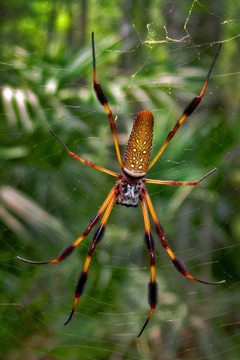
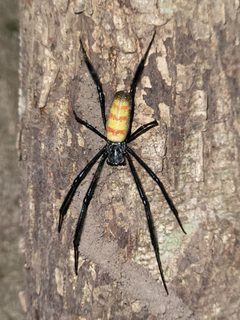
Nephilidae is a of large orb-weaving spiders commonly known as golden orb-weavers or golden silk spiders. Members of this family are renowned for constructing the largest orb-webs known among spiders, often exceeding one meter in diameter. The family exhibits extreme sexual size dimorphism, with females frequently 10 times larger and 100 times heavier than males. Nephilidae includes four : Nephila, Trichonephila, Nephilengys, Herennia, and Clitaetra. Several have become notable invaders, including Trichonephila clavata (Jorō spider) in eastern North America and Trichonephila clavipes (golden silk spider) established in the southeastern United States for over a century.
Pronunciation
How to pronounce Nephilidae: //nɪˈfɪlɪˌdiː//
These audio files are automatically generated. While they are not always 100% accurate, they are a good starting point.
Images
Distribution
Nephilidae has a pantropical to subtropical distribution, with native ranges spanning Africa, Asia, Australia, and the Americas. The Trichonephila clavipes occurs naturally from Central and South America through the southern United States (Texas to North Carolina). Trichonephila clavata is native to East Asia (Japan, China, Korea, Taiwan) and has established in the eastern United States since approximately 2010, now documented from Georgia northward to Maryland and Ohio. The genus Nephilengys has a pantropical distribution including tropical Africa, Madagascar, the Indian Ocean islands, South and Southeast Asia, and Australasia. Herennia occurs in tropical Asia and Australasia. Clitaetra has a Gondwanan distribution across Africa, Madagascar, the Comoros, Mayotte, and Sri Lanka.
Diet
Members of Nephilidae are passive hunters that construct large orb-webs to capture flying prey. Trichonephila clavata has been observed preying on brown marmorated stink bugs and spotted lanternflies in its North American range, with which it shares an ancient association in its native East Asian range.
Behavior
Spiderlings of Nephilidae disperse by ballooning on strands of silk, a that facilitates both natural range expansion and long-distance . and are readily transported by human activity. Trichonephila clavata exhibits higher metabolic rate, faster rate, and greater cold than its Trichonephila clavipes, enabling more rapid development and northward range expansion. Members of the Nephilengys are known as 'hermit spiders' for their habit of building retreats within their webs. Clitaetra construct ladder webs as adults, transitioning from orb webs in juveniles. Female Nephilidae accumulate prey larders on their webs and have demonstrated memory of larder size, adjusting search efforts when larders are pilfered.
Ecological Role
Nephilidae may provide services as agents of agricultural and forest pests. Trichonephila clavata has been documented preying on insects including brown marmorated stink bugs and spotted lanternflies. Large nephilid spiders serve as prey for birds and reptiles. In established invasive , T. clavata often becomes the orb-weaver, potentially competing with native large orb-weavers such as Argiope aurantia (black and yellow garden spider), Araneus marmoreus (marbled orb weaver), and Neoscona (spotted orb weavers).
Human Relevance
Nephilidae produce silk with remarkable mechanical properties that has been investigated for bioengineering applications. The Jorō spider (Trichonephila clavata) has generated significant media attention due to its large size and rapid spread in eastern North America, though it poses minimal direct risk to humans due to small fangs unlikely to pierce skin and non-aggressive . The golden silk spider (Trichonephila clavipes) has been established in the southeastern United States for over a century. In Japanese folklore, T. clavata is associated with the Jorō-gumo, a shapeshifting spirit that transforms into a beautiful woman.
Similar Taxa
- AraneidaeNephilidae was historically classified within Araneidae and shares orb-web architecture; distinguished by extreme sexual size dimorphism, web size, and partial web renewal
- TetragnathidaeNephilidae was formerly placed in Tetragnathidae; molecular and morphological analyses support separate status, with Nephilidae as sister to all other araneoids
Sources and further reading
- BugGuide
- GBIF taxonomy match
- iNaturalist taxon
- NCBI Taxonomy
- Catalogue of Life
- Golden Orbweavers Ignore Biological Rules | Bug Squad
- Terrifying big spiders soon in the DMV? Meet the Jorō Spider, Trichonephila clavata, and its cousin the Golden Silk Spider, Trichonephila clavipes — Bug of the Week
- Jorō spiders enjoy their new home in the DMV: Jorō spider, Trichonephila clavata — Bug of the Week
- Destination: Eastern North America to revisit Jorō spiders, Trichonephila clavata, spreading in their new home in the United States — Bug of the Week
- Is the Jorō spider coming to your neighborhood? Trichonephila clavata — Bug of the Week
- Phylogenetic systematics of the Gondwanan nephilid spider lineage Clitaetrinae (Araneae, Nephilidae)
- Phylogeny accurately predicts behaviour in Indian Ocean Clitaetra spiders (Araneae : Nephilidae)
- A monograph of Nephilengys , the pantropical ‘hermit spiders’ (Araneae, Nephilidae, Nephilinae)
- Ballooning behavior in the golden orbweb spider Nephila pilipes (Araneae: Nephilidae)
- Memory of prey larders in golden orb-web spiders, Nephila clavipes (Araneae: Nephilidae)
- Trichonephila sexpunctata (Araneae: Nephilidae): New Record from Rio Grande do Sul State, Southern Brazil
- A Natural Colonisation of Asia: Phylogenomic and Biogeographic History of Coin Spiders (Araneae: Nephilidae: Herennia)
- A GIS Model Predicting Potential Distributions of a Lineage: A Test Case on Hermit Spiders (Nephilidae: Nephilengys)
- Nephila clavata L. Koch, the Joro Spider of East Asia, newly recorded from North America ( Araneae: Nephilidae )
- Nephila clavata L. Koch, the Joro Spider of East Asia, newly recorded from North America ( Araneae: Nephilidae )
- Nephila clavata L. Koch, the Joro Spider of East Asia, newly recorded from North America ( Araneae: Nephilidae )
- Nephila clavata L. Koch, the Joro Spider of East Asia, newly recorded from North America ( Araneae: Nephilidae )
- The systematics and biology of the spider genus Nephila (Araneae : Nephilidae) in the Australasian region
- Phylogeny of extant nephilid orb‐weaving spiders (Araneae, Nephilidae): testing morphological and ethological homologies
- Ecology and web allometry of Clitaetra irenae, an arboricolous African orb-weaving spider (Araneae, Araneoidea, Nephilidae)