
Trichonephila clavata
(L. Koch, 1878)
Jorō spider, Joro Spider, Parachute spider
Trichonephila clavata, commonly known as the Jorō spider, is a large orb-weaving spider native to East Asia that has become established as an in the southeastern United States since approximately 2010. First confirmed in Georgia in 2014, it has expanded rapidly across multiple states through a combination of ballooning and human-mediated transport. The is notable for its substantial size, striking coloration, and extensive golden webs, but poses minimal risk to humans due to small fangs and docile . Its physiological adaptations—including higher metabolic rate, faster rate, and greater cold than its Trichonephila clavipes—suggest potential for continued northward range expansion.
Pronunciation
How to pronounce Trichonephila clavata: /ˌtrɪkoʊˈnɛfɪlə kləˈvɑːtə/
These audio files are automatically generated. While they are not always 100% accurate, they are a good starting point.
Identification
Distinguished from native North American orb-weavers by its exceptionally large size, bright yellow and blue abdominal striping with red markings, and three-layered web structure. Most readily confused with its Trichonephila clavipes (golden silk spider), from which it differs in lacking the hair tufts on the first, second, and fourth leg pairs characteristic of that . T. clavata also shows greater cold and more rapid development than T. clavipes. The marbled orb-weaver (Araneus marmoreus), black and yellow garden spider (Argiope aurantia), and spotted orb-weaver (Neoscona crucifera) are smaller native species with different color patterns and web architectures.
Images
Appearance
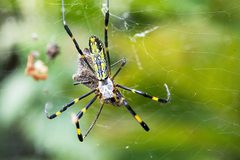
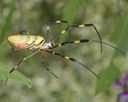
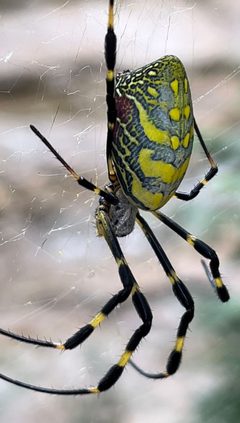
females are large-bodied spiders with body lengths of 17–25 mm, while males are considerably smaller at 7–10 mm. The female displays bold longitudinal stripes of yellow and dark blue, with distinctive red markings toward the rear. Both sexes possess large abdomens and long legs with yellow and black banding. The underside of the abdomen features striking red coloration. Webs are substantial structures, often exceeding one meter in diameter, with yellow silk threads that appear gold in sunlight. The web architecture is unusual among orb-weavers, consisting of three layers: a central orb flanked by irregular barrier webs both and .
Habitat
In its native East Asian range, occupies varied including forests, edges, and anthropogenic landscapes. In the introduced North American range, has been documented in secondary forests, suburban areas, urban environments, and along roadsides. Shows notable for human-disturbed habitats, with webs frequently constructed on homes, landscape plants, utility poles, and other structures. A 2024 study confirmed web placement within 5–10 meters of roads and demonstrated that spiders near moderate- to heavy-traffic roads showed slightly reduced prey attack rates (51% vs. 65%) compared to low-traffic sites, but maintained comparable body mass, indicating compensatory foraging ability.
Distribution
Native to East Asia: Japan (except Hokkaidō), Korea, Taiwan, China, and India. First detected in North America in northeast Georgia, USA around 2010, with confirmed establishment by 2014. As of October 2022, confirmed in Georgia, South Carolina, North Carolina, Tennessee, Alabama, Oklahoma, West Virginia, Maryland, and Pennsylvania. By 2024, documented in additional states including Virginia, Kentucky, Ohio, Massachusetts, New York, and Florida. Disjunct occur in the northeastern United States, including confirmed breeding populations in Howard County, Maryland since 2022. The has also been recorded in Jammu and Kashmir, India at 1,557 m elevation, representing a northern range extension in Asia.
Seasonality
Overwinters as within silk egg sacs attached to vegetation. Juveniles emerge and disperse in spring. are present from late summer through autumn, with mating occurring in autumn when smaller males enter female webs. Females deposit egg sacs containing 400–1,500 eggs on trees in autumn, then perish by late autumn or early winter. The is completed more rapidly than that of T. clavipes, enabling exploitation of narrower seasonal windows.
Diet
Captures flying insects and potentially other small animals in its orb web. metabarcoding studies of prey remains from webs in the southeastern United States revealed diverse prey , though specific taxonomic composition requires further resolution. In its native Asian range, has ancient associations with agricultural pests including brown marmorated stink bug (Halyomorpha halys) and spotted lanternfly (Lycorma delicatula). In North America, has been documented capturing brown marmorated stink bugs, which native spiders have not been known to consume.
Life Cycle
with stage. Eggs hatch in spring; juveniles disperse via ballooning on silk threads. Development proceeds through multiple instars, with sexual maturity reached in late summer. Mating occurs in autumn, with males seeking out females in their webs. Females produce a single egg sac containing 400–1,500 eggs attached to tree bark or vegetation. senesce and die with onset of cold weather; no overwintering adult stage.
Behavior
Exhibits pronounced startle response to disturbance, remaining immobile for extended periods (over one hour in experimental conditions following air puff stimulus)—the longest documented freezing response among studied spider . This behavioral trait may facilitate of urban environments by reducing responses to anthropogenic disturbance. When handled, females typically attempt to escape rather than bite, and bites require substantial provocation. Females display nonsexual toward other females, with fights occurring in 40% of same-size pairings and 18% of different-size pairings in laboratory trials; 9% of trials resulted in fatal outcomes. Field observations document kleptoparasitism by northern cardinals, which perch on webs to steal captured prey.
Ecological Role
As a large-bodied orb-weaver, functions as a of flying insects. Potential for of agricultural pests, particularly brown marmorated stink bug and spotted lanternfly, with which it shares evolutionary history. May compete with native large orb-weavers including Argiope aurantia, Araneus marmoreus, and Neoscona crucifera for web-building sites and prey resources; in other regions where established, T. clavata has become the orb-weaver. Serves as prey for birds and reptiles. Webs have been documented supporting perching birds (up to 70 g breaking strength), representing a novel structural role.
Human Relevance
Poses minimal direct risk to humans; fangs are too small to reliably pierce human skin, and bites are rare even with deliberate handling. When bites do occur, effects are comparable to mosquito bites—localized redness and swelling resolving within 24 hours. Frequently generates public concern due to large size, conspicuous web placement on structures, and media sensationalism. Management is typically unnecessary; physical removal with broom or stick is effective if desired. Several labeled spider control products are effective but generally not required. Named after the Jorō-gumo of Japanese folklore—a shapeshifting spider-woman who seduces and devours men. Consumed as food by Ao-Naga people in native range.
Similar Taxa
- Trichonephila clavipesGolden silk spider; native to Central and South America, established in southeastern US for over 160 years. Distinguished by hair tufts on legs 1, 2, and 4; lower cold ; restricted to warmer southern states.
- Argiope aurantiaBlack and yellow garden spider; native North American orb-weaver with similar warning coloration but smaller size (females to 28 mm but more slender), different web architecture ( present), and distinct zigzag silk patterns.
- Araneus marmoreusMarbled orb-weaver; native with rounded, variably colored but lacks bold longitudinal striping and red markings; smaller maximum size; builds more conventional orb webs without three-layer structure.
Misconceptions
Despite media characterizations as 'terrifying' or 'venomous,' the Jorō spider poses negligible medical risk to humans. The 'parachute spider' moniker refers to ballooning of spiderlings on silk threads, not aerial dropping of . Predictions of imminent massive range expansion should be tempered by recognition that establishment in new regions depends on multiple factors including winter survival, competitive interactions, and continued human transport.
Sources and further reading
- BugGuide
- Wikipedia
- GBIF taxonomy match
- iNaturalist taxon
- NCBI Taxonomy
- Catalogue of Life
- Terrifying big spiders soon in the DMV? Meet the Jorō Spider, Trichonephila clavata, and its cousin the Golden Silk Spider, Trichonephila clavipes — Bug of the Week
- Destination: Eastern North America to revisit Jorō spiders, Trichonephila clavata, spreading in their new home in the United States — Bug of the Week
- Jorō spiders enjoy their new home in the DMV: Jorō spider, Trichonephila clavata — Bug of the Week
- Is the Jorō spider coming to your neighborhood? Trichonephila clavata — Bug of the Week
- Jorō Spiders: Pretty, Big, and Not Very Bitey
- Archive — Bug of the Week
- Startle Responses of Jorō Spiders (Trichonephila clavata) to Artificial Disturbance
- Assessing the potential invasive range of Trichonephila clavata using species distribution models
- It’s a Spider-Eat-Spider World: Observations of Nonsexual Cannibalism in the Invasive Jorō Spider Trichonephila clavata
- Physiological evaluation of newly invasive jorō spiders ( Trichonephila clavata ) in the southeastern USA compared to their naturalized cousin, Trichonephila clavipes
- Fine Structural Characteristics of the Chorionic Microspheres on the Egg Surface of the Orb Web Spider Trichonephila clavata
- Novel Observation: Northern Cardinal (Cardinalis cardinalis) Perches on an Invasive Jorō Spider (Trichonephila clavata) Web and Steals Food
- Insights into the adaptation pattern of Joro Spider (Trichonephila clavata) in a new geographical distribution at Jammu and Kashmir, India
- The northernmost record of Eriostethus rufus (Uchida, 1932) (Hymenoptera, Ichneumonidae) with an indication of new host, Trichonephila clavata (Koch, 1878) (Araneae, Araneidae) and its web manipulation
- How Urban-Tolerant Are They? Testing Prey–Capture Behavior of Introduced Jorō Spiders (Trichonephila clavata) Next to Busy Roads
- The Jorō spider (Trichonephila clavata) in the southeastern U.S.: an opportunity for research and a call for reasonable journalism
- DNA metabarcoding analysis of three material types to reveal Joro spider (Trichonephila clavata) trophic interactions and web capture
- Three distinct genetic lineages of Trichonephila clavata based on mitochondrial COI and genome-wide SNPs on the Korean Peninsula.
- Keep calm and carry on: bites from Trichonephila clavata are unlikely and cause minimal discomfort.