
Mecaphesa schlingeri
(Schick, 1965)
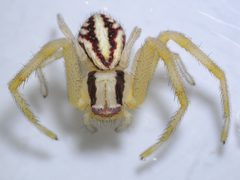
Mecaphesa schlingeri is a of crab spider in the Thomisidae, described by Schick in 1965. It is known from the United States, where it has been documented as a on the sticky plant Madia elegans (tarweed). The species is one of several predators that can navigate the resinous, hooked trichomes of tarweed to feed on trapped insect carrion. Research indicates its presence on tarweed plants increases when dead insects are experimentally added, suggesting it responds to carrion availability.
Pronunciation
How to pronounce Mecaphesa schlingeri: /ˌmɛkəˈfiːsə ˈʃlɪŋɡəri/
These audio files are automatically generated. While they are not always 100% accurate, they are a good starting point.
Images
Habitat
Documented from tarweed (Madia elegans) plants in California; tarweed occurs in open, dry and flowers mid to late summer. The spider's ability to navigate sticky plant surfaces suggests specialized adaptations for movement on plants with resinous or hooked trichomes.
Distribution
United States. GBIF records indicate occurrences in the USA, with research focused on in Solano County, California (Stebbins Cold Canyon Reserve area).
Seasonality
Active during tarweed's flowering period, approximately June through September in California.
Diet
; has been observed feeding on dead insects (carrion) trapped by tarweed's sticky hairs. Research documented the feeding on experimentally placed Drosophila fruit flies on Madia elegans plants.
Host Associations
- Madia elegans - /prey siteTarweed; sticky plant whose trapped insect carrion attracts this
Behavior
Can navigate sticky plant surfaces that trap other insects. Responds to increased carrion availability on plants, with increasing 76-450% when dead insects are experimentally added to plants. Part of a suite associated with tarweed that reduces herbivore damage to the plant.
Ecological Role
in a plant-mediated ; contributes to indirect plant defense by consuming carrion on tarweed, which increases predator abundance and reduces herbivory by caterpillars (Heliothodes diminutiva).
Similar Taxa
- Mecaphesa asperataAnother Mecaphesa found on flowers in similar ; M. schlingeri distinguished by association with tarweed's sticky surfaces and geographic distribution
- Peucetia sp.Green lynx spider, another documented on tarweed; differs in (Oxyopidae) and hunting strategy
More Details
Research significance
M. schlingeri was part of a 2013 study (Krimmel & Pearse, Letters) that demonstrated 'tourist trap' ecology—where sticky plants capture insect passers-by as carrion, attracting that indirectly defend the plant. This was the first documentation of plants capturing food from the external environment to support predators.
Taxonomic note
The epithet 'schlingeri' honors Evert I. Schlinger, an entomologist known for work on Acroceridae (small-headed flies) and other Diptera.
Sources and further reading
- BugGuide
- Wikipedia
- GBIF taxonomy match
- iNaturalist taxon
- Catalogue of Life
- Bring on the Tourists! | Bug Squad
- Bembicid Holdings | Entomology Research Museum
- Day hike at Little Lost Creek Conservation Area | Beetles In The Bush
- 🌿 Botanizing w/ the WGNSS Botany Group at Victoria Glades Preserve | Beetles In The Bush