
Mecaphesa celer
(Hentz, 1847)
swift crab spider
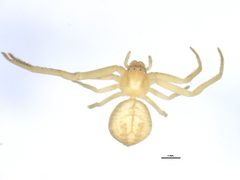
Mecaphesa celer is a crab spider in the Thomisidae, commonly known as the swift crab spider. It is distributed across much of North and Central America. The exhibits extreme sexual size dimorphism, with females more than twice the size of males. It is a sit-and-wait that hunts on flowers and upper plant parts, and has been studied for its genetics in fragmented volcanic .
Pronunciation
How to pronounce Mecaphesa celer: //ˌmɛkəˈfeɪsə ˈsɛlɚ//
These audio files are automatically generated. While they are not always 100% accurate, they are a good starting point.
Identification
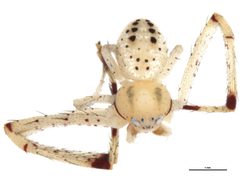
Females are readily distinguished from similar Mecaphesa by their large, round and coloration. Males are difficult to identify from Mecaphesa dubia and Mecaphesa rothi due to similar appearance; distinguishing these three species requires careful examination and may be complicated by natural intraspecific variation. The combination of red leg bands, white abdomen with V-shaped brown spots, and dark setae in males is characteristic but not definitive without comparison to related species.
Images
Appearance
display strong in both size and coloration. Females are dramatically larger than males, with body mass often exceeding ten times that of males. Females have large, round much larger than their and occur in three color variants: bright solid yellow with minimal brown spotting; yellow with reddish-brown abdominal streaking; or completely white with dull brown streaking. Males are roughly half the female size, with abdomens and heads approximately equal in size. Mature males are often darker than females and possess distinctive red bands on their legs, whiter abdomens with four or more pairs of brown spots forming a V-shape from mid-abdomen to the end, and noticeable dark setae covering the body. All individuals have characteristically long first two pairs of legs and short back two pairs of legs typical of Thomisidae.
Habitat
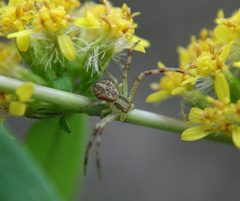
Occupies flowers and upper parts of plants, including shrubs, bushes, and small trees. Frequently found on crop plants such as sorghum, cotton, and alfalfa. In agricultural settings, has been recorded as comprising 5.3% of spider collections in Eastern Texas cotton fields. Also inhabits fragmented volcanic with isolated vegetated patches surrounded by barren matrix, as demonstrated by at Craters of the Moon in Idaho.
Distribution
Widely distributed across North and Central America. Nearctic distribution spanning the North American continent. Specific records include Alberta and British Columbia in Canada, and documented at Craters of the Moon National Monument and Preserve in Idaho, USA.
Diet
Preys upon insects visiting flowers, including pollinating insects. Specific prey items documented include aphids and other potential agricultural pests. Does not use webs for prey capture.
Life Cycle
Spins webs only for sac construction and mating purposes, not for hunting. occurs and appears sufficient to maintain across fragmented .
Behavior
Sit-and-wait that ambushes prey from flowers and upper plant stalks. Uses elongated front legs to seize prey. Males perform courtship involving abdominal vibration, slow approach with leg and gesturing, and touching the female with front legs. Receptive females respond by raising legs and suspending themselves in silk threads. Copulation lasts approximately 3 to 10 minutes, with the male remaining on the female until she becomes active. Females exhibit sexual , killing and consuming males that remain in proximity after copulation.
Ecological Role
Serves as a agent in agricultural systems by preying on insect pests of crops. In sorghum, cotton, and alfalfa, hunts in the upper plant parts where grains or harvested products develop, protecting against pests such as aphids. Trapped insect carrion on sticky plants may enhance indirect defense by attracting predatory arthropods, though this specific interaction has been documented for related crab spiders in similar systems.
Human Relevance
Valued as a natural pest control agent in agriculture. Provides protection for sorghum, cotton, and alfalfa crops by reducing herbivore damage. Formerly classified under Misumenops, with older literature using the synonym Misumenops celer.
Similar Taxa
- Mecaphesa dubiaMales appear quite similar to M. celer males, making visual identification difficult due to overlapping morphological traits
- Mecaphesa rothiMales closely resemble M. celer males; distinguishing between these three requires careful examination and is complicated by natural intraspecific variation
- Mecaphesa asperataCongeneric crab spider with similar hunting on flowers, but distinct in appearance and distribution
More Details
Sexual size dimorphism
Exhibits extreme female-biased sexual size dimorphism among the most pronounced in spiders. The evolutionary drivers of this dimorphism remain unclear; research has not found support for commonly hypothesized pre- or post-copulatory survival benefits to either sex.
Mating system
Virgin females show no mate choice, accepting the first male encountered. After one mating, females become selective and often reject or attack subsequent suitors. Males are capable of multiple matings; female remating occurs in approximately 15% of individuals despite a waxy epigynal coating that may prevent successive matings.
Population genetics
Genomic study at Craters of the Moon, Idaho found no structure despite fragmented volcanic , indicating panmixia likely maintained by abundant and possible connectivity to surrounding regions.
Taxonomic history
Transferred from Misumenops to Mecaphesa; older sources use Misumenops celer. Three recognized: M. c. celer, M. c. olivacea, and M. c. punctata.
Sources and further reading
- BugGuide
- Wikipedia
- GBIF taxonomy match
- iNaturalist taxon
- NCBI Taxonomy
- Catalogue of Life
- Bring on the Tourists! | Bug Squad
- Day hike at Little Lost Creek Conservation Area | Beetles In The Bush
- 🌿 Botanizing w/ the WGNSS Botany Group at Victoria Glades Preserve | Beetles In The Bush
- Panmixia in spiders ( Mecaphesa celer , Thomisidae) despite fragmented habitat at Craters of the Moon in Idaho