
Xysticus elegans
Keyserling, 1880
elegant crab spider
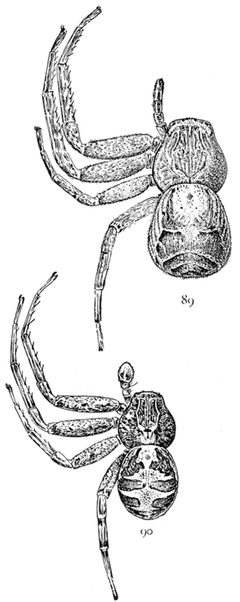
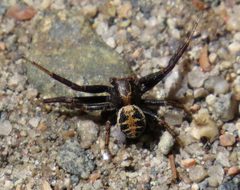
Xysticus elegans, commonly known as the elegant crab spider, is a medium-sized crab spider in the Thomisidae. The exhibits pronounced in body size, with females approximately twice as large as males. It is distributed across northern North America including the United States, Canada, and Alaska. The spider is characterized by distinctive coloration including a brown with lighter areas and white-outlined brown spots on the .
Pronunciation
How to pronounce Xysticus elegans: //ˈzɪstɪkəs ˈɛləɡænz//
These audio files are automatically generated. While they are not always 100% accurate, they are a good starting point.
Identification
Distinguished from similar Xysticus by the combination of: white-outlined brown spots on ; light tan band through region; and pronounced sexual size dimorphism with males under 5 mm and females 8–12 mm. The pale and patellae of females versus nearly black femora and patellae of males provides a reliable sexing character. Distinguished from other crab spider by typical Xysticus body form and eye arrangement.
Images
Appearance
Medium-sized crab spider with strong . Females measure 8–12 mm in body length; males measure 4–5 mm, less than half the size of females. brown with a lighter area sometimes outlined in white. Light tan band passes through the region. bears brown spots outlined in white. Legs brown overall. Females have paler and patellae; males have femora and patellae that are nearly black.
Distribution
United States, Canada, and Alaska. Specific provincial records include Alberta, British Columbia, and Manitoba in Canada.
Similar Taxa
- Other Xysticus speciesMany Xysticus share similar crab spider and brown coloration with abdominal markings; X. elegans is distinguished by the specific pattern of white-outlined brown spots on , the light tan band, and the pronounced sexual size dimorphism with males under half female size
- Misumena, Misumenoides, Mecaphesa (flower crab spiders)These related thomisid are often larger, frequently yellow or white in coloration, and associated with flowers rather than ground-level ; they lack the specific abdominal spot pattern of X. elegans
More Details
Sexual dimorphism
The shows one of the more pronounced size differences between sexes in the Xysticus, with males averaging less than 50% of female body length. This dimorphism extends to leg segment coloration, providing multiple characters for sex identification.
Sources and further reading
- BugGuide
- Wikipedia
- GBIF taxonomy match
- iNaturalist taxon
- NCBI Taxonomy
- Catalogue of Life
- Bring on the Tourists! | Bug Squad
- More Nematodes in Outer Space? | Bug Squad
- Showcasing Animal and Plant Parasitic Nematodes | Bug Squad
- Bug Eric: Wasp Wednesday: Steniolia elegans
- Bug Eric: ArachNovember?
- Bug Eric: Dimorphic Jumping Spider, Maevia inclemens