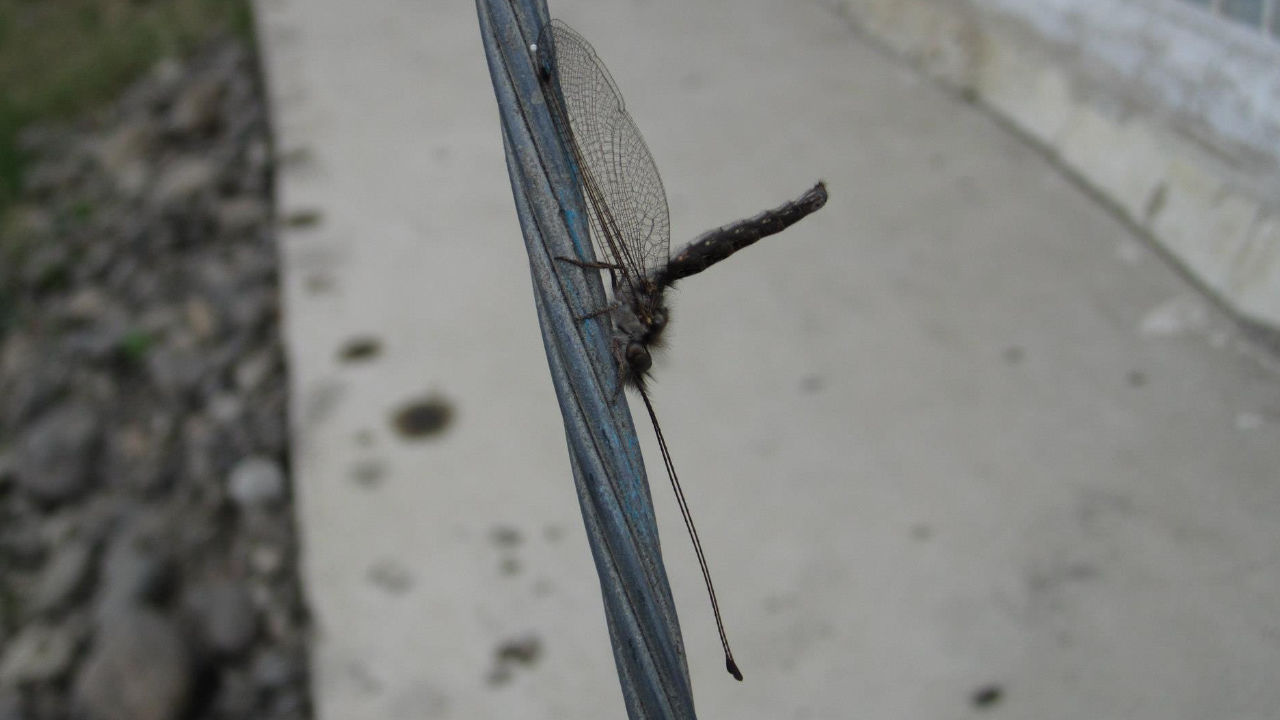
brown lacewing
Micromus posticus is a species of brown lacewing in the family Hemerobiidae. It is a predatory insect found across the Caribbean, Central America, and North America. Both larvae and adults feed on aphids, making it a potentially beneficial species in agricultural and garden settings. The species has been documented through blacklighting observations and is one of the more commonly encountered brown lacewings in its range.
Antique Brown Lacewing
Micromus subanticus is a species of brown lacewing in the family Hemerobiidae. It has a wide geographic distribution spanning the Caribbean, Europe and Northern Asia (excluding China), Central America, and North America. The species has been studied in Florida for its life cycle and parasitism patterns. As a brown lacewing, it is presumed to be predatory in both adult and larval stages, though specific prey associations are not well documented.
Variegated Brown Lacewing, Brown Lacewing
Micromus variegatus is a species of brown lacewing in the family Hemerobiidae, first described by Fabricius in 1793. It is one of the most widely recognized brown lacewing species, with its image being the most reused scientific image from Pensoft publications on Wikimedia Commons (over 6,500 uses across multiple languages). The species has a broad distribution spanning Europe, Northern Asia (excluding China), and North America. As a member of the Hemerobiidae, it belongs to a family of predatory insects commonly known as brown lacewings, which are closely related to green lacewings but generally smaller and more cryptically colored.
antlion, doodlebug
Myrmeleon is a cosmopolitan genus of antlions in the family Myrmeleontidae, distinguished by larvae that construct conical pitfall traps in sandy substrates. The larvae, commonly called doodlebugs, bury themselves at the bottom of these pits and use specialized mandibles to capture prey that falls in. Adults are delicate, lacy-winged insects resembling damselflies but with short, clubbed antennae. The genus is notable for being one of few antlion genera in North America that exhibits pit-building behavior, and it has been documented across multiple continents including North America, South America, Africa, Asia, and Europe.
Myrmeleon carolinus is a North American antlion species in the family Myrmeleontidae. Its larvae construct conical pitfall traps in sandy substrates to capture small ground-dwelling arthropods, a behavior characteristic of the genus Myrmeleon. Laboratory studies indicate that pit size varies with feeding history and prior pit-building experience, suggesting that physiological constraints alone do not determine trap dimensions. The species was described by Banks in 1943 and is accepted as valid in current taxonomic databases.
antlion
Myrmeleon crudelis is a pit-building antlion species whose larvae construct conical traps in fine-grained soil to capture small arthropods. Research on this species has focused on its behavioral plasticity in trap construction and prey capture kinematics. Larvae demonstrate sophisticated modulation of mandible velocity during strikes and adjust pit architecture in response to prey availability and soil conditions. The species occurs in tropical dry forests of Costa Rica and has been recorded from Middle and North America.
antlion
Myrmeleon exitialis is a species of antlion in the family Myrmeleontidae. It is found in North America. As a member of the genus Myrmeleon, its larvae construct the characteristic funnel-shaped pitfall traps in sandy soil to capture prey. Adults are delicate, slender insects with lacy wings that superficially resemble damselflies but possess short, clubbed antennae.
Doodlebug
Myrmeleon immaculatus is a pit-trapping antlion species in the family Myrmeleontidae. Adults are approximately 30 mm in length and typically blue-grey in color. The species is particularly common in the eastern United States, though its range extends across North America and into Central America. Like other members of the genus Myrmeleon, its larvae construct characteristic conical pits in sandy soil to capture prey.
Myrmeleon mexicanus is an antlion species in the family Myrmeleontidae, described by Banks in 1903. The species occurs in Central America and North America. As with other antlions, it has a predatory larval stage that constructs pit traps in sandy soil to capture prey, and a winged adult stage that is primarily nocturnal.
Myrmeleon mobilis is a pit-making antlion species in the family Myrmeleontidae. The larva constructs conical pits in sandy substrate to trap small ground-dwelling arthropods, using a unique discontinuous gut physiology where solid waste is retained until adulthood. A 2005 microbiological study identified its bacterial associates as primarily Proteobacteria, including Wolbachia-like organisms in non-gut tissues and Enterobacteriaceae-like bacteria in the gut. The species is recorded from North America.
Myrmeleon texanus is a species of antlion in the family Myrmeleontidae, first described by Nathan Banks in 1900. As a member of the genus Myrmeleon, its larvae construct characteristic conical pitfall traps in sandy soil to capture prey. The species occurs in North America and Middle America, though specific details of its biology remain poorly documented compared to more widespread congeners such as M. immaculatus.
Antlions, Antlion lacewings, Doodlebugs, Owlflies
Myrmeleontidae is a family of neuropteran insects comprising approximately 2,000 species, commonly known as antlions or antlion lacewings. The family is best known for the distinctive predatory behavior of its larvae, which in many species construct conical pit traps in sandy soil to capture prey. Adults are aerial insects with delicate, often patterned wings, and are frequently mistaken for dragonflies or damselflies. The family includes two traditional subfamilies: Myrmeleontinae (antlions) and Ascalaphinae (owlflies), though the latter is sometimes treated as a separate family. Antlions exhibit remarkable diversity in larval hunting strategies, with pit-digging behavior restricted to certain genera while others employ ambush or roaming predation.
antlions
Myrmeleontinae is a subfamily of antlions (Myrmeleontidae) within the order Neuroptera. The subfamily comprises three tribes: Myrmeleontini, Maulini, and Porrerini. It includes the type genus Myrmeleon, established by Linnaeus in 1767, along with other genera such as Euroleon and Hagenomyia. Species in this subfamily have been documented across multiple continents, with recent taxonomic work describing new species from Pakistan.
Pit-trapping Antlions
Myrmeleontini is a tribe of antlions within the subfamily Myrmeleontinae, comprising approximately 12 genera including Myrmeleon, Euroleon, and Baliga. The tribe is distinguished by pit-trapping predatory behavior in larval stages, where larvae construct conical pits in loose substrate to capture prey. Adults are aerial predators with elongated bodies and large, transparent wings. The group has a broad geographic distribution spanning Europe, Asia, and Australia.
Nacarina robusta is a species of green lacewing in the family Chrysopidae, order Neuroptera. The species was originally described by Nathan Banks in 1905 as Chrysopa robusta and later transferred to the genus Nacarina. It is known from North America. The genus Nacarina was established to accommodate species previously placed in Chrysopa that share distinct morphological characteristics. Like other chrysopids, this species is predatory in both larval and adult stages.
pleasing lacewings
Nallachius is a genus of pleasing lacewings in the family Dilaridae, established by Navás in 1909. The genus contains more than 20 described species distributed primarily in the Neotropical region. Members are characterized by their distinctive wing venation and relatively broad wings compared to other dilarid genera. Adults are typically nocturnal and attracted to light.
pleasing lacewing
Nallachius americanus is a species of pleasing lacewing in the family Dilaridae. It occurs across a broad geographic range spanning the Caribbean, North America, and South America. The species was originally described by McLachlan in 1881 under the basionym Dilar americanus. As a member of the pleasing lacewings, it belongs to a small family of neuropteran insects characterized by distinctive morphological features.
pleasing lacewing
Nallachius pulchellus is a species of pleasing lacewing in the family Dilaridae, described by Nathan Banks in 1938. The species is distributed across the Caribbean Sea, Central America, and North America. As a member of the Dilaridae, it belongs to a small family of lacewings commonly known as pleasing lacewings, characterized by their relatively broad wings and often colorful appearance.
Neoconis is a genus of dustywing lacewings in the family Coniopterygidae. The genus contains approximately 17 described species distributed primarily in the Neotropical region, with records from Central and South America and the Caribbean. Several species were described by the Finnish entomologist Heikki Meinander in the 1970s–1990s, reflecting a period of active taxonomic work on the group. The genus includes one fossil species, Neoconis paleocaribis, described from Dominican amber.
Nineta lacewings
Nineta is a genus of green lacewings in the family Chrysopidae, tribe Chrysopini, erected by Longinos Navás in 1912. Species occur across Europe, eastern Asia, and North America. Research on Nineta species has contributed significant findings on photoperiodic sensitivity in insects, particularly regarding diapause induction and seasonal adaptation in larval development.
Nolima pinal is a mantidfly species endemic to the southwestern United States, ranging from Arizona to Nevada. First described by Rehn in 1939, the species was redescribed in a 2019 taxonomic revision that synonymized N. dine and N. kantsi under it. The species is distinguished by distinctive male abdominal cuticular structures and genitalic morphology, including a strongly projecting, deeply bifid male mediuncus apex and a female spermatheca with a distal accessory gland. Its forewing has a short subcostal space with Sc contacting C near the middle of the costal margin, distal to the pterostigma base.
San Francisco lacewing
Nothochrysa californica, commonly known as the San Francisco lacewing, is a species of green lacewing in the family Chrysopidae. It is native to North America and was first described by Nathan Banks in 1892. The species is part of a genus of large lacewings distinguished from typical green lacewings (Chrysoperla) by morphological features.
Oliarces is a genus of moth lacewings (Neuroptera: Ithonidae) containing a single described species, O. clara. Moth lacewings are a relatively obscure group of neuropterans characterized by their moth-like appearance and reduced wing venation compared to other lacewings. The genus was established by Nathan Banks in 1908. Very little is known about the biology or ecology of this genus due to its rarity and limited observations.
Cheeseweed Owlfly
Oliarces clara is a species of owlfly in the family Ithonidae, commonly known as the Cheeseweed Owlfly. It is a neuropteran insect native to North America. Owlflies in this family are generally nocturnal or crepuscular predators, though specific behavioral details for this species remain poorly documented. The species was described by Nathan Banks in 1908.
Paranthaclisis congener is a species of antlion in the family Myrmeleontidae. It is found in Central America and North America. The species is nocturnal. As an antlion, it belongs to a group of neuropteran insects whose larvae are known for constructing pit traps to capture prey.
Paranthaclisis floridensis is a species of antlion in the family Myrmeleontidae, described by Stange and Miller in 2012. It belongs to a genus of small antlions found in North America. The species epithet indicates a Florida association, though detailed natural history information appears limited in available sources.
Hagen's antlion
Paranthaclisis hageni is a species of antlion (Neuroptera: Myrmeleontidae) originally described by Banks in 1899 as Acanthaclisis hageni. The species is native to North and Middle America, with documented presence in both regions. As a member of the antlion family, it shares the characteristic life history of having predatory larvae that construct pit traps in sandy substrates to capture prey, and aerial adults that are typically nocturnal and weak fliers.
Peruveleon is a genus of antlions (Myrmeleontidae) established in 2011, containing five described species distributed in the Neotropical region. The genus was erected by Miller and Stange, with species previously assigned to other genera. Adult antlions are aerial predators, while larvae are pit-building or debris-dwelling predators that hunt small arthropods.
Peruveleon dorsalis is a species of antlion in the family Myrmeleontidae. Antlions are predatory insects whose larvae construct conical pit traps in sandy or loose soil to capture prey. The species is distributed across Central America and North America. As a member of the genus Peruveleon, it represents part of the diverse antlion fauna found in the Western Hemisphere.
Pimachrysa is a genus of green lacewings in the family Chrysopidae, established by Adams in 1957. The genus is relatively small and poorly documented in published literature. As members of Chrysopidae, these insects possess the characteristic delicate, net-veined wings and predatory larval habits typical of the family. The genus appears to be rarely encountered, with limited observational records.
Pimachrysa albicostales is a species of green lacewing in the family Chrysopidae, described by Adams in 1967. It belongs to the genus Pimachrysa, which is distributed in the Americas. As with other chrysopids, adults are likely predatory, though specific ecological details for this species remain poorly documented.
Pimachrysa fusca is a species of green lacewing in the family Chrysopidae, described by Adams in 1967. It belongs to the order Neuroptera, a group of insects commonly known as lacewings, antlions, and allies. The genus Pimachrysa is part of a diverse family of predatory insects whose larvae are often important biological control agents. This species has been documented in North America, though detailed biological information remains limited.
Platystoechotes is a genus of lacewings in the family Ithonidae, established by Carpenter in 1940. The genus belongs to the order Neuroptera, a group of insects characterized by their highly veined, membranous wings. Members of Ithonidae, including Platystoechotes, are often associated with warm, dry habitats and are among the more relictual lineages of Neuroptera.
Platystoechotes lineatus is a species of spongillafly in the family Sisyridae, a group of lacewing relatives specialized for feeding on freshwater sponges. The species is native to western North America. Like other sisyrids, its larvae are aquatic predators with piercing-sucking mouthparts adapted for extracting fluids from sponge tissue. Adults are terrestrial and typically found near streams or lakes where their larval hosts occur.
Plega is a genus of mantidflies in the subfamily Symphrasinae, recently transferred from Mantispidae to Rhachiberothidae. Species in this genus are known to be parasitoids or predators of other insects during their larval stages. Plega banksi larvae are obligate predators of spider eggs, while Plega spinosa has been documented as an ectoparasitoid of sawfly larvae (Monoctenus cuauhtemoci). The genus exhibits diverse host associations across different life history strategies.
Mantidfly, Mantidfly (no common name specific to this species)
Plega signata is a species of mantidfly in the family Mantispidae, first described by Hagen in 1877. Originally placed in the genus Symphrasis, it was later transferred to Plega. Mantidflies are neuropteran insects that exhibit remarkable morphological convergence with praying mantises, possessing raptorial forelegs adapted for capturing prey. The species occurs in Middle America and North America according to distribution records. As with other mantidflies, the larvae are likely parasitoids, though specific host relationships for P. signata remain poorly documented. The genus Plega contains species that are generally less studied than the more common North American mantidflies in the genus Mantispa.
giant lacewing
Polystoechotes punctata is a giant lacewing in the family Ithonidae, reaching up to two inches in length. The species was considered extirpated from eastern North America by the 1950s but was rediscovered in Fayetteville, Arkansas in 2012 when an individual was found on a Walmart facade. The specimen was misidentified until 2020. The species shows evidence of a distributional shift, with eastern populations declining and western populations becoming more prominent.
Psectra is a genus of brown lacewings (family Hemerobiidae) comprising more than 20 described species. These small predatory insects are part of the order Neuroptera, characterized by their net-veined wings. The genus has been documented through 695 iNaturalist observations, indicating moderate field recognition. Species-level identification within Psectra generally requires examination of genitalic characters.
brown lacewing
Psectra diptera is a species of brown lacewing in the family Hemerobiidae. The species has a broad distribution spanning Europe, Northern Asia (excluding China), and North America. As a member of the brown lacewing family, it belongs to a group of predatory insects closely related to green lacewings. The species was first described by Burmeister in 1839.
antlions
Scotoleon is a genus of antlions (family Myrmeleontidae, order Neuroptera) containing more than 20 described species. Adult Scotoleon are delicate, slender insects with lacy wings that superficially resemble damselflies but possess short, thick, clubbed antennae. Males frequently exhibit a much longer abdomen tipped with bracket-like claspers. The genus was established by Banks in 1913.
Scotoleon carrizonus is a species of antlion in the family Myrmeleontidae. The genus Scotoleon is found in North America and Central America. Adult males of Scotoleon species frequently have a much longer abdomen tipped with bracket-like claspers. The larvae of Scotoleon species do not construct the trademark pit traps associated with the genus Myrmeleon; instead, they bury themselves just below the soil surface and wait for prey.
Scotoleon dissimilis is a species of antlion in the family Myrmeleontidae. It was first described by Banks in 1903, originally placed in the genus Brachynemurus before being transferred to Scotoleon. The species occurs in Central America and North America. As with other antlions, it undergoes complete metamorphosis with a predatory larval stage and an adult stage.
Scotoleon expansus is an antlion species in the family Myrmeleontidae, found in North and Middle America. Adults are delicate, slender insects with lacy wings that superficially resemble damselflies but are distinguished by their short, clubbed antennae. Males possess a notably longer abdomen tipped with bracket-like claspers. The larvae are predatory, burying themselves just below the soil surface to ambush prey rather than constructing pit traps.
Scotoleon nigrescens is a species of antlion in the family Myrmeleontidae, order Neuroptera. It was described by Stange in 1970. Antlions in the genus Scotoleon are found in North America, and adults are characterized by their delicate, lacy wings and cryptic coloration that allows them to blend seamlessly against vegetation. The larvae are predatory, living in soil or sand and feeding on small insects.
Scotoleon nigrilabris is a species of antlion in the family Myrmeleontidae, distributed across Central America and North America. Like other antlions, it undergoes complete metamorphosis from a predatory larva to a delicate, lacy-winged adult. The genus Scotoleon is distinguished by adult males having a notably elongated abdomen with bracket-like claspers. Adults are cryptic and frequently observed among tall grasses at dusk.
Scotoleon yavapai is a species of antlion in the family Myrmeleontidae, first described by Currie in 1903. The genus Scotoleon is distributed across North America, with adults characterized by cryptic coloration and slender, lacy wings. Males of this genus typically possess elongated abdomens with bracket-like claspers. Larvae of Scotoleon species are predatory, burying themselves just below the soil surface to ambush prey rather than constructing pit traps.
dusty-wing
Semidalis is a genus of dusty-wing lacewings (family Coniopterygidae) comprising small predatory insects with bodies covered in white wax. Adults and larvae are active predators of tiny arthropods including spider mites, scale insects, and whiteflies. The genus has an almost cosmopolitan distribution, with records from Europe, China, Africa, and North America. Some species remain active during winter months in temperate regions.
spongillafly, spongilla-fly
Sisyra is a genus of spongillaflies (Neuroptera: Sisyridae), a small family of aquatic insects. The genus comprises at least eight described species distributed across multiple continents, including Brazil, Panama, Australia, and Asia. Sisyra species have been documented in freshwater habitats, with larvae associated with freshwater sponges. The family holds a basal phylogenetic position within Neuroptera, and at least one species (S. nigra) exhibits an unusual achiasmatic sex chromosome segregation mechanism not observed in other neuropterans.
spongillafly
Sisyra apicalis is a species of spongillafly in the family Sisyridae, first described by Banks in 1908. Spongillflies are a small family of aquatic insects with specialized larval biology tied to freshwater sponges. The species has a broad Neotropical and Nearctic distribution, spanning from North America through Central America and the Caribbean to South America, with documented records across Brazil including the semiarid Caatinga biome.
spongillafly
Sisyra vicaria is a species of spongillafly (family Sisyridae) found in North America. Spongillaflies are small, delicate neuropteran insects whose larvae are obligate associates of freshwater sponges (Porifera), feeding on the sponge tissue. The species was originally described by Francis Walker in 1853 as Hemerobius vicarius. As with other members of the genus Sisyra, the adults are typically nocturnal and attracted to light.