
Myrmeleon texanus
Banks, 1900
Myrmeleon texanus is a of antlion in the Myrmeleontidae, first described by Nathan Banks in 1900. As a member of the Myrmeleon, its larvae construct characteristic conical pitfall traps in sandy soil to capture prey. The species occurs in North America and Middle America, though specific details of its remain poorly documented compared to more widespread such as M. immaculatus.
Pronunciation
How to pronounce Myrmeleon texanus: /mɪrˈmiːliən tɛkˈsænəs/
These audio files are automatically generated. While they are not always 100% accurate, they are a good starting point.
Identification
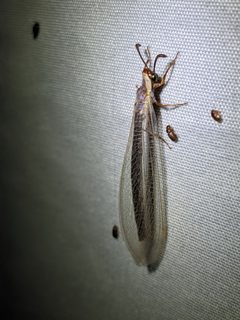
Larvae can be distinguished from other antlion by their pit-building —only Myrmeleon in North America construct conical traps. separated from by clubbed (damselflies have thread-like antennae). Specific identification of M. texanus adults requires examination of wing venation and genitalia; the species lacks the conspicuous wing patterns seen in genera such as Glenurus.
Images
Habitat
Larvae inhabit fine, powdery soils or sandy substrates, often in dry, sheltered locations such as beneath rock overhangs, at the base of trees, under bridges, or in the dirt floors of old barns and sheds. The has been observed utilizing sawdust as a substrate for pit construction when available.
Distribution
Recorded from North America and Middle America. Specific locality records are sparse compared to widespread .
Diet
Larvae are obligate , feeding on ants and other small ground-dwelling arthropods that fall into their pitfall traps. have been observed to consume soft-bodied insects and pollen, though detailed feeding records for this are lacking.
Life Cycle
Complete : laid in sandy soil; larva constructs pit and feeds; occurs within a silken cocoon spun underground and incorporating sand grains; emerges from cocoon.
Behavior
Larvae walk only backwards, rapidly burying themselves by shuffling rear-first into sand. When constructing pits, larvae move in reverse spirals while flicking sand with and the flattened top of the . Upon detecting prey, larvae flick additional sand onto victims to prevent escape. When disturbed, larvae remain motionless, relying on sand-covered bodies for camouflage. are cryptic, aligning their bodies with vegetation to become nearly invisible.
Ecological Role
Larvae function as sit-and-wait in sandy soil , potentially regulating of ground-dwelling arthropods. Their pit construction may also influence soil microtopography in localized areas.
Human Relevance
Larvae are frequently encountered by children and naturalists, serving as an accessible introduction to predatory insect . The "doodlebug" derives from the winding trails larvae leave while searching for pit locations. occasionally attracted to outdoor lights.
Similar Taxa
- Myrmeleon immaculatusWidespread North American with similar pit-building larval ; may occur sympatrically and require careful examination for separation.
- Scotoleon spp.North American antlion with free-living larvae that do not construct pits; larvae hide under objects or roam beneath sand surface.
- Glenurus spp.Antlion with striking black, white, and pink wingtip patterns in ; larvae do not build pits.
More Details
Taxonomic Note
Myrmeleon texanus was described by Nathan Banks in 1900. The remains poorly known biologically, with most published information on antlion pit-building derived from studies of M. immaculatus and other more accessible .
Substrate Flexibility
An observation of a Myrmeleon larva in sawdust (referenced in source material) suggests that females may oviposit in loose, substrates other than sand if texture is appropriate, though this specific record was not definitively identified to .